AI Driven Tech Layoffs and Impact on India Service Economy
Source:The Hindu ↗
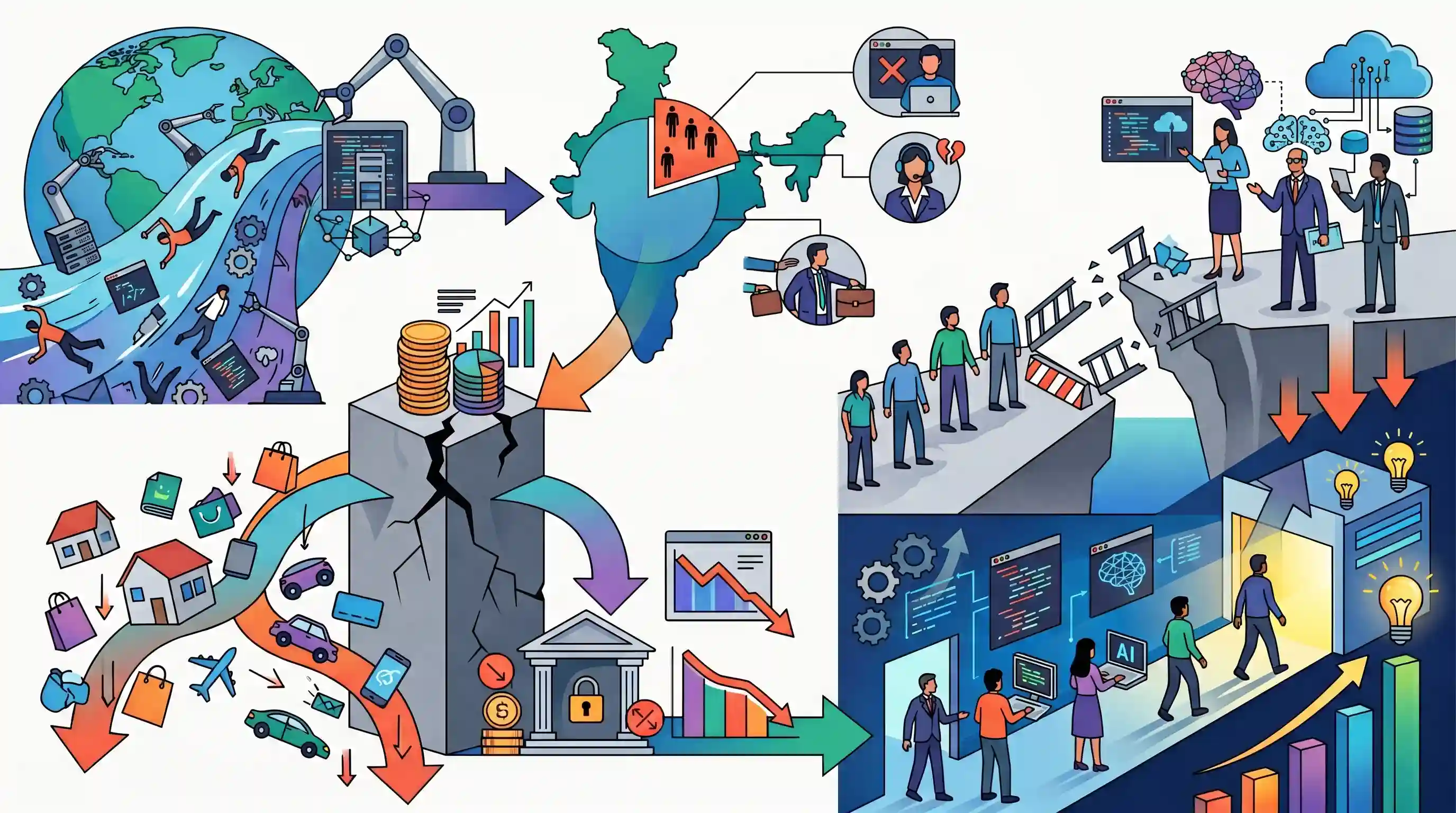
Why It Matters
AI-induced structural unemployment presents a direct threat to India’s service-led economic growth model and its $1 trillion digital economy goal. Understanding the macroeconomic spillover effects of localized sector crises is crucial for devising structural economic policies, labor market interventions, and skill development frameworks.
Summary
The global tech industry is undergoing massive layoffs driven by the rise of Generative AI, changing enterprise needs, and shrinking IT budgets, heavily impacting India. Nearly 20% of global layoffs are affecting Indian IT professionals, especially in coding, support, and middle-management roles. The technology sector currently contributes around $283 billion to India's GDP, meaning extensive job losses threaten a cascading macroeconomic effect, reducing domestic consumption—including home, retail, and lifestyle spending—and potentially leading banks to tighten lending. The core issue for Indian IT is a lack of deep specialist consulting skills required for complex AI transformation, placing structural pressure on mid-level roles and highlighting the urgent need for workforce reskilling.
Key Points
- Approximately 20% of the over 105,000 global tech job cuts by multinationals occurred in India, driven by efficiency drives and automation from AI technologies like ChatGPT and DeepSeek.
- The IT sector forms a substantial chunk of India's economy ($283B in FY25), supporting an ecosystem that fuels urban real estate, consumer spending, and the retail sector.
- High-level tech layoffs suppress macroeconomic consumption and may lead to tighter credit lines as banks reassess risk, especially affecting tech hubs like Bengaluru, Pune, and Hyderabad.
- The 'bulging middle' of IT managers—those sitting between frontline coders and senior leadership—faces the highest risk of redundancy as hierarchical structures flatten.
- Indian IT providers must transition from low-cost 'body shopping' to high-end specialist AI consulting to remain relevant, highlighting an acute need for structural reskilling.
Important Terms
Nasscom

The apex non-profit trade association and advocacy group for India's $250B+ Information Technology and Business Process Management (BPM) industry.
UPSC context
GS Paper 3: Indian Economy (Services Sector) and Science & Tech; vital for analyzing industrial policy and digital growth.
Gartner
A premier global technology research and advisory firm famous for the 'Hype Cycle' and 'Magic Quadrant' frameworks used to evaluate emerging technologies and market players.
UPSC context
GS Paper 3: Science & Technology; relevant for assessing global tech trends and their impact on India’s IT leadership.
HfS Research
A global business services analyst firm specializing in the 'Digital Operations' and 'Services-as-Software' models, frequently cited for data on automation-driven workforce displacement.
UPSC context
GS Paper 3: Employment and Economy; used to discuss structural unemployment and the automation of 'low-skilled' IT roles.
ISG (Information Services Group)
A global technology research and advisory firm that advises enterprises on digital transformation, sourcing transactions, and operational cost optimization.
UPSC context
GS Paper 3: Economy (Service Sector); identifies shifts in global outsourcing demand and enterprise spending patterns.
EIIRTrend
A specialized information platform and research firm focusing on Engineering, IoT (Internet of Things), Industry 4.0, and high-end R&D services.
UPSC context
GS Paper 3: Science & Technology and Infrastructure; examines India’s transition toward high-value engineering and digital transformation.
Prelims Trap
"AI-driven IT layoffs in India represent cyclical unemployment caused by shrinking global enterprise budgets."
These layoffs are structural, not cyclical. They stem from a permanent technological shift (Generative AI) rendering existing skills obsolete, requiring massive workforce reskilling, rather than just temporary demand dips.
Static Concepts Connected
What are the key types of unemployment relevant to technological shifts?
- Structural Unemployment: Caused by a fundamental mismatch between workers' skills and market needs (e.g., AI replacing routine coding jobs).
- Cyclical Unemployment: Job losses driven by overall economic downturns and a temporary deficiency in aggregate demand.
- Frictional Unemployment: Temporary, short-term joblessness occurring during the transition period between jobs.
How does a sectoral slowdown trigger a macroeconomic cascading effect?
- Consumption Shock: Reduced disposable income in a major sector directly lowers aggregate domestic demand.
- Multiplier Effect: Lower spending severely hits allied sectors like urban real estate, retail, and lifestyle, causing secondary job losses.
- Credit Contraction: Banks tighten lending as retail loan default risks rise among laid-off workers, further stifling economic growth.
Cross-Topic Patterns
Service Exports & Current Account Deficit
India relies heavily on IT service exports to offset its massive merchandise trade deficit. A structural, AI-driven decline in IT revenues directly threatens India's Current Account Balance and forex stability.
AI Disruption vs. Demographic Dividend
The displacement of mid-level jobs by Generative AI occurs right as India’s youth population peaks, threatening to turn the demographic dividend into a demographic disaster without urgent state-led reskilling initiatives.

AI-induced structural unemployment and its multiplier effect on India's service exports and urban consumption is highly probable for GS3 2026.
Linked PYQs · 3
Linked PYQs · 3
- 2022MainsGS3
Economic growth in the recent past has been led by increase in labour productivity." Explain this statement. Suggest the growth pattern that will lead to creation of more jobs without compromising labour productivity.
- 2023MainsGS3
Most of the unemployment in India is structural in nature. Examine the methodology adopted to compute unemployment in the country and suggest improvements.
- 2023MainsGS3
What is the status of digitalization in the Indian economy? Examine the problems faced in this regard and suggest improvements.
