Artificial Intelligence Impact on Employment and Global Tech Jobs
Source:Indian Express ↗
Why It Matters
The debate on AI's impact on employment is a critical issue for economic policy and labor rights. It connects directly to UPSC GS3 topics on employment, structural unemployment, and the application of emerging technologies like Artificial Intelligence. Furthermore, discussions held at the World Economic Forum represent vital perspectives on global macroeconomic trends and future governance mechanisms.
Summary
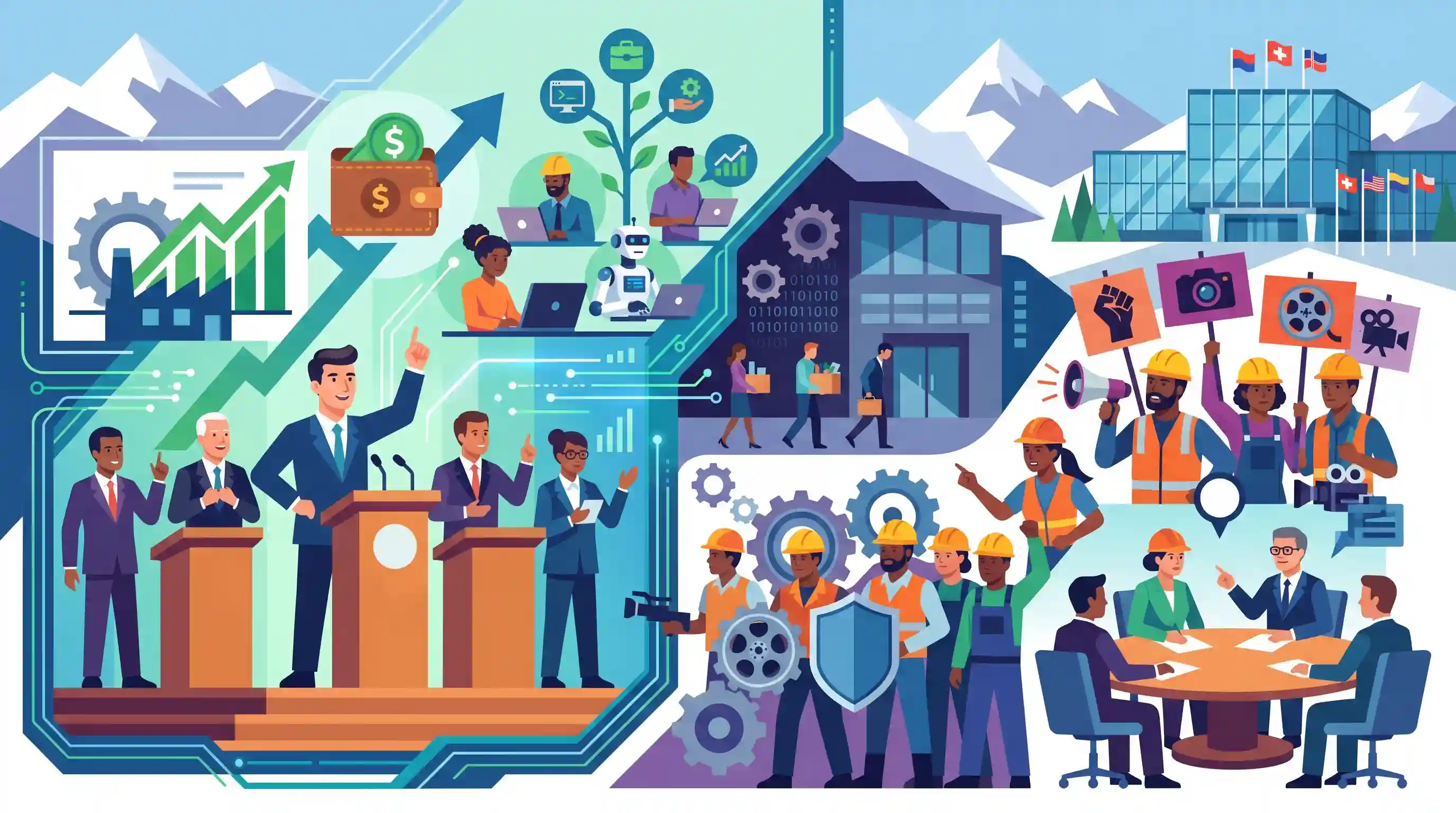
At the World Economic Forum (WEF) annual meeting in Davos, global tech executives presented an optimistic view of Artificial Intelligence, arguing that it will enhance productivity, increase wages, and ultimately create jobs. Despite the tech sector facing massive layoffs to correct pandemic-era over-hiring, leaders like NVIDIA's Jensen Huang and Cloudflare's Matthew Prince downplayed fears of an 'AI apocalypse'. However, labor union representatives stressed the need to involve workers in AI deployment strategies to protect livelihoods, referencing the recent Hollywood strikes as a model for safeguarding jobs against automation.
Key Points
- At the WEF summit in Davos, tech leaders argued that AI will boost worker productivity and create new jobs, despite rising fears of AI-induced unemployment.
- Tech companies have seen significant layoffs recently (over 300,000 jobs in a year), but executives attribute these to post-pandemic 'right-sizing' rather than AI displacement.
- Global union leaders advocated for workers to have a say in how AI is implemented, citing the Hollywood strikes as a precedent for protecting human jobs.
- Leaders like Bill Gates emphasized that while AI currently affects white-collar work, future physical robots will also impact blue-collar jobs.
Important Terms
World Economic Forum (WEF)

A Swiss-based international organization (est. 1971) facilitating public-private cooperation. It is famous for its annual Davos summit and flagship reports on global risks, competitiveness, and gender gaps.
UPSC context
GS-II: International Institutions; GS-III: Economy. Tests understanding of global governance and developmental reports.
International Trade Union Confederation (ITUC)
The world's largest trade union federation (Brussels-based), representing over 200 million workers. It advocates for labor rights and coordinates global campaigns within international bodies like the ILO.
UPSC context
GS-II: Important International Institutions; Welfare of vulnerable sections (labor). Tests international labor advocacy.
UNI Global Union
A global union federation for the service sectors representing 20 million workers. It leads advocacy on "digital retraining" as a labor right and regulates AI’s impact on jobs.
UPSC context
GS-III: Employment/Tech; GS-II: Labor Rights. Tests issues related to automation and worker welfare.
BlackRock
The world's largest asset management firm, overseeing $10 trillion+ in assets. It exerts significant influence on global financial markets, ESG (Environmental, Social, Governance) standards, and corporate governance.
UPSC context
GS-III: Indian Economy and mobilization of resources. Tests awareness of global financial influencers.
Microsoft
A leading technology multinational and key architect of the AI transition through its Azure cloud and OpenAI partnership. It shapes global productivity and labor market evolution.
UPSC context
GS-III: Science and Technology (AI). Tests understanding of major actors in the 4th Industrial Revolution.
NVIDIA
The dominant semiconductor company specializing in GPUs (Graphics Processing Units) that power AI models. It is a central player in global tech supply chains and infrastructure.
UPSC context
GS-III: Science and Technology; Economy. Relevant for discussions on semiconductors and AI hardware sovereignty.
Prelims Trap
"AI-induced job displacement is a form of cyclical unemployment that corrects itself."
Automation and AI create structural unemployment (a mismatch of skills), not cyclical unemployment, which is driven by a general downturn in economic demand.
Static Concepts Connected
How does Structural Unemployment differ from other common types?
- Structural: Arises from fundamental shifts in the economy (like AI/automation), rendering existing worker skills obsolete.
- Cyclical: Caused by a general lack of demand during economic downturns and recessions.
- Frictional: The temporary, transitional period of unemployment while workers are voluntarily searching for new jobs.
What characterizes the Fourth Industrial Revolution (4IR)?
- Technological Convergence: Characterized by the blurring of lines between the physical, digital, and biological spheres (e.g., AI, IoT, CRISPR).
- Exponential Velocity: Unlike previous revolutions driven by steam or electronics, 4IR evolves at an exponential rather than linear pace.
- Origin: Coined by Klaus Schwab, Founder and Executive Chairman of the World Economic Forum (WEF).
Cross-Topic Patterns
AI & Algorithmic Management in Gig Work
AI dictating worker tasks links directly to India's gig economy debates, particularly the challenges of regulating "algorithmic management" under the Code on Social Security 2020.
WEF's 'Future of Jobs' Report index matching
WEF's Davos discussions invariably tie back to their 'Future of Jobs' report. UPSC frequently tests the publishers of such indices and the labor trends they project.

Expect a multi-statement Prelims question linking 4th Industrial Revolution technologies to structural unemployment and WEF reports.
Linked PYQs · 5
Linked PYQs · 5
- 2022MainsGS3
Economic growth in the recent past has been led by increase in labour productivity." Explain this statement. Suggest the growth pattern that will lead to creation of more jobs without compromising labour productivity.
- 2023MainsGS3
Introduce the concept of Artificial Intelligence (AI). How does Al help clinical diagnosis? Do you perceive any threat to privacy of the individual in the use of Al in healthcare?
- 2023MainsGS3
Most of the unemployment in India is structural in nature. Examine the methodology adopted to compute unemployment in the country and suggest improvements.
- 2006PrelimsGS1
Where is Davos- the venue of the annual meeting of World Economic. Forum, located?
- 2020PrelimsGS1
With the present state of development, Artificial Intelligence can effectively do which of the following? 1. Bring down electricity consumption in industrial units 2. Create meaningful short stories and songs 3. Disease diagnosis 4. Text-to-Speech Conversion 5. Wireless transmission of electrical energy Select the correct answer using the code given below:
