School Nutrition Education and FSSAI Compliance for Child Health
Source:The Hindu ↗
Why It Matters
Child malnutrition directly impacts human capital formation and economic growth. The topic bridges health, education, and governance, making it highly relevant for GS Paper 2 (Social Justice and Governance). It also tests awareness of statutory bodies like FSSAI and flagship welfare schemes like PM POSHAN and NFSA.
Summary
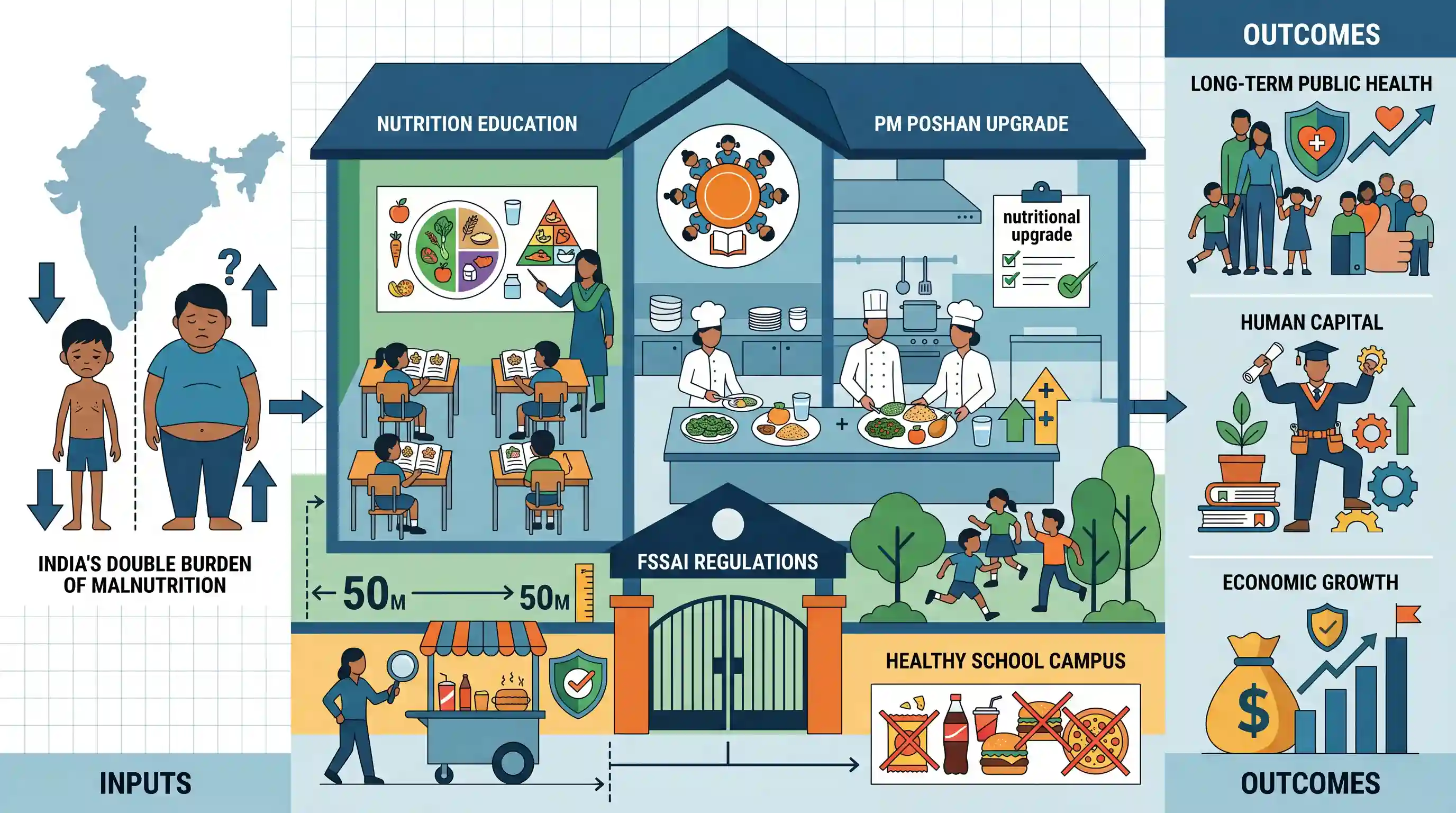
The article emphasizes the critical role of schools in fostering healthy eating habits among children to combat India's double burden of malnutrition—undernutrition and rising childhood obesity. It advocates for integrating nutrition education into the school curriculum, upgrading the nutritional quality of meals provided under the PM POSHAN scheme, and strictly enforcing FSSAI regulations to ban the sale of ultra-processed junk food around school campuses. By instilling food literacy early on, the education system can serve as a powerful tool for improving long-term public health and human capital outcomes.
Key Points
- India's children face a dual burden of malnutrition, dealing simultaneously with undernutrition (stunting and wasting) and rising rates of obesity driven by ultra-processed foods.
- Schools offer a captive environment to integrate food literacy and nutrition education into the core curriculum, shaping lifelong dietary habits.
- There is an urgent need to strictly enforce FSSAI guidelines that restrict the availability and marketing of High Fat, Sugar, and Salt (HFSS) junk foods within 50 meters of school premises.
- Leveraging and improving existing nutritional safety nets like the PM POSHAN scheme can provide children with balanced, nutrient-dense meals every day.
- Addressing child malnutrition is a prerequisite for robust human capital formation and requires a multi-sectoral approach combining public health policies, education, and regulatory oversight.
Important Terms
PM POSHAN Scheme

Centrally Sponsored Scheme (60:40) providing hot cooked meals to students (Classes 1-8) in government-aided schools to improve nutrition, enrollment, and retention. It integrates with the National Food Security Act, 2013.
UPSC context
GS II: Government Policies/Interventions; Poverty and Hunger. Evaluates implementation challenges and nutritional outcomes for human capital development.
National Food Security Act (NFSA) 2013
A legal framework providing subsidized food grains to ~67% of India's population. It marks a paradigm shift to a rights-based approach to food security, encompassing schemes like PM POSHAN and ICDS.
UPSC context
GS II: Issues relating to Poverty and Hunger; Welfare Schemes. Essential for understanding India's rights-based food security architecture.
Double Burden of Malnutrition
The simultaneous occurrence of undernutrition (stunting, wasting) and overnutrition (obesity, non-communicable diseases) within the same individuals or populations, reflecting a complex structural shift in India's nutrition profile.
UPSC context
GS II: Health and Human Development. Tests understanding of evolving public health challenges where obesity coexists with persistent undernutrition.
FSSAI (Food Safety and Standards Authority of India)
Statutory body under the Ministry of Health and Family Welfare that regulates food safety standards. It enforces restrictions on selling high fat, salt, and sugar (HFSS) foods near school campuses.
UPSC context
GS II: Statutory Bodies; Governance. Important for regulatory roles in public health and preventing Non-Communicable Diseases (NCDs).
Anaemia Mukt Bharat
Strategic initiative launched in 2018 to reduce anaemia across six beneficiary groups via a 6x6x6 strategy (6 groups, 6 interventions, 6 institutional mechanisms), targeting a 3% annual reduction.
UPSC context
GS II: Social Sector (Health). Relevant for maternal and child health interventions under POSHAN Abhiyaan.
Eat Right India
Flagship FSSAI movement ("Sahi Bhojan, Behtar Jeevan") focused on transforming the food system through three pillars—Eat Safe, Eat Healthy, and Eat Sustainably—to combat malnutrition and lifestyle diseases.
UPSC context
GS II: Health and Governance. Tests awareness of preventive healthcare initiatives and multisectoral approaches to food safety.
Prelims Trap
"The PM-POSHAN scheme is purely an executive welfare initiative without any statutory backing."
PM-POSHAN is a legal entitlement governed by the National Food Security Act (NFSA), 2013, not just a discretionary executive scheme.
Static Concepts Connected
What are FSSAI's regulations for child diets in schools?
- HFSS Ban: Prohibits the sale and advertisement of High Fat, Salt, and Sugar (HFSS) foods within a 50-meter radius of school premises.
- FBO Registration: Requires school canteens, boarding houses, and mid-day meal kitchens to obtain an FSSAI license or registration.
- Oversight Nodes: Mandates regular inspection of school meals by municipal authorities and encourages schools to form Health and Wellness nodes.
What constitutes India's 'Double Burden of Malnutrition'?
- Undernutrition: Persistent high rates of stunting (height-for-age) and wasting (weight-for-height) reflecting severe and chronic caloric/nutrient deficits.
- Overnutrition: Rapidly rising rates of childhood overweight and obesity conditions, driven by sedentary lifestyles and ultra-processed food consumption.
- Hidden Hunger: Severe micronutrient deficiencies, such as pervasive anemia, that paradoxically coexist across both underweight and overweight demographics.
Cross-Topic Patterns
Nutrition as Human Capital
Links early childhood stunting directly to irreversible cognitive deficits, impacting India's labor productivity and the long-term realization of its demographic dividend.
Agro-Policy vs Nutritional Diversity
Connects India's MSP-driven, cereal-heavy public distribution to rising hidden hunger, emphasizing the need for millets and bio-fortification in PM-POSHAN.

Expect a Prelims question testing PM-POSHAN’s NFSA statutory backing, Balvatika inclusion, alongside FSSAI’s 50-meter HFSS school rule.
Linked PYQs · 5
Linked PYQs · 5
- 2024MainsGS2
Poverty and malnutrition create a vicious cycle, adversely affecting human capital formation. What steps can be taken to break the cycle ?
- 2020MainsGS2
In order to enhance the prospects of social development, sound and adequate health care policies are needed particularly in the fields of geriatric and maternal health care. Discuss.
- 2018PrelimsGS1
Consider the following statements: 1. The Food Safety and Standards Act, 2006 replaced the Prevention of Food Adulteration Act, 1954. 2. The Food Safety and Standards Authority of India (FSSAI) is under the charge of Director General of Health Services in the Union Ministry of Health and Family Welfare. Which of the statements given above is/are correct?
- 2023PrelimsGS1
Consider the following statements in the context of interventions being undertaken under Anaemia Mukt Bharat Strategy: 1. It provides prophylactic calcium supplementation for pre-school children, adolescents and pregnant women. 2. It runs a campaign for delayed cord clamping at the time of child-birth. 3. It provides for periodic deworming to children and adolescents. 4. It addresses non-nutritional causes of anaemia in endemic pockets with special focus on malaria, hemoglobinopathies and fluorosis. How many of the statements given above are correct?
- 2018PrelimsGS1
With reference to the provisions made under the National Food Security Act, 2013, consider the following statements : 1. The families coming under the category of 'below poverty line (BPL)' only are eligible to receive subsidised food grains. 2. The eldest woman in a household, of age 18 years or above, shall be the head of the household for the purpose of issuance of a ration card. 3. Pregnant women and lactating mothers are entitled to a 'take-home ration' of 1600 calories per day during pregnancy and for six months thereafter. Which of the statements given above is/are correct?
