Supreme Court Ruling Clarifies NCTE Rules for Teacher Education
Source:Indian Express ↗
આ શા માટે મહત્વનું છે
Teacher education institutions form the bedrock of the educational ecosystem. Understanding judicial interpretations of NCTE regulations and statutory powers is crucial for aspirants studying educational governance, human resource development, and regulatory frameworks under GS Paper II.
સારાંશ
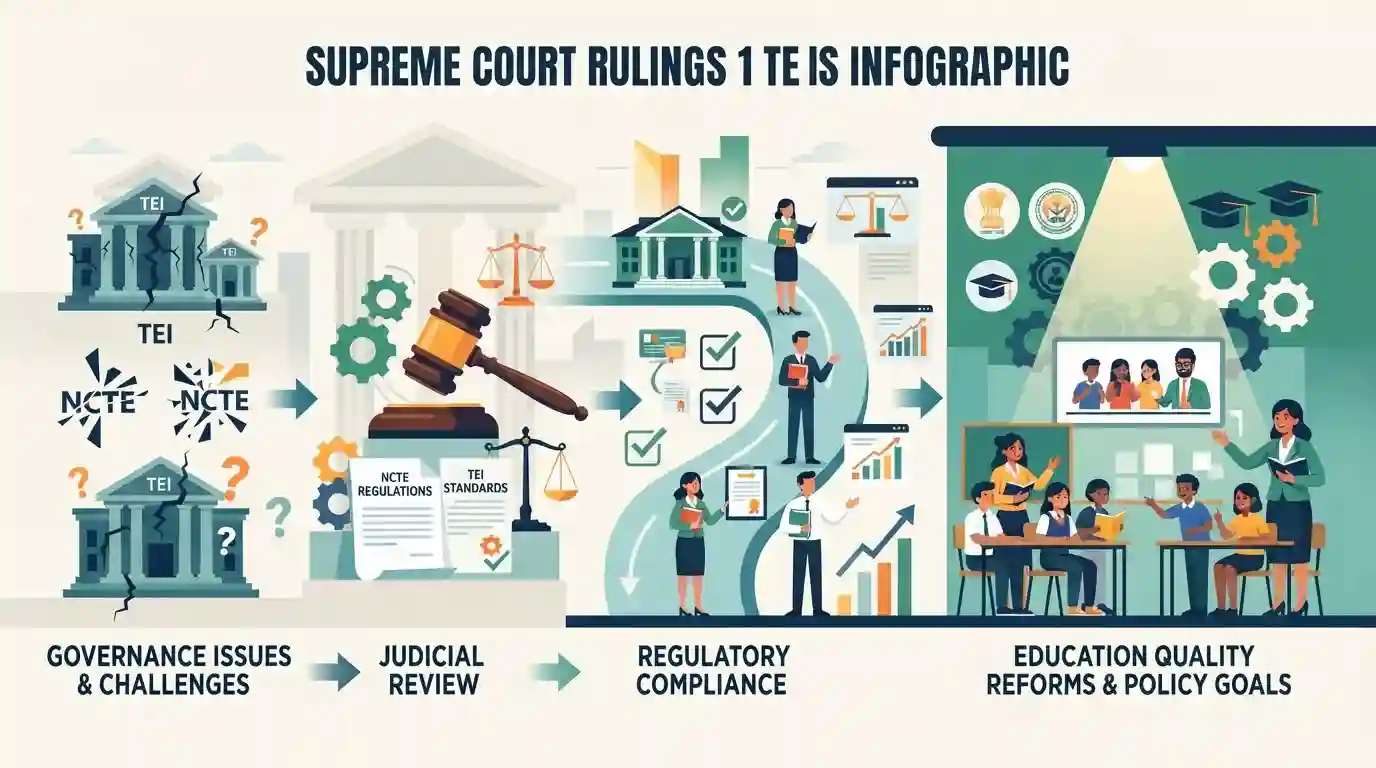
An analysis of Supreme Court rulings concerning Teacher Education Institutions (TEIs) and NCTE regulations, highlighting governance issues in teacher training, regulatory compliance, and education quality reforms in line with national policy goals.
મુખ્ય મુદ્દા
- The Supreme Court has addressed matters regarding Teacher Education Institutions (TEIs) and the regulatory framework enforced by the National Council for Teacher Education (NCTE).
- Teacher education regulation is critical for ensuring foundational quality in school education under the framework of the NEP 2020 and RTE Act.
- The legal and administrative oversight of TEIs balances institutional autonomy with mandatory quality control standards set by statutory bodies like NCTE.
મહત્વપૂર્ણ શબ્દો
National Council for Teacher Education (NCTE)

A statutory body established under the NCTE Act, 1993, responsible for achieving planned and coordinated development and maintaining standards of teacher education systems across India.
UPSC context
Relevant for GS Paper II (Governance, Statutory Bodies, and Educational Administration). Tests understanding of regulatory jurisdictions and institutional accountability.
Teacher Education Institutions (TEIs)
Colleges, university departments, and institutions offering professional training programmes (such as B.Ed, D.El.Ed) requiring statutory recognition to operate.
UPSC context
Important for GS Paper II (Education Policy and Governance). Tests governance frameworks and quality control standards in professional education.
NCTE Act
The parliamentary legislation enacted in 1993 to provide for the establishment of the NCTE with a view to planned and coordinated development of teacher education systems.
UPSC context
Appears in GS Paper II under Statutory Frameworks and Regulatory Bodies governing higher and professional education in India.
National Education Policy (NEP) 2020
Comprehensive policy framework guiding educational restructuring in India, which advocates shifting teacher education into multidisciplinary universities and institutions.
UPSC context
Crucial for GS Paper II (Social Sector/Education Policy). Evaluates structural reforms, quality enhancement, and modernization roadmaps in Indian education.
Right to Education (RTE) Act
Fundamental right under Article 21A ensuring free and compulsory elementary education, linked directly to the quality of teachers and teacher-training institutions.
UPSC context
Important for GS Paper II (Rights Issues, Governance, and Social Justice). Focuses on state obligations and standards for elementary education delivery.
પ્રિલિમ્સ ટ્રેપ
Since the NCTE Act does not explicitly mention every administrative fee or report, the regulator lacks the authority to mandate them.
Aspirants often assume statutory bodies can only exercise powers explicitly listed in their parent act, missing the doctrine of incidental and ancillary powers upheld by the Supreme Court.
સંલગ્ન સ્થિર ખ્યાલો
What are the core powers and constitutional status of the National Council for Teacher Education (NCTE)?
- Statutory Basis: Statutory Origin: Established under the National Council for Teacher Education Act, 1993, as a statutory body to achieve planned and coordinated development of the teacher education system.
- Core Functions: Mandate: Lays down norms, standards, and guidelines for teacher education courses, including minimum qualifications for teachers and recognition of institutions.
- Constitutional Link: Constitutional Linkage: Directly impacts Article 21A (Right to Education) by ensuring that the quality of teachers matches foundational learning requirements.
આંતર-વિષય પેટર્ન
Teacher Regulation vs. Medical & Higher Education Standards
The legal debate over NCTE's regulatory powers parallels UGC and MCI/NMC oversight disputes, where the Court balances institutional autonomy against statutory standard-setting under Article 21A.
NEP 2020 Multidisciplinary Transition & Statutory Oversight
NEP 2020's push to shift teacher training into multidisciplinary universities links educational governance directly with structural higher education reforms.

SC rulings on statutory bodies like NCTE balancing autonomy vs accountability under Article 21A frequently feature in polity MCQs.
સંલગ્ન PYQ · 2
સંલગ્ન PYQ · 2
- 2020MainsGS2
National Education Policy 2020 is in conformity with the Sustainable Development Goal-4 (2030). It intends to restructure and reorient education system in India. Critically examine the statement.
- 2018PrelimsGS1
Consider the following statements: 1. As per the Right to Education (RTE) Act, to be eligible for appointment as a teacher in a State, a person would be required to possess the minimum qualification laid down by the concerned State Council of Teacher Education. 2. As per the RTE Act, for teaching primary classes, a candidate is required to pass a Teacher Eligibility Test conducted in accordance with the National Council of Teacher Education guidelines. 3. In India, more than 90% of teacher education institutions are directly under the State Governments. Which of the statements given above is/are correct?
