Supreme Court Ruling on Teacher Education and NCTE Rules
Source:Indian Express ↗
Why It Matters
Teacher education is the bedrock of foundational learning and educational reforms under NEP 2020. Understanding Supreme Court interpretations of regulatory frameworks like the NCTE Act helps analyze structural bottlenecks in India's education sector.
Summary
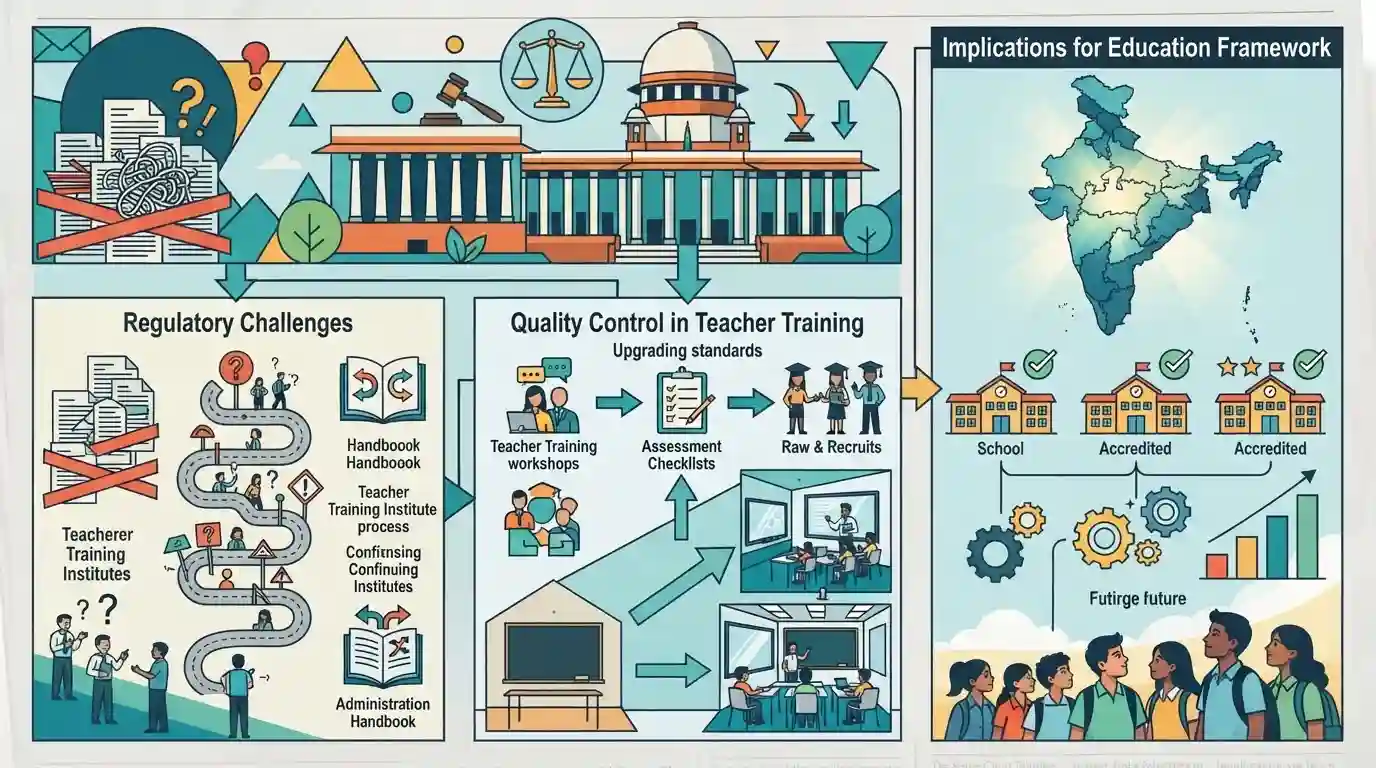
An overview of the Supreme Court ruling concerning Teacher Education Institutions and NCTE regulations, highlighting regulatory challenges, quality control in teacher training, and implications for India's educational framework.
Key Points
- The Supreme Court examined rules and regulations governing Teacher Education Institutions (TEIs) under the National Council for Teacher Education (NCTE).
- The ruling addresses standards, recognition, and regulatory oversight required to improve the quality of teacher training in India.
- Teacher quality is identified as a critical pillar for revamping school education in line with the National Education Policy (NEP) 2020.
Important Terms
National Council for Teacher Education (NCTE)

A statutory body established under the National Council for Teacher Education Act, 1993, to achieve planned and coordinated development of the teacher education system across India and maintain norms and standards.
UPSC context
Important for UPSC GS Paper II (Governance, Statutory Bodies, Educational Frameworks and Institutional Regulation).
NCTE Act
Legislation enacted in 1993 providing the legal framework for the establishment of the NCTE to oversee teacher training institutions and regulate teacher education standards.
UPSC context
Important for GS Paper II under statutory frameworks governing education and regulatory oversight.
National Education Policy (NEP) 2020
Comprehensive national framework introduced in 2020 to reform India's educational architecture, emphasizing multidisciplinary teacher education institutions and robust quality assurance.
UPSC context
Crucial for GS Paper II (Education, Human Resource Development, Policy Analysis).
Supreme Court of India
The apex judicial body of India that recently upheld NCTE's authority to mandate annual Performance Appraisal Reports (PAR) for Teacher Education Institutions, reinforcing accountability.
UPSC context
Relevant for GS Paper II (Judicial Rulings, Separation of Powers, Regulatory Governance).
Prelims Trap
Since the NCTE Act does not explicitly mention Performance Appraisal Reports, the regulator lacks the authority to mandate them.
Aspirants often assume statutory bodies can only exercise powers explicitly enumerated in their parent act, missing the legal doctrine of incidental and ancillary powers recognized by the Supreme Court.
Static Concepts Connected
What are the key powers and constitutional status of the National Council for Teacher Education (NCTE)?
- Statutory Origin: Statutory status created by the National Council for Teacher Education Act, 1993 for planned development of teacher education.
- Core Mandate: Empowered to lay down norms and standards for teacher courses, minimum qualifications, and grant recognition to institutions.
- Jurisdiction: Functions as a central regulatory body across India, coordinating standards between central and state educational authorities.
Cross-Topic Patterns
Judicial expansion of fundamental rights duty bearers
The Supreme Court's expansion of Article 21A duty bearers connects judicial review of delegated legislation with fundamental rights enforcement in social sector governance.
Statutory regulatory oversight and NEP 2020 reforms
Alignment of NCTE mandates with NEP 2020 reflects the systemic convergence between statutory educational regulators and broader socio-economic reforms in higher education.

Supreme Court rulings on statutory bodies like NCTE and their incidental powers under delegated legislation are high-yield for Polity Prelims.
Linked PYQs · 2
Linked PYQs · 2
- 2020MainsGS2
National Education Policy 2020 is in conformity with the Sustainable Development Goal-4 (2030). It intends to restructure and reorient education system in India. Critically examine the statement.
- 2018PrelimsGS1
Consider the following statements: 1. As per the Right to Education (RTE) Act, to be eligible for appointment as a teacher in a State, a person would be required to possess the minimum qualification laid down by the concerned State Council of Teacher Education. 2. As per the RTE Act, for teaching primary classes, a candidate is required to pass a Teacher Eligibility Test conducted in accordance with the National Council of Teacher Education guidelines. 3. In India, more than 90% of teacher education institutions are directly under the State Governments. Which of the statements given above is/are correct?
