Political Clashes Erupt Over DSC Recruitment Protest in Andhra
Source:The Hindu ↗
ఇది ఎందుకు ముఖ్యం
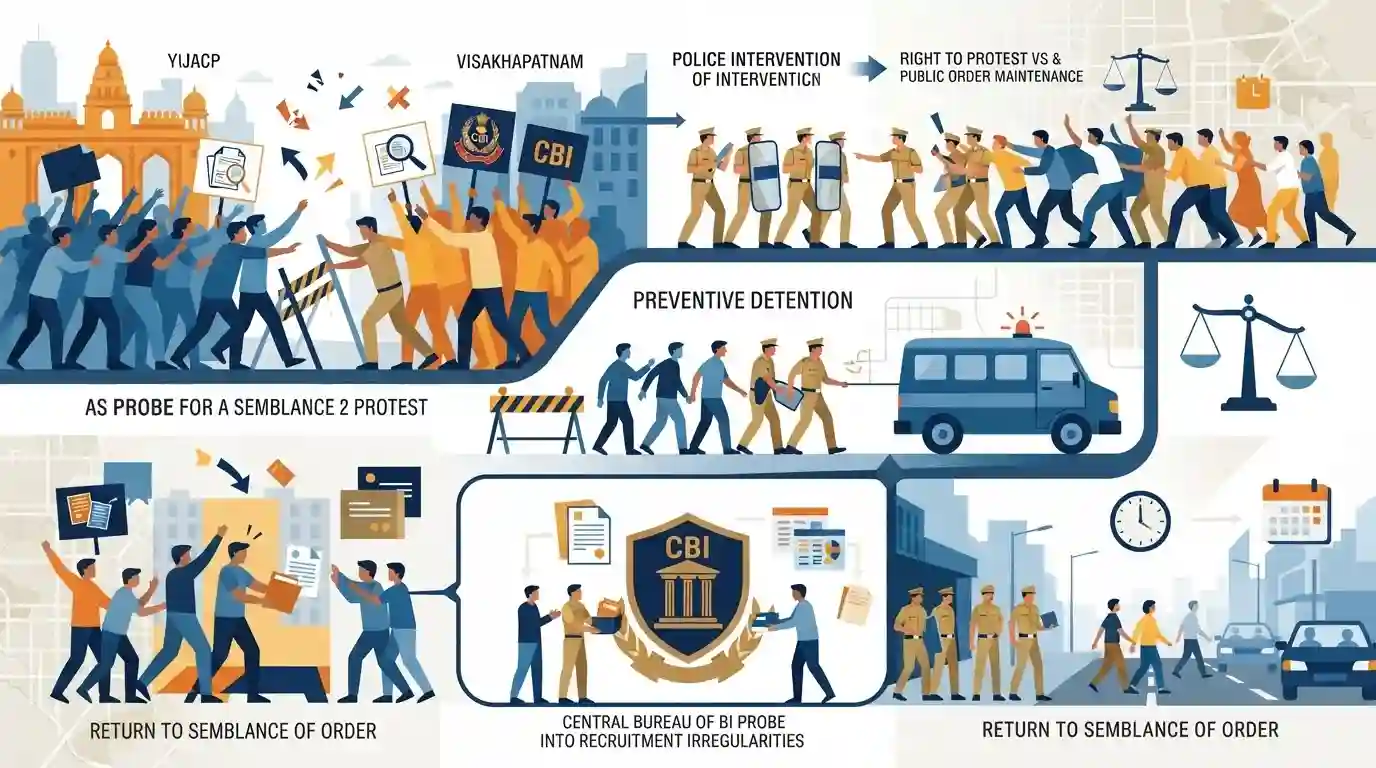
The incident highlights the practical tensions between the constitutional right to freedom of assembly (Article 19) and the state's obligation to maintain public order through preventive detention. It also touches upon issues of administrative transparency in state recruitment processes (reservation/quotas) and political demands for central agency interventions in state-level jurisdictions.
సారాంశం
A political clash erupted in Vijayawada and Visakhapatnam between YSRCP and TDP workers during a protest organized by the YSRCP. The demonstrators were demanding a CBI probe into alleged irregularities in the state's DSC-2025 teacher recruitment, accusing the government of manipulating results, altering Government Orders, and misusing the sports quota. TDP workers opposed the protest, citing traffic blockades and lack of police permission. In response to the unrest, police detained several YSRCP leaders, including former MLA Malladi Vishnu, under preventive custody to restore public order.
ముఖ్య అంశాలు
- YSRCP workers protested in Vijayawada and Visakhapatnam, demanding a CBI inquiry into alleged irregularities in the DSC-2025 teacher recruitment process.
- The protest led to clashes with TDP workers, who claimed the YSRCP was blocking traffic and agitating without police permission.
- Police intervened to disperse the crowds and detained several YSRCP leaders, including former MLA Malladi Vishnu, under preventive custody to maintain public order.
- YSRCP leaders alleged that the state government manipulated the DSC recruitment by improperly introducing a sports quota, altering Government Orders (GOs), and tampering with results, demanding the resignation of HRD Minister Nara Lokesh.
ముఖ్యమైన పదాలు
Central Bureau of Investigation (CBI)

India's premier investigative agency operating under the Ministry of Personnel. It investigates high-profile corruption, economic offenses, and serious crimes, often requiring state government consent for jurisdiction.
UPSC context
GS Paper 2: Tests knowledge of statutory/regulatory bodies, central agencies, and center-state jurisdictional disputes.
District Selection Committee (DSC)
A state-level administrative mechanism in Andhra Pradesh tasked with conducting examinations and recruiting teachers for government and local body public schools.
UPSC context
GS Paper 2: Highly relevant to issues of employment, state governance, public recruitment mechanisms, and transparency.
Yuvajana Sramika Rythu Congress Party (YSRCP)
A prominent regional political party in Andhra Pradesh, often acting as a major ruling or opposition force, known for advocating strong welfare-based governance.
UPSC context
GS Paper 2: Important for understanding state politics, federalism, and the evolving role of regional parties.
Telugu Desam Party (TDP)
A dominant regional political party in Andhra Pradesh, established to promote Telugu regional pride, economic development, and state-level welfare.
UPSC context
GS Paper 2: Tests knowledge of regionalism, state-level political dynamics, and coalition politics in India.
Andhra Pradesh Police
The primary law enforcement agency of Andhra Pradesh, operating under the State List. It is responsible for upholding public order, traffic management, and invoking preventive detention.
UPSC context
GS Paper 2 & 3: Covers Schedule VII (State Subjects), internal security, police reforms, and public order maintenance.
ప్రిలిమ్స్ ఉచ్చు
Preventive detention can be legally invoked to manage routine 'law and order' disruptions during protests.
Courts strictly distinguish between 'law and order' (routine policing) and 'public order' (community-wide disruption). Preventive detention cannot legally be used as a shortcut for ordinary law enforcement.
అనుసంధానమైన స్థిర భావనలు
What governs the CBI's jurisdiction to investigate state-level cases?
- DSPE Act 1946: The CBI derives its investigative powers from this Act and requires state consent under Section 6 to operate within a state's territorial jurisdiction.
- Consent types: General consent allows seamless entry for probes; if withdrawn, the CBI must seek specific, case-by-case permission from the state government.
- Judicial override: The Supreme Court and High Courts can direct a CBI investigation into a state matter without requiring the state government's consent.
How do special quotas operate alongside social reservations in recruitment?
- Vertical Reservation: Social reservations (SC/ST/OBC) under Article 16(4) are mutually exclusive vertical compartments.
- Horizontal Reservation: Special quotas (sports, women, disabled) under Articles 15(3) and 16(1) are horizontal and cut across vertical categories as an interlocking system.
- Mid-way alterations: Under Articles 14 and 16, recruitment eligibility and quotas cannot be arbitrarily altered or introduced mid-way after the advertisement is published.
అంతర-అంశ నమూనాలు
Federalism vs. Central Agencies
Demands for CBI probes in state recruitment scams highlight ongoing federal frictions, particularly around the withdrawal of general consent by states under the DSPE Act.
Article 22 vs. Protest Rights
The frequent use of preventive detention for political protests tests the constitutional boundary between Article 19 assembly rights and 'public order' restrictions.

The distinction between 'public order' and 'law and order' regarding preventive detention is a highly probable 2026 Prelims trap statement.
అనుసంధాన PYQలు · 3
అనుసంధాన PYQలు · 3
- 2019APPSC_PRELIMSGS1
A person whose freedom of movement has been taken away by imprisonment or detention does not thereby lose his freedom of
- 2024APPSC_PRELIMSGS1
Which of the following statement is correct regarding Parliamentary Privileges ?
- 2023APPSC_PRELIMSGS1
Which of the following is not a function of the Union Public Service Commission (UPSC)?
