Travancore Devaswom Board resolution on Sabarimala temple entry
Source:The Hindu ↗
Why It Matters
The Sabarimala issue is a textbook case study for the clash between fundamental rights (specifically gender equality under Articles 14 and 15) and religious freedoms/denominational autonomy (Articles 25 and 26). It highlights the challenges courts face in defining 'essential religious practices' and 'constitutional morality,' as well as the political realities of executing contentious Supreme Court rulings.
Summary
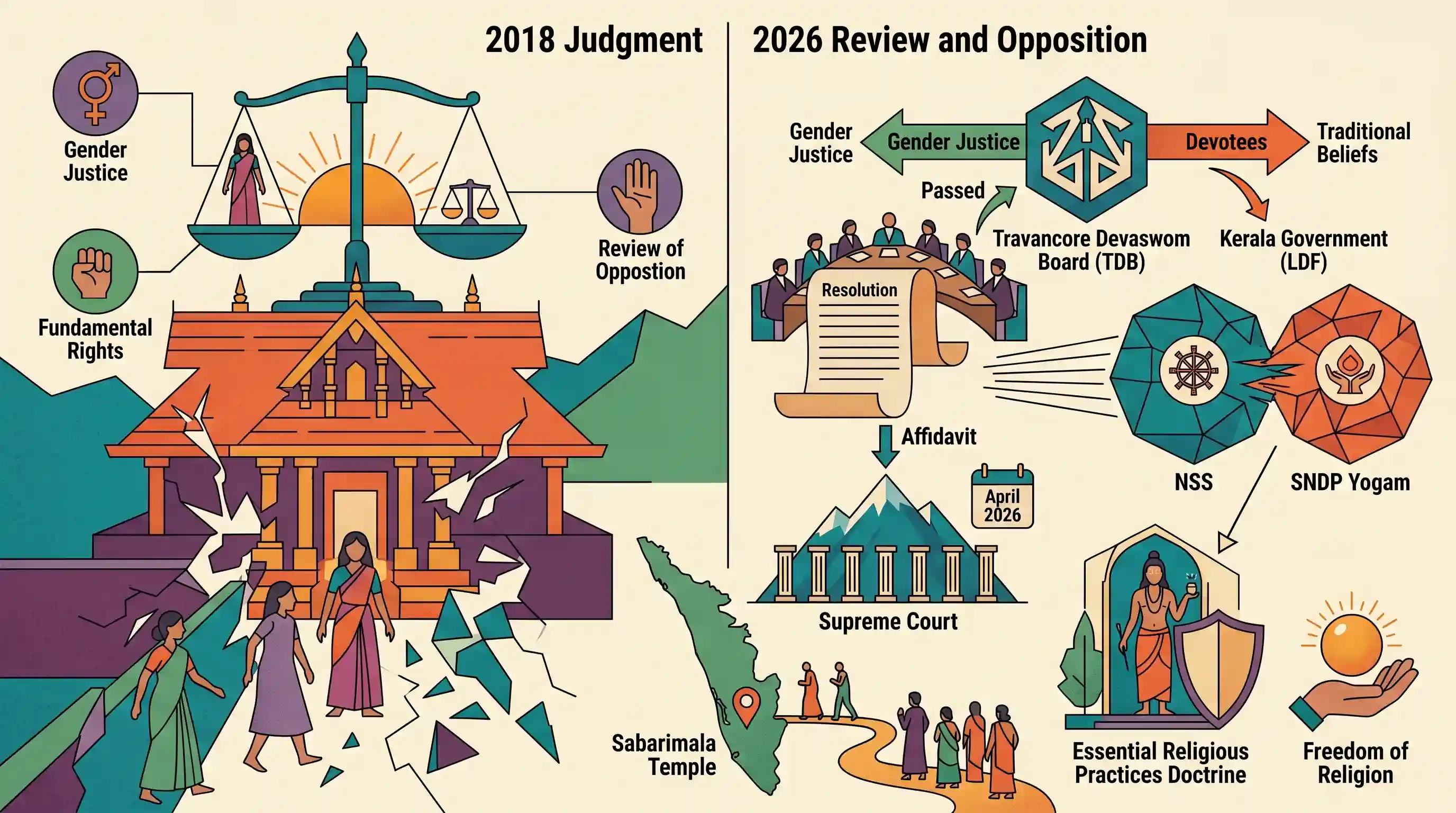
The Travancore Devaswom Board (TDB) in Kerala has passed a formal resolution opposing the landmark 2018 Supreme Court judgment that allowed women of menstruating age into the Sabarimala Temple. Defending the temple's traditional customs and the rights of the deity, the TDB intends to base its upcoming Supreme Court affidavit on this resolution ahead of a review hearing in April 2026. Significantly, the ruling CPI(M)-led LDF government has signaled a shift in its historical stance, aligning closer with the traditional beliefs of devotees. The development reignites political and societal debates involving major organizations like the SNDP Yogam and NSS, reflecting the complex intersection of religion, politics, and constitutional law in Kerala.
Key Points
- The Travancore Devaswom Board (TDB) passed a resolution opposing the 2018 Supreme Court verdict that permitted women of all ages to enter the Sabarimala Temple.
- The resolution seeks to protect the temple's unique customs and asserts the constitutional rights of the Sabarimala deity.
- The TDB will use this resolution to draft a new affidavit for the Supreme Court's review petition hearing scheduled for April 14, 2026.
- The CPI(M)-led LDF government has indicated a shift in its stance, prioritizing the protection of devotees' beliefs over its previous proactive approach to enforcing the 2018 verdict.
- The move has triggered political discourse, with support from the SNDP Yogam and criticism from the Nair Service Society towards political parties regarding central legislation on religious practices.
Important Terms
Travancore Devaswom Board (TDB)

An autonomous statutory body managing over 1,200 temples in Kerala, including Sabarimala. It was established following the 1949 integration of the Travancore and Cochin princely states.
UPSC context
GS-II (Polity/Governance); tests knowledge of statutory bodies and the state's role in managing religious institutions.
Essential Religious Practices Doctrine
A judicial test evolved by the Supreme Court to identify practices integral to a religion, distinguishing core beliefs from secular activities to determine constitutional protection under Article 25.
UPSC context
GS-II (Fundamental Rights/Judiciary); critical for understanding the intersection of religious freedom and constitutional morality.
Travancore-Cochin Hindu Religious Institutions Act XV of 1950
The primary legislation governing the administration of Hindu temples and endowments in southern Kerala. It provides the legal framework for the Travancore and Cochin Devaswom Boards.
UPSC context
GS-II (Polity); relevant for questions on historical-legal frameworks governing state-religion relations in India.
Covenant for the Formation of the United States of Travancore and Cochin
The 1949 agreement between the Rulers of Travancore, Cochin, and the Government of India that integrated the states and mandated the creation of Devaswom Boards to manage temples.
UPSC context
GS-I (Post-Independence Consolidation); explains the origin of modern temple administration and state integration.
Sree Narayana Dharma Paripalana Yogam (SNDP)
A socio-political organization in Kerala representing the Ezhava community. Founded by Sree Narayana Guru, it historically advocated for temple entry and social equality for backward castes.
UPSC context
GS-I (Modern History/Social Reform); tests knowledge of 19th-20th century reform movements and their contemporary relevance.
Nair Service Society (NSS)
A prominent socio-cultural organization representing Kerala's Nair community. Founded by Mannathu Padmanabhan, it plays a key role in the state's education, politics, and protection of religious traditions.
UPSC context
GS-I/II (Society/Polity); highlights the role of civil society and community organizations in religious-legal disputes.
Prelims Trap
As a juristic person, a Hindu deity enjoys fundamental rights like the Right to Privacy under Article 21.
While a consecrated deity is a juristic person capable of owning property and being sued, the SC clarified they do not possess fundamental constitutional rights like citizens.
Static Concepts Connected
What is the Essential Religious Practices (ERP) doctrine?
- Origin: Formulated by the Supreme Court in the 1954 Shirur Mutt case.
- Purpose: It distinguishes core, integral religious tenets (protected under Article 25) from secular, superstitious, or non-essential rituals.
- Sabarimala Application: The SC majority held that barring menstruating women was not an 'essential practice' integral to the Hindu religion.
What qualifies as a 'religious denomination' under Article 26?
- Legal Criteria: To qualify, a group must have a common faith, a common organization, and a distinct name.
- Sabarimala Ruling: The SC ruled that devotees of Lord Ayyappa do not constitute a separate denomination, voiding their claim to exclusive rights to exclude women.
Cross-Topic Patterns
Constitutional morality vs. religious customs
The Sabarimala case highlights the tension between Articles 25/26 (religious freedom) and Articles 14/15 (equality), establishing 'constitutional morality' as the guiding principle over traditional, exclusionary religious customs.
State control of religious institutions
The role of statutory bodies like the TDB (administering 1,200+ temples) raises recurring UPSC Mains questions about the secular nature of the Indian State and its administrative control over Hindu temples.

Expect a 2026 Mains question on the limits of judicial intervention in religious customs and the evolution of the ERP doctrine.
Linked PYQs · 2
Linked PYQs · 2
- 2023MainsGS2
Explain the constitutional perspectives of Gender Justice with the help of relevant Constitutional Provisions and case laws.
- 2025MainsGS2
"Constitutional morality is the fulcrum which acts as an essential check upon the high functionaries and citizens alike...." In view of the above observation of the Supreme Court, explain the concept of constitutional morality and its application to ensure balance between judicial independence and judicial accountability in India.
