TCS Layoffs Highlight Tech Sector Strain from AI Disruption
Source:Indian Express ↗
Why It Matters
The IT sector is one of the largest private employers and a massive contributor to India's foreign exchange earnings. Structural shifts due to AI and cyclical pressures from global markets can severely impact formal employment, undermining India's demographic dividend—making this a critical issue for GS3 (Economy, Employment, and Technology).
Summary
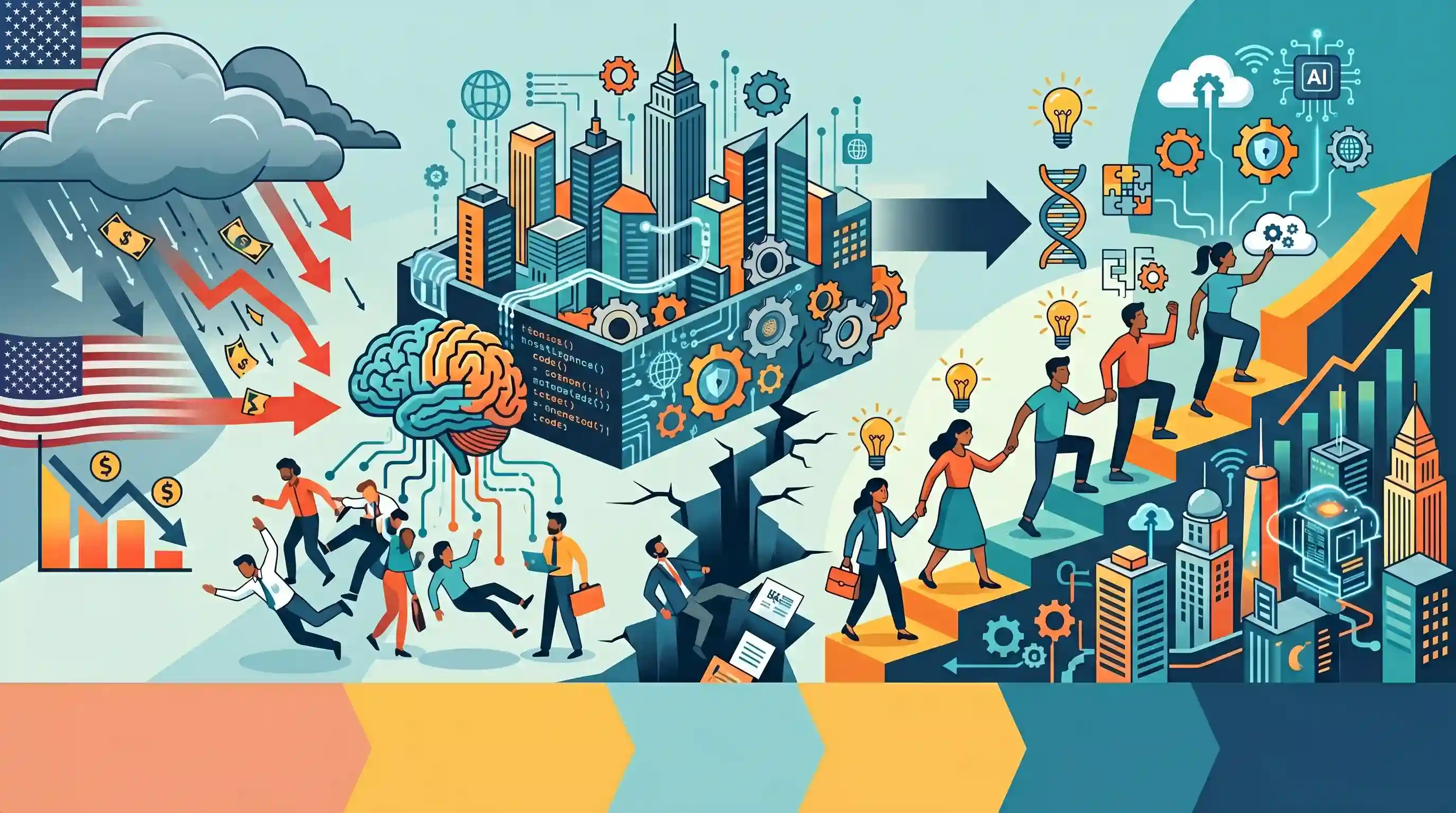
Reports of layoffs at Tata Consultancy Services (TCS) highlight emerging vulnerabilities in the Indian Information Technology (IT) sector, driven by a combination of technological and macroeconomic factors. The rapid evolution of Artificial Intelligence is disrupting traditional IT service models by automating routine tasks, while ongoing economic uncertainty in the United States—a primary market for Indian IT exports—has led to reduced client spending. Together, these factors are threatening formal sector jobs in an industry that has long been a pillar of India's service-led economic growth. The situation underscores the urgent necessity for the IT workforce to pivot toward advanced technological skills and for the sector to adapt to an evolving global landscape.
Key Points
- Recent layoffs at major Indian IT firms like TCS signal growing strain within India's crucial IT services export sector.
- The rapid advancement and adoption of Artificial Intelligence (AI) are automating routine tech jobs, causing structural disruption and reducing demand for traditional IT roles.
- Macroeconomic woes and uncertainty in the US economy have prompted global clients to scale back or delay IT spending, squeezing the revenues of Indian tech firms.
- The dual threat of AI disruption and global economic headwinds highlights the urgent need for comprehensive reskilling and upskilling of the Indian IT workforce to preserve employment and leverage demographic advantages.
Important Terms
Tata Consultancy Services (TCS)

India's largest multinational IT services company and a global leader in consulting, often viewed as a bellwether for the health of India's formal tech employment.
UPSC context
GS Paper 3 (Economy/Employment); illustrates the impact of global macroeconomic cycles and technological shifts on India's primary export sector.
AI Disruption
The structural transformation of industries caused by Artificial Intelligence, leading to the automation of routine tasks and a shift in demand toward high-skilled roles.
UPSC context
GS Paper 3 (Science & Tech/Employment); critical for analyzing the future of work and the necessity for technology-driven labor policy reforms.
Service Sector Exports
The export of intangible services like IT and business consulting, which contributes significantly to India's foreign exchange earnings and balances the merchandise trade deficit.
UPSC context
GS Paper 3 (Economy); vital for maintaining the Balance of Payments (BoP) and achieving a $5 trillion economy target.
Formal Sector Employment
Jobs in registered businesses providing legal contracts, regular wages, and social security benefits like pensions (EPF) and health insurance (ESI).
UPSC context
GS Paper 3 (Economy/Employment); tests concepts of job quality, workforce formalization, and social security nets for the urban workforce.
Upskilling and Reskilling
Upskilling refers to deepening existing competencies, while reskilling involves learning new skills for different roles, essential for workforce adaptability amid technological change.
UPSC context
GS Paper 2 (Human Resources); central to leveraging India’s demographic dividend and addressing the structural skills gap in the economy.
US Economic Headwinds
External economic pressures from the United States, such as high inflation or interest rates, which reduce client budgets for Indian IT services.
UPSC context
GS Paper 3 (Economy); highlights the global integration of India’s service sector and its vulnerability to external market shocks.
Global Capability Centers (GCCs)
In-house centers established by multinational corporations in India to handle high-value research, innovation, and core business operations beyond traditional outsourcing.
UPSC context
GS Paper 3 (Economy); represents the evolution of India from a back-office hub to a global center for R&D and high-end services.
Prelims Trap
"India's service sector employs over 50% of the workforce, reflecting its dominant contribution to the national GDP."
While the service sector contributes over 50% to India's GDP, it employs only about 30-32% of the workforce. Agriculture remains the largest employer.
Static Concepts Connected
What characterizes India's "service-led" growth model and its employment paradox?
- Sectoral Disparity: The services sector contributes ~55% to India's GDP but employs only about 32% of the total workforce.
- Skewed Absorption: Skill-intensive modern services (like IT) fail to absorb the massive surplus of unskilled or semi-skilled labor transitioning out of agriculture.
- Manufacturing Gap: India bypassed the traditional labor-intensive manufacturing phase (the 'flying geese' model) seen in East Asian economies, leading to structural 'jobless growth'.
What is the difference between 'Labor Arbitrage' and 'Global Capability Centres (GCCs)'?
- Labor Arbitrage: The traditional IT outsourcing model that relies on leveraging a large pool of low-cost labor for routine, repetitive tasks.
- Global Capability Centres (GCCs): MNC-owned offshore hubs established in India that focus on high-value R&D, strategic operations, and AI innovation rather than mere cost-saving.
- Employment Impact: The shift to GCCs changes employment demand from mass entry-level headcount to specialized, high-skill professionals.
Cross-Topic Patterns
AI disruption & Demographic Dividend
AI-driven automation in entry-level coding directly threatens mass campus hiring, increasing the risk of India's demographic dividend turning into a liability without rapid upskilling.
Trade dependence & Macroeconomic Contagion
The Indian IT sector's reliance on North American clients exposes India to external macroeconomic shocks, where western economic slowdowns directly shrink formal employment domestically.

Mains 2026 could feature a question examining how AI-driven automation in IT exacerbates India's 'jobless growth' and forces a shift to GCCs.
Linked PYQs · 5
Linked PYQs · 5
- 2016MainsGS3
How globalization has led to the reduction of employment in the formal sector of the Indian economy? Is increased informalization detrimental to the development of the country?
- 2025MainsGS3
What are the challenges before the Indian economy when the world is moving away from free trade and multilateralism to protectionism and bilateralism? How can these challenges be met?
- 2022MainsGS3
Economic growth in the recent past has been led by increase in labour productivity." Explain this statement. Suggest the growth pattern that will lead to creation of more jobs without compromising labour productivity.
- 2014MainsGS3
While we flaunt India's demographic dividend, we ignore the dropping rates of employability. What are we missing while doing so? Where will the jobs that India desperately needs come from? Explain.
- 2023MainsGS3
Introduce the concept of Artificial Intelligence (AI). How does Al help clinical diagnosis? Do you perceive any threat to privacy of the individual in the use of Al in healthcare?
