Patna Metro Phase I: TBM breakthrough achieved at Rajendra Nagar
Source:globalmasstransit ↗
Why It Matters
This infrastructure project is a milestone for Bihar's capital city. For BPSC Prelims, state-specific infrastructure milestones, corridor details, funding agencies (like JICA), and executing bodies (PMRC/DMRC) are frequent areas of questioning, alongside Bihar's rapid urbanization trends.
Summary
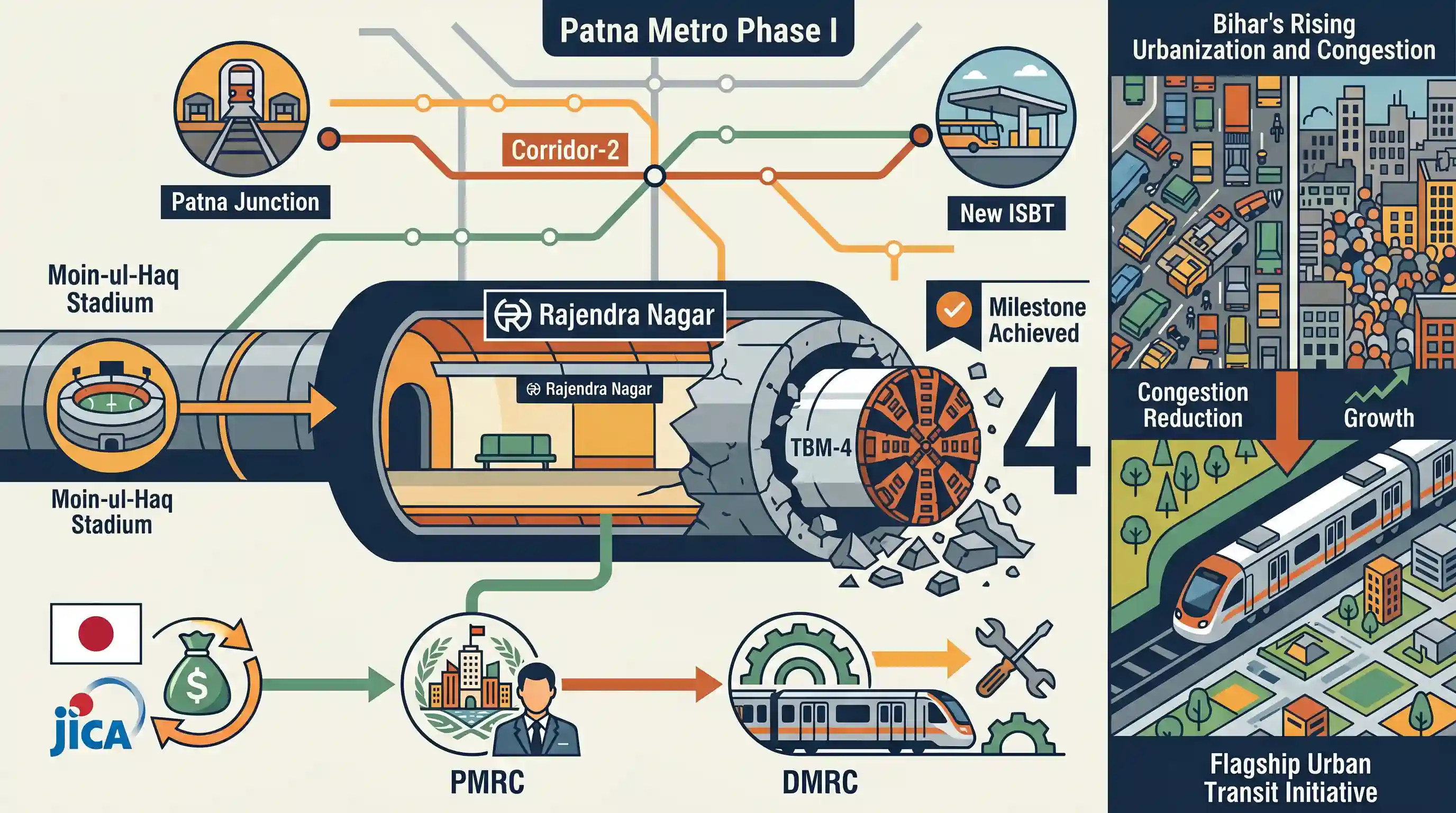
The Tunnel Boring Machine (TBM)-4 achieved a major milestone by completing its breakthrough at Rajendra Nagar underground station under Patna Metro Phase I [1.1]. Launched from the Moin-ul-Haq Stadium station, the machine completed a critical segment of the underground tunnel for Corridor-2, which will eventually connect Patna Junction to New ISBT [1.1]. Managed by Patna Metro Rail Corporation (PMRC) with Delhi Metro Rail Corporation (DMRC) as the executing agency and assisted by funding from Japan International Cooperation Agency (JICA), this project is Bihar's flagship urban transit initiative designed to handle the state's rising urbanization and congestion challenges.
Key Points
- Tunnel Boring Machine (TBM)-4 successfully achieved a breakthrough at Rajendra Nagar station under Phase I of the Patna Metro Rail Project [1.1].
- The TBM-4 machine had been launched from the Moin-ul-Haq Stadium station, making this a crucial progress milestone in the underground construction corridor [1.1].
- Patna Metro Phase I features two corridors: Corridor-1 (Danapur to Khemni Chak) and Corridor-2 (Patna Junction to New ISBT); this breakthrough is part of Corridor-2.
- The project is being executed by the Delhi Metro Rail Corporation (DMRC) on behalf of Patna Metro Rail Corporation (PMRC), with substantial funding support from the Japan International Cooperation Agency (JICA).
- This infrastructure milestone is essential for easing urban congestion in Patna and supports Bihar's rapid urbanization and modernisation drive.
Important Terms
Patna Metro Rail Project Phase I

A 30.91 km mass rapid transit network under construction in Bihar's capital, designed to enhance urban connectivity, reduce traffic congestion, and lower carbon emissions.
UPSC context
GS Paper III (Infrastructure); tests understanding of modern urban transport systems, transit-oriented development, and regional economic growth.
Patna Metro Rail Corporation (PMRC)
A special purpose vehicle established by the Bihar government responsible for the planning, implementation, and overall administration of the Patna Metro project.
UPSC context
GS Paper II (Governance); tests institutional frameworks, public-sector SPVs, and administrative machinery for state-level infrastructure delivery.
Delhi Metro Rail Corporation (DMRC)
A central-state joint venture that operates the Delhi Metro and acts as the executing consultant for several other urban rapid transit networks across India.
UPSC context
GS Paper III (Infrastructure); tests successful models of public-sector joint ventures and inter-state consultancy in executing mega-projects.
Japan International Cooperation Agency (JICA)
A Japanese governmental agency delivering Official Development Assistance (ODA) loans, technical expertise, and grants to advance socio-economic progress and infrastructure in developing nations.
UPSC context
GS Paper II (Bilateral Relations); tests strategic Indo-Japan developmental partnerships, foreign funding mechanisms, and international cooperation in domestic infrastructure.
Prelims Trap
Bihar was the least urbanized state in India as per the 2011 Census.
Himachal Pradesh had the lowest urbanization rate (10%) in 2011. Bihar was the second-lowest (11.3%), though often misidentified due to its massive rural population base.
Static Concepts Connected
What are the core mandates of India's Metro Rail Policy, 2017?
- Mandatory PPP: Requires private sector participation in operations or maintenance to qualify for Central government financial assistance.
- Transit-Oriented Development: Promotes high-density, mixed-use commercial and residential zones alongside metro corridors to boost economic activity.
- Alternative Financing: Encourages land value capture, debt financing, and transit-adjacent advertising to ensure project sustainability.
How do 50:50 Joint Venture SPVs operate in Indian Metro projects?
- Equity Sharing: The Government of India and the respective State Government contribute equal equity (50:50) to the company's capital.
- Administrative Control: Board of Directors is split equally, with the Chairman typically nominated by the Center and Managing Director by the State.
- Debt Responsibility: Sovereign guarantees for external multilateral loans (like JICA) are extended through the Central Government.
Cross-Topic Patterns
Tier-2 transit + Fiscal federalism
Growth of joint-venture SPVs shows how financially strained states rely on combined central equity and sovereign-backed multilateral loans to fund Tier-2 urban infrastructure projects.
Indo-Japan ODA + Geopolitical balancing
Japan's JICA remains India's largest bilateral development partner, acting as a non-commercial strategic alternative to Chinese infrastructure investments across South Asia.

SPV ownership models, Metro Rail Policy 2017 criteria, and Tier-2 urbanization metrics are high-probability areas for GS-3/Prelims.
Linked PYQs · 1
Linked PYQs · 1
- 2023BPSC_PRELIMSGS1
The urbanization of the State has increased very rapidly in the last ten years. According to the 2011 Census, the level of urbanization in Bihar was just __ percent, which has increased to __ percent at present.
