BCG Vaccine Potential in Trained Immunity Against Alzheimer
Source:The Hindu ↗
Why It Matters
Highlights how existing, well-understood medical interventions (like the BCG vaccine) can be repurposed through a deeper understanding of immunology ('trained immunity') to tackle complex, untreatable neurodegenerative conditions like Alzheimer's, making it highly relevant for the Science and Technology portion of the UPSC syllabus.
Summary
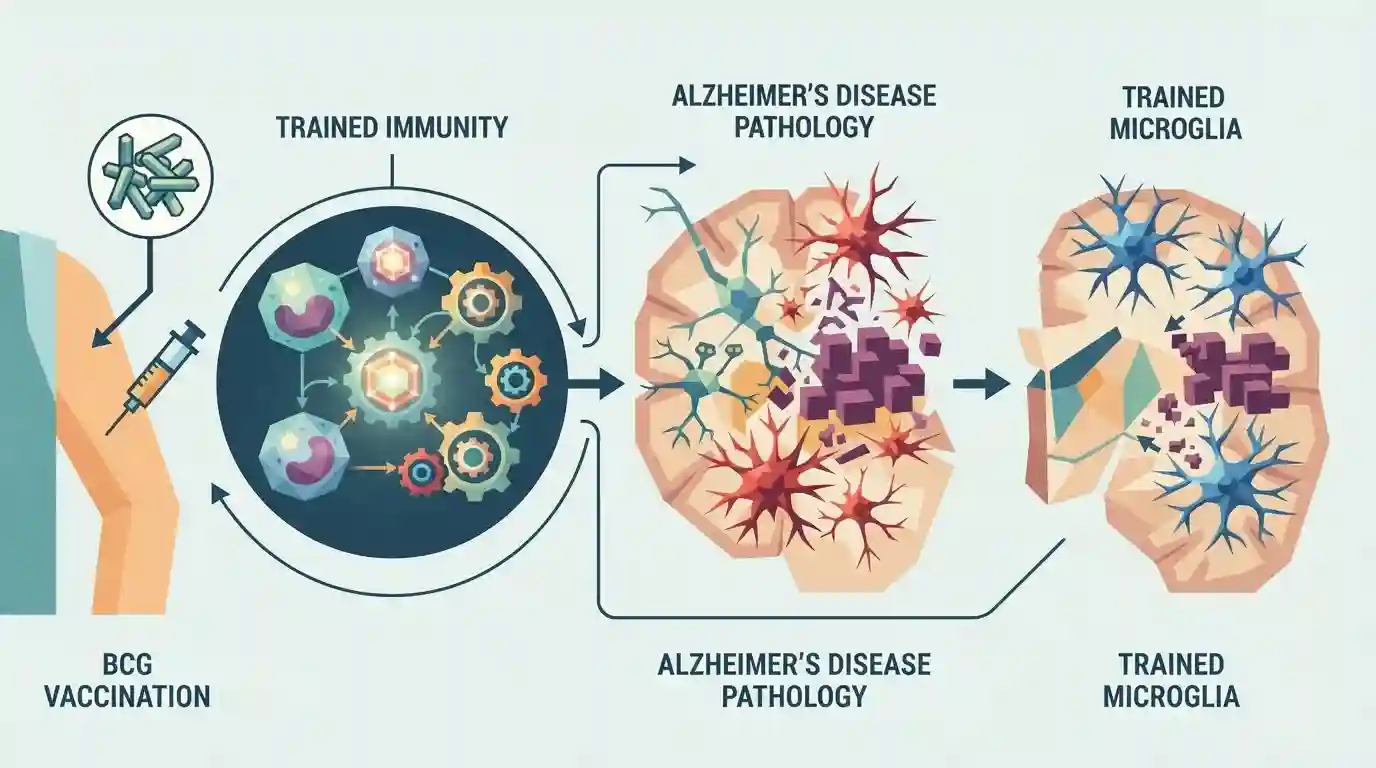
Recent scientific studies suggest that the Bacillus Calmette-Guérin (BCG) vaccine, traditionally administered to prevent tuberculosis, may hold clues for treating or preventing Alzheimer’s disease. The therapeutic potential lies in a phenomenon known as 'trained immunity', where the BCG vaccine induces long-lasting epigenetic and metabolic reprogramming of the innate immune system. In the context of Alzheimer's, this process targets microglia—the resident immune cells of the brain. While microglia often become dysfunctional and hyper-inflammatory in Alzheimer's patients, failing to clear amyloid-beta plaques, the BCG vaccine's trained immunity effect appears to 'retrain' these cells. This allows them to resume their protective functions, clear toxic protein buildups, and mitigate neuroinflammation, offering a promising new avenue for immunotherapy in neurodegenerative diseases.
Key Points
- The Bacillus Calmette-Guérin (BCG) vaccine, primarily used to prevent tuberculosis, exhibits beneficial off-target effects that could help combat Alzheimer's disease.
- The mechanism relies on 'trained immunity,' a process where the innate immune system is reprogrammed via epigenetic and metabolic changes to respond more effectively to various threats.
- In Alzheimer's disease, the brain's resident immune cells (microglia) become dysfunctional, leading to neuroinflammation and a failure to clear toxic amyloid-beta plaques.
- The BCG vaccine may 'retrain' these microglia, shifting them into a protective state that enhances plaque clearance and reduces cognitive decline, offering a novel immunotherapeutic approach.
Important Terms
Universal Immunization Programme (UIP)

A flagship public health initiative of India's Ministry of Health and Family Welfare providing free, routine vaccines to children and pregnant women against 12 vaccine-preventable diseases.
UPSC context
GS Paper II (Social Justice/Health). Tests awareness of welfare schemes, maternal-child healthcare, and national immunization strategies.
Bacillus Calmette-Guérin (BCG) Vaccine
A live-attenuated vaccine derived from Mycobacterium bovis, primarily administered under the UIP to protect infants against severe forms of childhood tuberculosis.
UPSC context
GS Paper III (Science & Technology/Biotechnology). Tests knowledge of vaccines, microbial pathogens, and emerging immunotherapeutic uses.
Trained Immunity
A state of the innate immune system where exposure to stimuli induces long-term epigenetic and metabolic reprogramming, allowing a faster, enhanced response to subsequent infections.
UPSC context
GS Paper III (Biotechnology). Tests understanding of modern immunological mechanisms, vaccine developments, and therapeutic innovations.
Microglia
Specialized myeloid immune cells resident in the central nervous system that maintain brain homeostasis, clear debris, and defend against pathogens.
UPSC context
GS Paper III (Science/Biotechnology). Tests knowledge of human cellular biology, neurodegenerative disease progression, and therapeutic targets.
World Health Organization (WHO)
A specialized United Nations agency directing and coordinating international public health, setting global guidelines, and supporting member states in disease control.
UPSC context
GS Paper II (International Relations). Tests knowledge of multilateral institutions, global health security, and international governance.
Prelims Trap
Trained immunity is achieved through permanent genetic mutations and DNA sequence modifications in adaptive immune cells.
Trained immunity relies strictly on epigenetic/metabolic changes in the innate immune system (macrophages/NK cells), without any alterations to the underlying DNA sequence or involvement of adaptive T/B cells.
Static Concepts Connected
How do Innate and Adaptive Immunity differ in human defense systems?
- Innate Immunity: Non-specific, rapid-acting system using physical barriers, phagocytes (macrophages, monocytes), and NK cells. Historically thought to lack immunological memory.
- Adaptive Immunity: Highly specific, delayed response mediated by B-cells (producing antibodies) and T-cells, which retain antigen-specific memory for long-term protection.
What is the BCG Vaccine and its therapeutic footprint in India?
- Origin and Primary Use: A live-attenuated vaccine derived from Mycobacterium bovis, primarily used to protect newborns from severe childhood tuberculosis.
- UIP Status: Administered at birth as a single dose under India's Universal Immunization Programme (UIP).
- Immunotherapy Application: Beyond TB, it is clinically used as an FDA-approved immunotherapy (intravesical instillation) to treat superficial bladder cancer.
Cross-Topic Patterns
Vaccine repurposing + Geriatric care policy
Repurposing old infectious disease tools like the BCG vaccine offers a cost-effective strategy to address India's rapidly rising geriatric and neurodegenerative disease burden.
Epigenetics vs Gene Editing regulations
Unlike CRISPR, therapies leveraging epigenetic reprogramming avoid the complex bioethical and clinical trial regulations surrounding direct DNA sequence alterations.

Innate vs adaptive immunity differences, focusing on 'trained immunity' and off-target uses of BCG, are highly likely for Prelims.
Linked PYQs · 3
Linked PYQs · 3
- 2022PrelimsGS1
Which one of the following statements best describes the role of B cells and T cells in the human body?
- 2022MainsGS3
What is the basic principle behind vaccine development ? How do vaccines work? What approaches were adopted by the Indian vaccine manufacturers to produce COVID-19 vaccines ?
- 2019PrelimsGS1
Which one of the following statements is not correct?
