TB Drug Patent Rejection and Public Health Access in India
Source:Indian Express ↗
Why It Matters
It directly addresses the intersection of intellectual property rights, patent laws like Section 3(d), and affordable healthcare access, which are core themes in GS Paper 3 (Economy and Science & Technology).
Summary
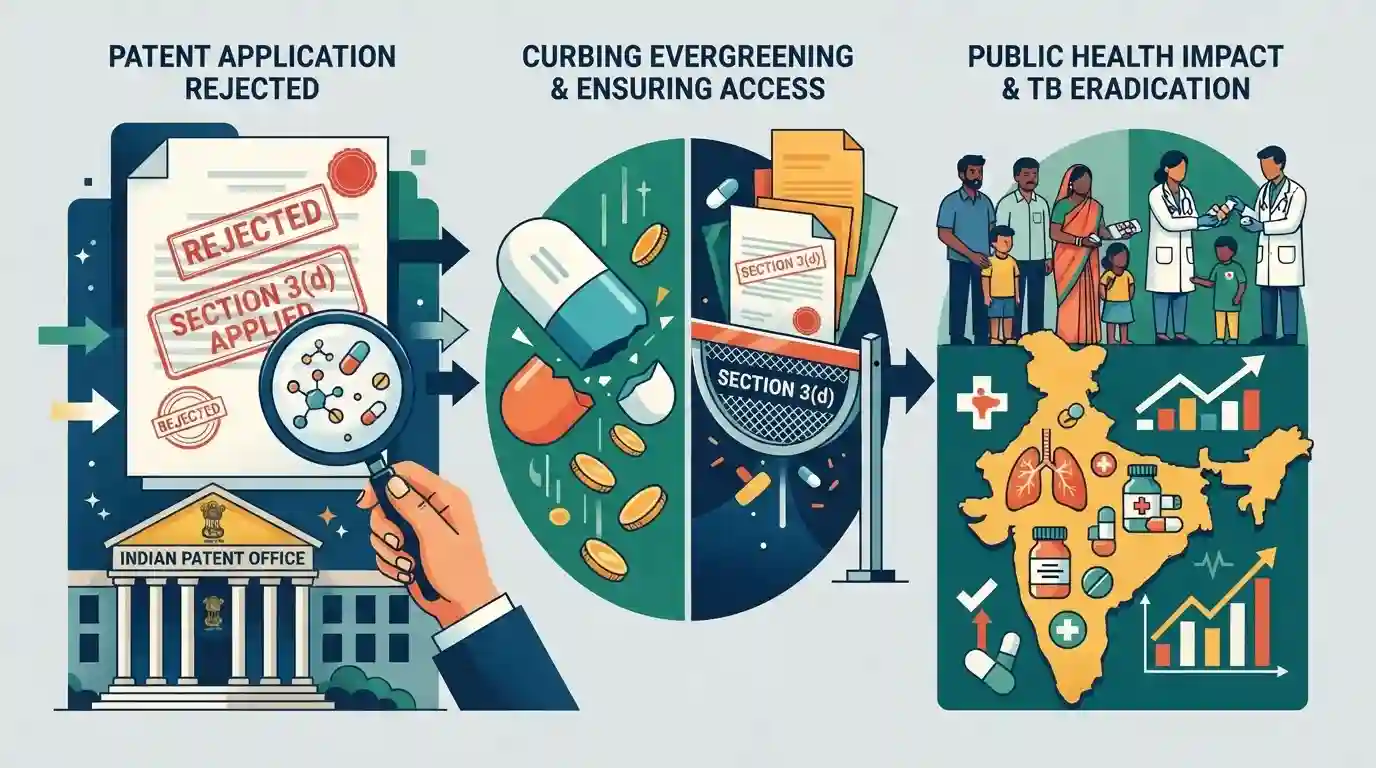
The Indian Patent Office's rejection of a patent application for a tuberculosis drug highlights the tension between intellectual property rights and public health access. By leveraging provisions like Section 3(d) of the Indian Patents Act, India continues to curb pharmaceutical evergreening, ensuring lower treatment costs and wider availability of life-saving drugs for public health priorities like TB eradication.
Key Points
- The Indian Patent Office rejected a patent application for a crucial tuberculosis drug formulation, preventing market monopoly and keeping treatment affordable.
- Section 3(d) of the Indian Patents Act plays a vital role in preventing the evergreening of patents by pharmaceutical companies.
- Affordable access to TB medicines is critical for India's public health goals, given its high burden of tuberculosis cases globally.
- Balancing intellectual property rights with public health flexibilities under international trade agreements remains a key policy challenge.
Important Terms
Indian Patents Act Section 3d

A key provision in India's Patents Act of 1970 that prevents pharmaceutical evergreening by requiring new forms of known substances to prove significantly enhanced therapeutic efficacy before receiving patent protection.
UPSC context
GS Paper III (Economy / Science & Technology); tests understanding of IPR regimes, TRIPS flexibilities, and balancing innovation with public health access.
TRIPS Agreement
A WTO international agreement setting minimum standards for the regulation of intellectual property rights, featuring flexibilities like compulsory licensing that developing nations use to protect public health.
UPSC context
GS Paper III (International Relations / Economy); evaluates international trade agreements, multilateral conventions, and global governance of intellectual property.
Indian Patent Office
The national authority under the Ministry of Commerce and Industry responsible for administering patent laws, examining applications, and granting or rejecting patent rights in India.
UPSC context
GS Paper III (Economy / Governance); highlights institutional mechanisms for statutory compliance, patent examination, and domestic intellectual property administration.
Prelims Trap
Section 3(d) completely prohibits granting patents on any new form or derivative of an existing pharmaceutical substance.
Section 3(d) does not outright ban patents on derivatives; it permits them ONLY if there is a proven, significant enhancement in therapeutic efficacy.
Static Concepts Connected
What are the key exceptions and provisions under Section 3(d) of the Indian Patents Act?
- Evergreening Check: Prevents evergreening by disallowing patents on new forms of known substances without enhanced therapeutic efficacy.
- Strict Thresholds: Explicitly excludes mere discovery of a new property, new use, or derivative of a known substance unless efficacy is proven.
- TRIPS Alignment: Subject to international scrutiny, yet fully compliant with TRIPS flexibilities safeguarding public health.
Cross-Topic Patterns
Pharmaceutical Patents vs Public Health (TRIPS Flexibilities)
India's use of compulsory licensing and Section 3(d) sets a precedent for Global South access to medicines, frequently tested against TRIPS compliance.
IPR Policy and National Health Missions
Domestic patent rejections directly support national health missions like the National TB Elimination Programme (NTEP) by removing cost barriers.

Section 3(d) thresholds and TRIPS flexibilities are recurring themes; expect a statement-based prelims question on evergreening.
Linked PYQs · 3
Linked PYQs · 3
- 2024MainsGS3
What is the present world scenario of intellectual property rights with respect to life materials? Although, India is second in the world to file patents, still only a few have been commercialized. Explain the reasons behind this less commercialization.
- 2013MainsGS3
Bringing out the circumstances in 2005 which forced amendment to the section 3(d) in Indian Patent Law, 1970, discuss how it has been utilized by the Supreme Court in its judgement in rejecting Novratis' patent application for 'Glivec'. Discuss briefly the pros and cons of the decision.
- 2019MainsGS3
How is the Government of India protecting traditional knowledge of medicine from patenting by pharmaceutical companies?
