Cloud Computing Infrastructure and Data Centre Policy
Source:Indian Express ↗
Why It Matters
The growth of digital infrastructure is central to India's digital economy ambitions. Understanding the actual structural requirements for data centres (power, connectivity) versus superficial policy tools (tax holidays) is critical for answering questions on infrastructure development, investment models, and the IT sector in GS3.
Summary
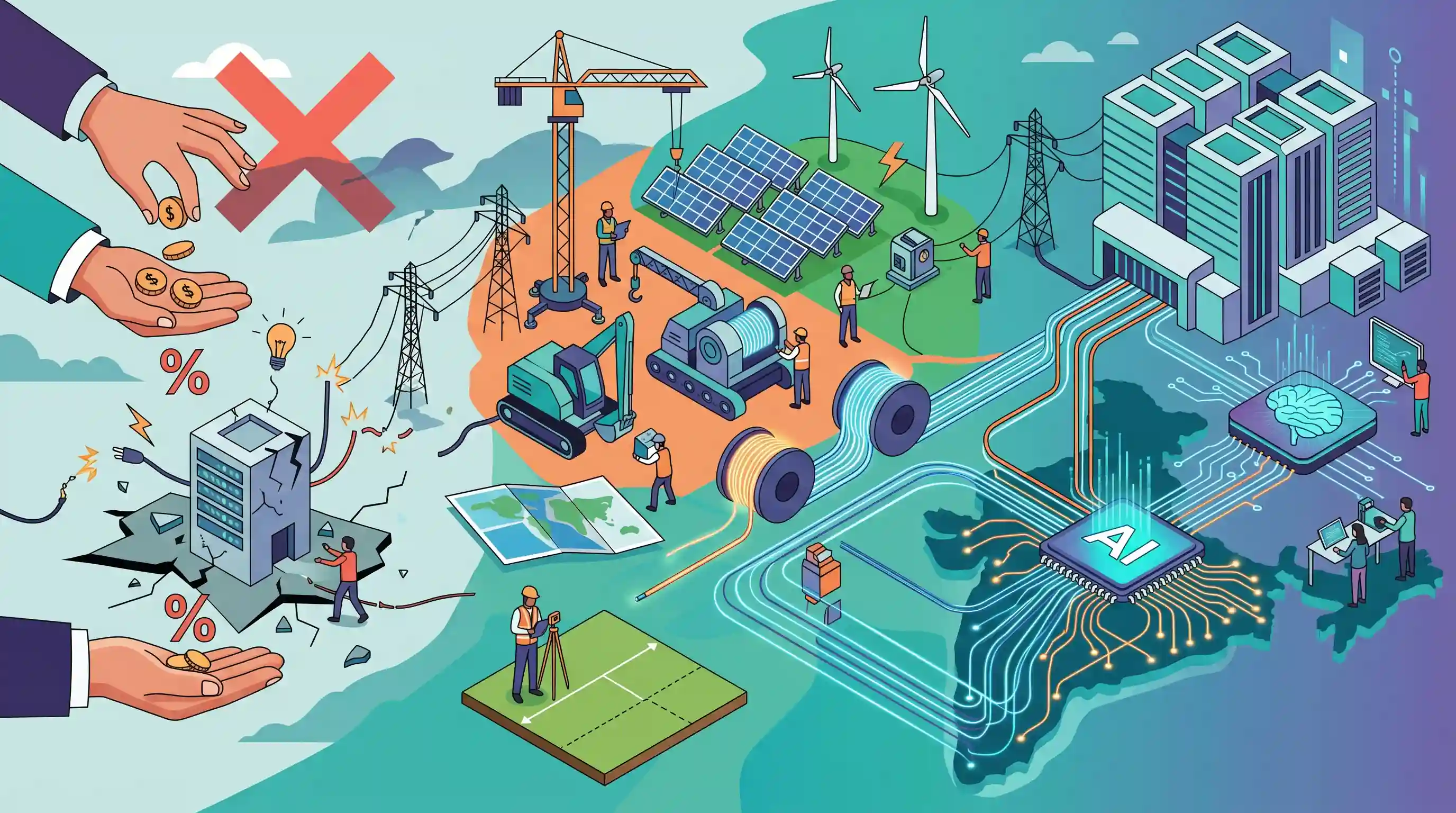
The article evaluates India's strategy to become a global hub for cloud computing and data centres. It argues that relying primarily on tax holidays and financial incentives is inadequate for attracting the massive capital required for such facilities. Large-scale data centres, particularly those necessary to support the exponential growth of Artificial Intelligence (AI) and machine learning, have demanding prerequisites: uninterrupted and massive power supplies (increasingly green energy), extensive high-speed optical fibre connectivity, and suitable land. The piece emphasizes that the government must focus on structural enablers—building robust physical and digital infrastructure and ensuring stable regulatory and power environments—rather than just offering tax breaks, to build a competitive and sustainable digital ecosystem.
Key Points
- Tax incentives and financial holidays are insufficient on their own to establish India as a global cloud computing and data centre hub.
- Modern, large-scale data centres, especially those built for Artificial Intelligence (AI) workloads, require immense and uninterrupted power supply, increasingly demanding green or renewable energy sources.
- Robust digital and physical infrastructure, including dense, high-speed optical fibre networks and suitable land, are fundamental prerequisites for data centre investments.
- Policymakers must prioritize long-term structural reforms, stable regulatory frameworks, and grid modernization over short-term tax breaks to attract sustainable capital into the digital infrastructure sector.
Important Terms
Digital India

A 2015 flagship program aiming to transform India into a digitally empowered society and knowledge economy through enhanced digital infrastructure and online service delivery.
UPSC context
GS Paper 2 (E-governance) and GS Paper 3 (S&T/Infrastructure); tests understanding of digital inclusion and economic transformation.
Production Linked Incentive (PLI)
A government initiative providing financial incentives to companies based on incremental sales from products manufactured in domestic units to boost manufacturing and self-reliance.
UPSC context
GS Paper 3 (Economy/Industrial Policy); relevant for questions on 'Aatmanirbhar Bharat' and manufacturing competitiveness.
Data Centres
Centralized facilities housing servers, storage, and networking equipment to process and manage large volumes of data; recently granted 'infrastructure status' in India.
UPSC context
GS Paper 3 (Infrastructure/Economy); vital for discussions on digital economy growth and energy-intensive infrastructure challenges.
Cloud Computing
The on-demand delivery of computing services—including servers, storage, and software—over the internet, allowing for scalability and reduced upfront capital expenditure.
UPSC context
GS Paper 3 (Science & Technology); focuses on emerging technologies and their role in governance (e.g., MeghRaj initiative).
Data Localisation
The legal requirement that data generated within a country’s borders be stored and processed domestically, often to ensure digital sovereignty and security.
UPSC context
GS Paper 3 (S&T/Internal Security); critical for topics concerning the DPDP Act and national strategic autonomy.
Infrastructure Status
A regulatory classification that allows sectors to access long-term, low-cost credit, external commercial borrowings (ECB), and easier FDI to facilitate massive capital investment.
UPSC context
GS Paper 3 (Economy/Infrastructure); tests knowledge of financing mechanisms for large-scale national development projects.
Green Energy Corridor
A power system project designed to integrate large-scale renewable energy into the national grid, ensuring stable supply for high-demand sectors like data centres.
UPSC context
GS Paper 3 (Environment/Energy); relevant for questions on India's Net Zero targets and sustainable industrial growth.
Prelims Trap
India regulates its cloud infrastructure under the comprehensive National Data Centre Policy of 2020.
India lacks a formally adopted National Data Centre Policy; the 2020 version remains a draft. Regulation currently relies on fragmented state-level policies.
Static Concepts Connected
Key geographical and infrastructure prerequisites for locating Data Centres
- Cable Landing Stations: Proximity to submarine optical fibre cables ensures low latency and high-speed data transfer.
- Stable Base Load: Requires massive, 24/7 uninterrupted power, acting as an inflexible base load on the electrical grid.
- Cooling Resources: Continuous water supply or naturally cold climates are vital for the thermal management and cooling of servers.
- Seismic Stability: Locations must have a low risk of earthquakes and natural disasters to ensure continuous uptime.
Difference between Base Load and Peak Load power generation
- Base Load: The minimum continuous level of electricity demand on a grid over 24 hours. Supplied by inflexible, steady sources like coal, nuclear, or massive data centres' demands.
- Peak Load: The time of highest electricity demand. Supplied by flexible generation sources, like hydro or gas, that can be ramped up or down quickly.
Cross-Topic Patterns
AI cooling vs Urban Water Security
AI servers require millions of gallons for thermal management, creating emerging "Water vs. Data" resource conflicts in drought-prone IT hubs like Bengaluru and Chennai.
Submarine Cables & Hub Concentration
70-90% of India's data centre capacity clusters in coastal cities like Mumbai and Chennai because undersea cable landing stations physically anchor the internet, dictating digital geography.

Expect a GS3 mains question linking AI's massive base-load power and water needs to India's net-zero 2070 targets.
Linked PYQs · 4
Linked PYQs · 4
- 2023MainsGS3
What is the status of digitalization in the Indian economy? Examine the problems faced in this regard and suggest improvements.
- 2015MainsGS3
Discuss the advantages and security implications of cloud hosting of servers vis-a-vis in-house machine-based hosting for government businesses.
- 2021MainsGS3
“Investment in infrastructure is essential for more rapid and inclusive economic growth.” Discuss in the light of India's experience.
- 2023MainsGS3
Introduce the concept of Artificial Intelligence (AI). How does Al help clinical diagnosis? Do you perceive any threat to privacy of the individual in the use of Al in healthcare?
