Tax Cuts Constrain Fiscal Space for Centre and States
Source:Indian Express ↗
Why It Matters
It provides a crucial macroeconomic perspective on the trade-offs of tax reduction, bridging GS3 (economy and budgeting) and GS2 (fiscal federalism) by illustrating how central revenue policies impact state-level developmental expenditure.
Summary
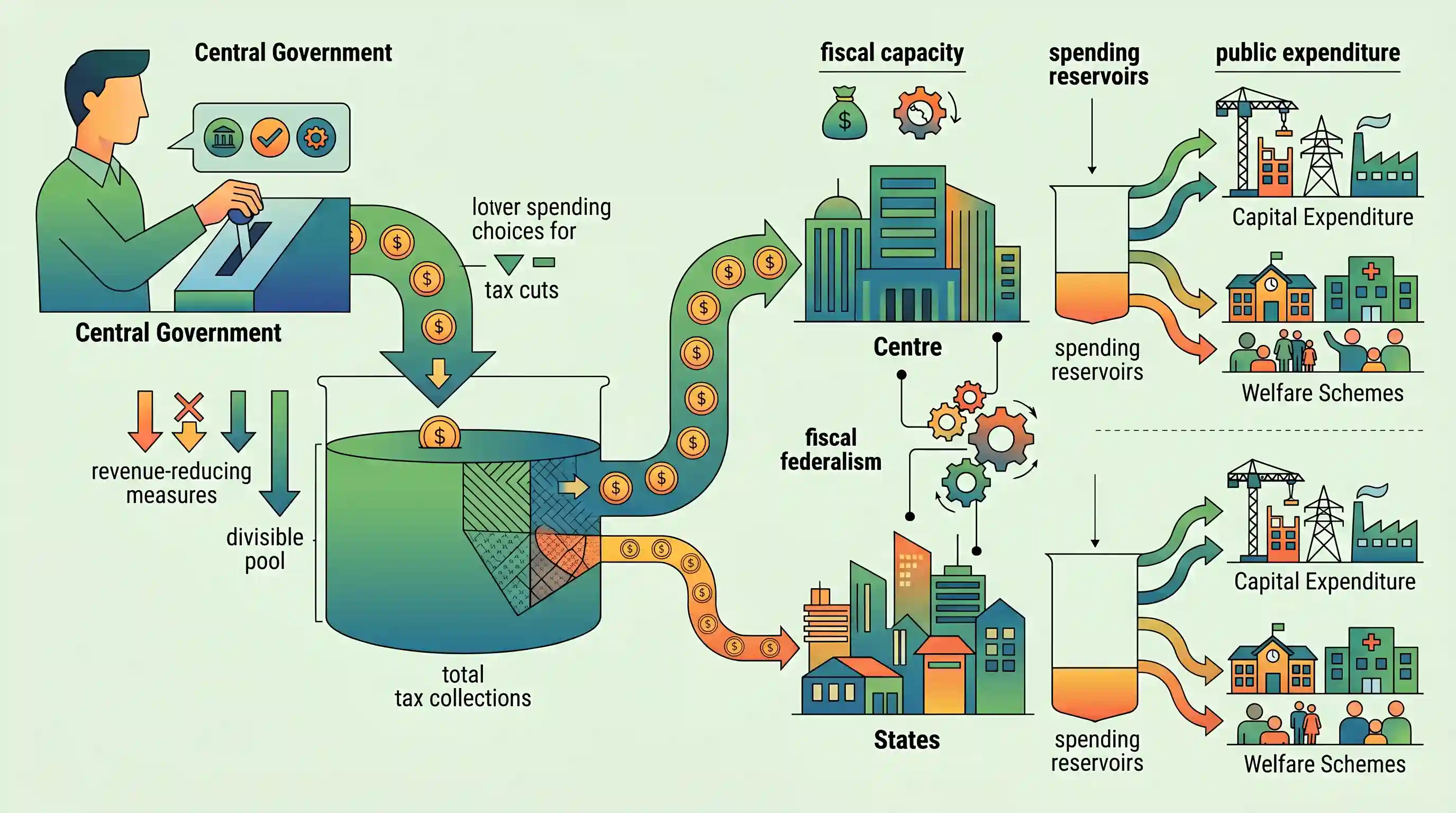
The article critically examines the macroeconomic and federal implications of tax cuts, arguing that such revenue-reducing measures severely hem in the fiscal capacities of both the Centre and State governments. By reducing the overall tax collections, the size of the divisible pool shrinks, which in turn diminishes the states' share of devolved funds. This financial constriction leaves both levels of government with limited resources to expand public spending, particularly crucial capital expenditure and welfare schemes. The dynamic underscores the delicate balance required in fiscal policymaking, where measures intended to boost private growth can inadvertently impair the developmental and autonomous spending power embedded in India's fiscal federalism.
Key Points
- Tax cuts implemented by the Centre lead to a direct shortfall in gross tax revenues, inherently shrinking the government's fiscal space.
- Because state governments receive a constitutionally mandated share of central taxes through the divisible pool, Union-level tax cuts disproportionately constrain states' revenues.
- A reduced fiscal capacity hampers both tiers of government from undertaking necessary capital expenditure, infrastructure development, and social welfare programs.
- The situation highlights a core tension in fiscal federalism: while tax cuts are often designed to spur private investment, they risk undermining public spending capacities and the financial autonomy of states.
Important Terms
Finance Commission

A constitutional body established under Article 280 to recommend the distribution of tax revenues between the Union and the States, and among the States.
UPSC context
GS Paper II (Polity) and III (Economy); tests knowledge of fiscal federalism and resource allocation mechanisms.
Divisible Pool
The portion of gross tax revenue shared between the Centre and States. It excludes cesses and surcharges, which are retained entirely by the Union.
UPSC context
GS Paper III (Economy); critical for understanding vertical fiscal imbalance and Centre-State financial relations.
Tax Devolution
The statutory distribution of the net proceeds of central taxes to state governments based on formulas recommended by the Finance Commission.
UPSC context
GS Paper III (Economy); key to analyzing state fiscal autonomy and development spending capacity.
Capital Expenditure
Government spending used to create long-term assets like infrastructure, schools, and hospitals, or to reduce liabilities, thereby increasing the economy's productive capacity.
UPSC context
GS Paper III (Economy); essential for evaluating budget quality and its impact on long-term economic growth.
Fiscal Responsibility and Budget Management (FRBM) Act
A 2003 law aimed at ensuring fiscal discipline by setting targets for reducing fiscal and revenue deficits and managing government debt levels.
UPSC context
GS Paper III (Budgeting); tests understanding of fiscal consolidation and the legal limits on government borrowing.
Fiscal Federalism
The financial relationship and division of powers/responsibilities between different levels of government (Union, State, Local) in a federal system.
UPSC context
GS Paper II (Governance); central theme regarding the balance of revenue-raising powers and expenditure responsibilities.
Cesses and Surcharges
Specific levies imposed by the Union for targeted purposes (e.g., education) that are not part of the divisible pool and not shared with states.
UPSC context
GS Paper III (Economy); highlights loopholes in tax sharing and their impact on state revenue shares.
Prelims Trap
"All tax revenues collected by the Centre, including cesses and surcharges, are part of the divisible pool shared with States."
Under Article 271, cesses and surcharges are exclusively retained by the Union and form no part of the divisible pool, making it a major point of Centre-State friction.
Static Concepts Connected
What exactly constitutes the Divisible Pool of Taxes under the Indian Constitution?
- Article 270: Article 270 defines the pool to include major central taxes like personal income tax, corporate tax, CGST, and customs duties.
- Constitutional Exclusions: Article 271 explicitly excludes cesses, surcharges, and the administrative cost of tax collection from being shared with the states.
- Distribution Mechanism: The exact vertical and horizontal distribution formula is determined every five years by the Finance Commission (Article 280).
What is the Capital Expenditure (Capex) Multiplier and why is it fiscally critical?
- Definition & Value: It measures the change in GDP resulting from an increase in government capital expenditure. RBIs estimates place India's capex multiplier between 2.45 and 3.0.
- Vs Revenue Expenditure: Revenue expenditure (salaries, subsidies) has a multiplier of less than 1 (~0.99), meaning it stimulates less economic growth per rupee spent compared to capex.
- Impact of Cuts: When tax cuts shrink fiscal space, governments often cut capex to balance budgets, inadvertently harming long-term macroeconomic growth.
Cross-Topic Patterns
16th Finance Commission negotiations
The debate over shrinking effective devolution (currently ~30-32% despite a 41% mandate) due to rising cesses will heavily dominate the negotiations and final recommendations of the newly constituted 16th Finance Commission.
Tax Expenditure vs FRBM Targets
Cutting taxes to spur private investment is classified as "revenue foregone". To meet FRBM fiscal deficit targets, the government often resorts to slashing capital spending, neutralizing the intended growth multiplier.

Expect a 2026 Mains question linking corporate tax cuts, rising cesses, and shrinking effective devolution to states under the 16th FC.
Linked PYQs · 4
Linked PYQs · 4
- 2013MainsGS3
What is the meaning of the term 'tax expenditure'? Taking housing sector as an example, discuss how it influences the budgetary policies of the government.
- 2025MainsGS2
Examine the evolving pattern of Centre-State financial relations in the context of planned development in India. How far have the recent reforms impacted the fiscal federalism in India?
- 2024MainsGS2
What changes has the Union Government recently introduced in the domain of Centre-State relations ? Suggest measures to be adopted to build the trust between the Centre and the States and for strengthening federalism.
- 2025PrelimsGS1
Suppose the revenue expenditure is ₹ 80,000 crores and the revenue receipts of the Government are ₹60,000 crores. The Government budget also shows borrowings of ₹ 10,000 crores and interest payments of ₹ 6,000 crores. Which of the following statements are correct? I. Revenue deficit is ₹ 20,000 crores. II. Fiscal deficit is ₹ 10,000 crores. III. Primary deficit is ₹ 4,000 crores. Select the correct answer using the code given below.
