Escalating Global Conflicts Threaten International Security And Energy
Source:Indian Express ↗
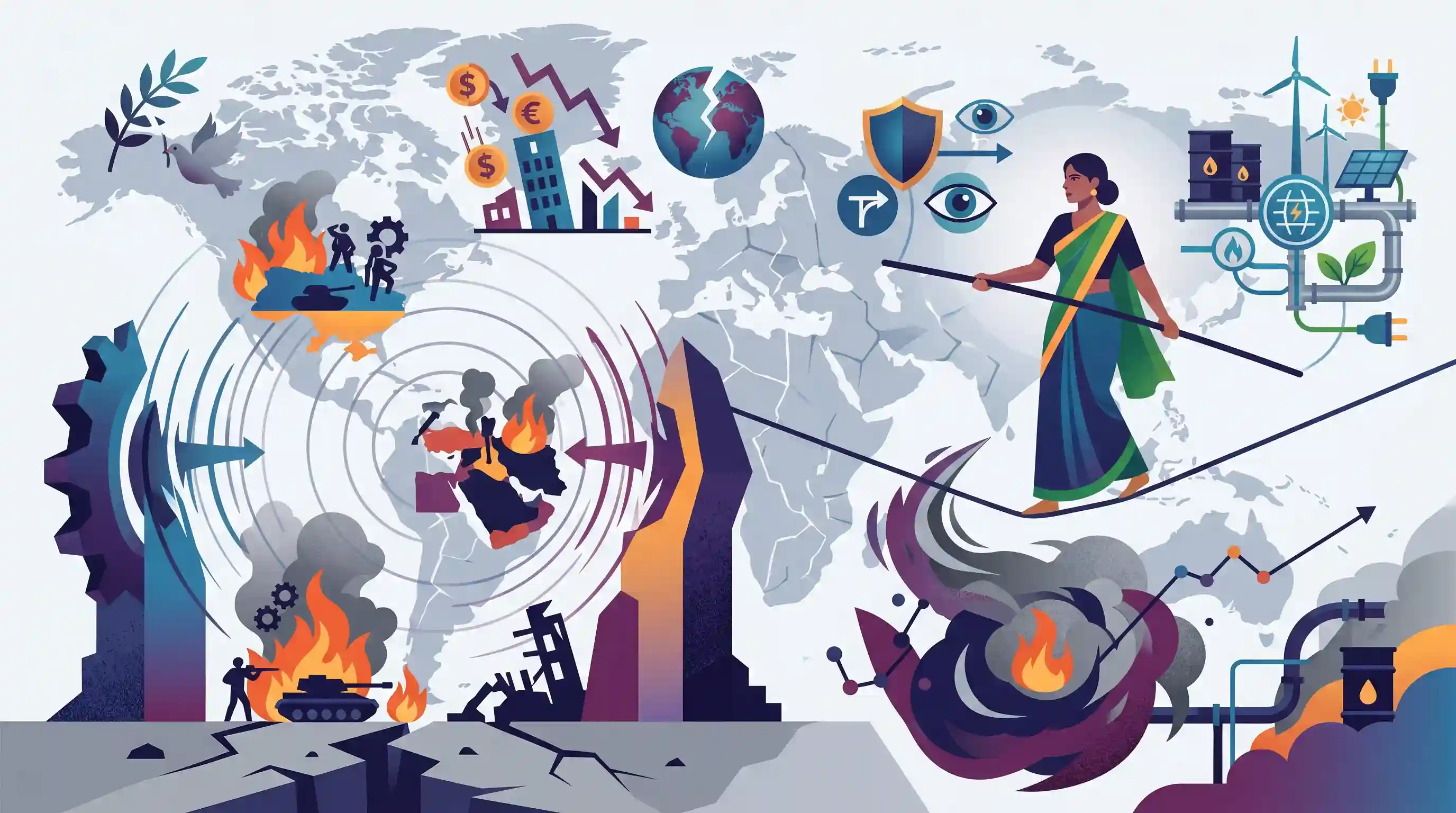
Why It Matters
Understanding the shifting dynamics of global conflicts is crucial for UPSC aspirants, as it directly impacts India's foreign policy calculus, energy security, and its role as a stabilizing power in a polarized global order.
Summary
In 'Whispers of War', Tavleen Singh examines the fragile state of global security amid escalating conflicts in the Middle East and Ukraine. The article underscores the risks of these localized wars expanding into broader geopolitical confrontations, threatening global peace and economic stability. It highlights India's complex diplomatic tightrope, stressing the need for New Delhi to safeguard its strategic autonomy and energy security while navigating an increasingly polarized world order.
Key Points
- The article reflects on the escalating global geopolitical tensions, describing them as 'whispers of war' driven by ongoing conflicts in the Middle East and Eastern Europe.
- Highlights the dangerous potential for regional disputes, such as the Israel-Iran conflict and the Russia-Ukraine war, to broaden into wider global confrontations.
- Emphasizes India's diplomatic challenge in maintaining strategic autonomy and balancing ties between Western powers, Russia, and key Middle Eastern nations.
- Points out the profound economic vulnerabilities for developing nations, including India, particularly concerning energy security, inflation, and supply chain disruptions resulting from prolonged conflicts.
Important Terms
Strategic Autonomy

The ability of a state to pursue its national interests and foreign policy independently, without being constrained by other powers or formal military alliances.
UPSC context
GS Paper 2: India's Foreign Policy. Tests India's shift from non-alignment to pragmatic multi-alignment in a polarized world.
United Nations (UN)
An international organization of 193 member states established in 1945 to maintain global peace and security through multilateral diplomacy.
UPSC context
GS Paper 2: International Institutions. Tests understanding of structural flaws, veto paralysis, and the push for UNSC reforms.
North Atlantic Treaty Organization (NATO)
A political and military alliance of 32 North American and European countries committed to collective defense under the 1949 North Atlantic Treaty.
UPSC context
GS Paper 2: Important Groupings. Tests analysis of Western security architecture and its influence on global conflict dynamics.
Energy Security
The uninterrupted availability of energy sources at an affordable price, encompassing long-term investment and short-term resilience to supply-demand shocks.
UPSC context
GS Paper 3: Infrastructure/Energy. Tests knowledge of India's import dependency and its link to strategic diplomatic autonomy.
Geopolitics
The study of how geographical factors, including location and resources, influence international relations and the exercise of political power.
UPSC context
GS Paper 2: International Relations. Tests the ability to analyze how territory and resources drive global strategic confrontations.
Prelims Trap
India's policy of 'Strategic Autonomy' restricts it from entering into defense and strategic partnerships.
Strategic autonomy today (multi-alignment) actively seeks issue-based engagements (e.g., Quad, SCO) without formal alliance constraints. It is not about isolation or strict neutrality.
Static Concepts Connected
What is the Strait of Hormuz and why is it critical for India?
- Geographic Location: A crucial strait connecting the Persian Gulf to the Gulf of Oman and the Arabian Sea.
- Energy Transit Chokepoint: It accounts for approximately 20% of global oil transit and facilitates nearly 50% of India's crude oil imports.
- Strategic Vulnerability: Highly susceptible to blockade during regional escalations (e.g., Iran-Israel/US tensions), which directly threatens India's energy security.
How does India's 'Multi-alignment' differ from traditional 'Non-Alignment'?
- NAM Focus: Aimed at ideological distancing from Cold War blocs to preserve decision-making independence and avoid proxy wars.
- Multi-alignment Focus: Pragmatic, concurrent engagement with competing powers to maximize national interest (e.g., buying Russian oil while partnering with the US).
Cross-Topic Patterns
Middle East conflicts & Imported Inflation
Geopolitical conflicts inflate crude prices, which directly widens India's Current Account Deficit (CAD) and causes 'imported inflation', complicating the RBI's monetary policy and inflation targeting.
The 3F Crisis (Food, Fuel, Fertilizer)
The Russia-Ukraine war exposed India's reliance on imported fertilizers. This links European geopolitics directly to Indian agricultural input costs, food security, and the government's subsidy burden.

Mapping questions on Middle Eastern chokepoints (Hormuz, Bab-el-Mandeb) paired with recent conflict zones are highly likely in 2026.
Linked PYQs · 4
Linked PYQs · 4
- 2025MainsGS2
"Energy security constitutes the dominant kingpin of India's foreign policy, and is linked with India's overarching influence in Middle Eastern countries.” How would you integrate energy security with India's foreign policy trajectories in the coming years?
- 2023MainsGS2
‘Virus of Conflict is affecting the functioning of the SCO’ In the light of the above statement point out the role of India in mitigating the problems.
- 2018MainsGS2
In what ways would the ongoing US-Iran Nuclear Pact Controversy affect the national interest of India? How should India respond to this situation?
- 2024MainsGS2
Critically analyse India's evolving diplomatic, economic and strategic relations with the Central Asian Republics (CARs) highlighting their increasing significance in regional and global geopolitics.
