Judicial delays and the need for substantive justice in India
Source:Indian Express ↗
Why It Matters
This perspective is highly relevant for GS Paper 2 (Polity and Governance), specifically concerning the functioning, independence, and accountability of the judiciary. It provides critical insights for answers evaluating the collegium system, case pendency, and the broader challenges facing justice delivery in India.
Summary
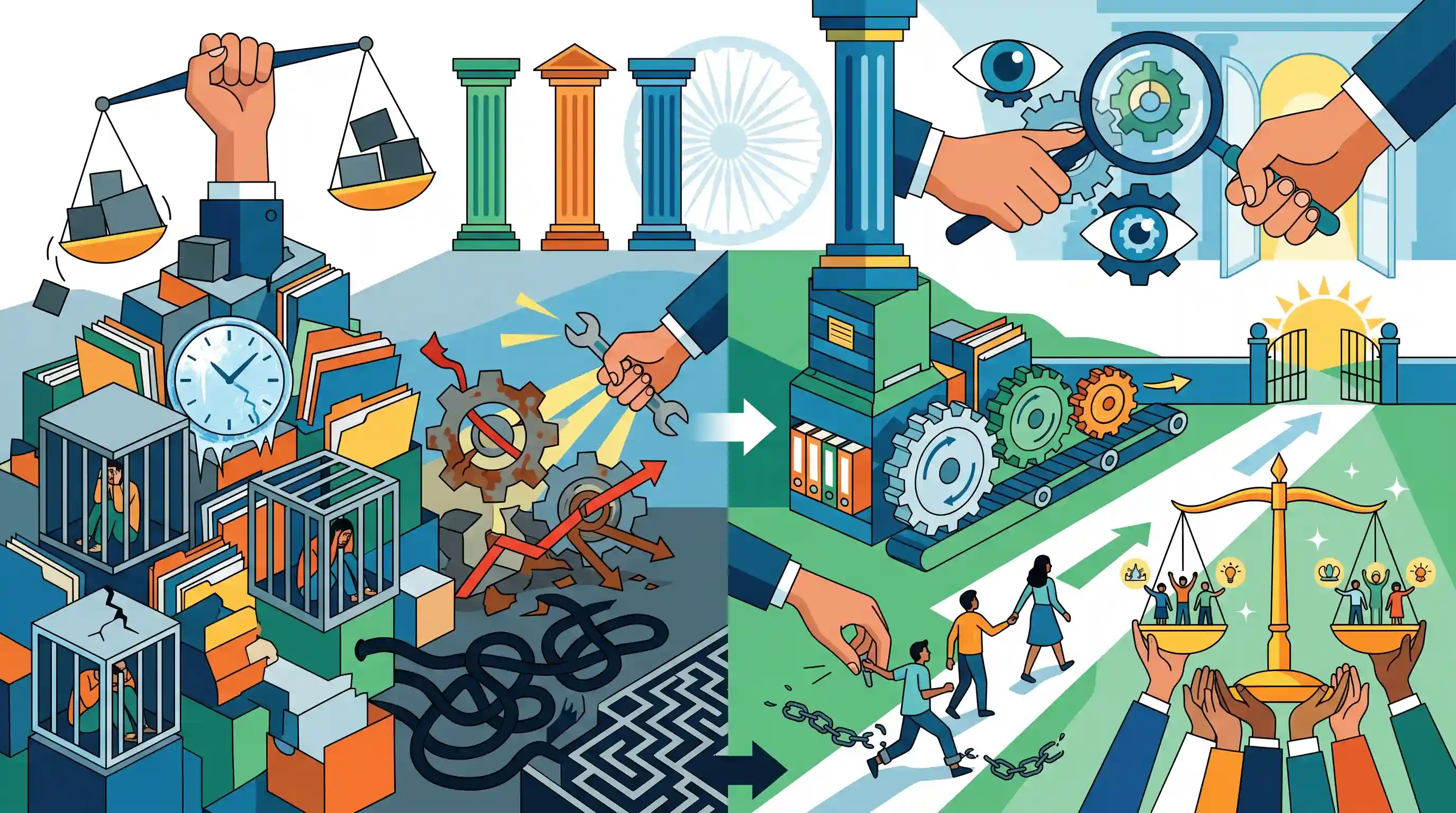
The author argues that the Indian judicial system needs to shift its focus from mere procedural justice to delivering 'real justice' to citizens. Highlighting the plight of undertrials, massive case pendency, and structural delays, the article calls for urgent judicial reforms and greater accountability among judges. It emphasizes that while judicial independence is vital, it must be balanced with the functional efficiency required to address the grievances of the common man promptly.
Key Points
- The article underscores the urgent need for systemic judicial reforms to address the disconnect between procedural law and substantive justice.
- The author highlights how the common man often suffers due to structural delays, immense pendency of cases, and a lack of timely redressal in the judicial process.
- The judiciary must reflect on its accountability and efficiency to ensure that 'real justice' is delivered rather than getting bogged down in technicalities.
- Effective checks, modernization of judicial infrastructure, and maintaining a balance between judicial independence and public accountability are essential.
Important Terms
Supreme Court of India

The apex judicial body under the Constitution, serving as the final court of appeal and guardian of fundamental rights.
UPSC context
GS Paper II: Polity. Relevant for its original, appellate, and advisory jurisdictions and as the ultimate interpreter of the Constitution.
Indian Judiciary
A single, integrated three-tier system (Supreme Court, High Courts, Subordinate Courts) that interprets and implements the laws of India.
UPSC context
GS Paper II: Structure and functioning of the judiciary. Tests knowledge of the unified judicial hierarchy.
Undertrials
Individuals detained in judicial custody while awaiting trial or investigation; currently constituting over 75% of India's prison population.
UPSC context
GS Paper II: Social Justice/Governance. Highlights issues in criminal justice and violations of Article 21 (Right to Life).
Case Pendency
The backlog of unresolved cases across all court levels, exceeding 5 crore cases, primarily due to judge vacancies and procedural delays.
UPSC context
GS Paper II: Judicial reforms. Tests understanding of structural challenges in the delivery of timely justice.
Judicial Independence
The principle that the judiciary must function free from executive or legislative pressure, considered part of the Constitution's 'Basic Structure'.
UPSC context
GS Paper II: Separation of powers. Key for questions on judicial appointments (Collegium system) and autonomy.
Judicial Accountability
The requirement for judges to be answerable for their conduct and performance to maintain public trust and democratic legitimacy.
UPSC context
GS Paper II: Governance. Often contrasted with independence in debates regarding judicial transparency and the Master of Roster.
Procedural vs. Substantive Justice
A distinction between following strict legal processes (procedural) and ensuring outcomes that align with social, economic, and moral fairness (substantive).
UPSC context
GS Paper II: Social Justice/Philosophy. Essential for evaluating whether laws fulfill the Preamble’s promise of justice.
Prelims Trap
"The Indian Constitution explicitly guarantees 'due process of law' under Article 21."
Article 21 explicitly states "procedure established by law". The Supreme Court introduced the substantive "due process" standard through judicial interpretation in the 1978 Maneka Gandhi case.
Static Concepts Connected
What distinguishes 'Procedure Established by Law' from 'Due Process'?
- Procedure Established: Validates a law if enacted by a competent legislature following correct procedure, regardless of the law's substantive fairness (British origin).
- Due Process: Ensures the law itself is just, fair, and reasonable, protecting citizens against arbitrary or oppressive legislative action (American origin).
- Indian Evolution: The Constitution uses 'procedure established by law', but the Supreme Court integrated 'due process' elements into Article 21 via the Maneka Gandhi case (1978).
How does the Constitution protect the Right to a Speedy Trial?
- Implicit Right: Recognized as an integral part of the Right to Life and Personal Liberty under Article 21, established in the Hussainara Khatoon case (1979).
- Statutory Backing: Section 479 of the new BNSS (replacing 436A CrPC) mandates bail for undertrials who have served half of their potential maximum sentence.
- Writ Enforcement: The Supreme Court enforces this through writ jurisdictions (Art 32 and 226) to quash proceedings if unreasonable delays violate an individual's rights.
Cross-Topic Patterns
Undertrials + Prison Reforms
Judicial pendency directly drives India's 131% prison occupancy (76% undertrials), linking court administration to the state-subject of prison management and broader human rights issues.
e-Courts Phase III + AI in Governance
Modernization of courts aligns with Digital India, bringing e-filing, the National Judicial Data Grid (NJDG), and predictive AI into the core of constitutional grievance redressal mechanisms.

Expect a Prelims question interlinking new BNSS bail provisions for undertrials, Article 21's speedy trial right, and NCRB prison data.
Linked PYQs · 3
Linked PYQs · 3
- 2025MainsGS2
"Constitutional morality is the fulcrum which acts as an essential check upon the high functionaries and citizens alike...." In view of the above observation of the Supreme Court, explain the concept of constitutional morality and its application to ensure balance between judicial independence and judicial accountability in India.
- 2023MainsGS2
“Constitutionally guaranteed judicial independence is a prerequisite of democracy.” Comment.
- 2024MainsGS2
Explain the reasons for the growth of public interest litigation in India. As a result of it, has the Indian Supreme Court emerged as the world's most powerful judiciary ?
