India Pakistan Relations and the Limits of Diplomatic Engagement
Source:Indian Express ↗
Why It Matters
This piece is highly relevant for GS Paper 2 (International Relations) as it provides a critical analysis of India-Pakistan dynamics, the limitations of diplomatic engagement with militarily-dominated 'bonsai democracies', and the impact of state-sponsored terrorism on bilateral ties.
Summary
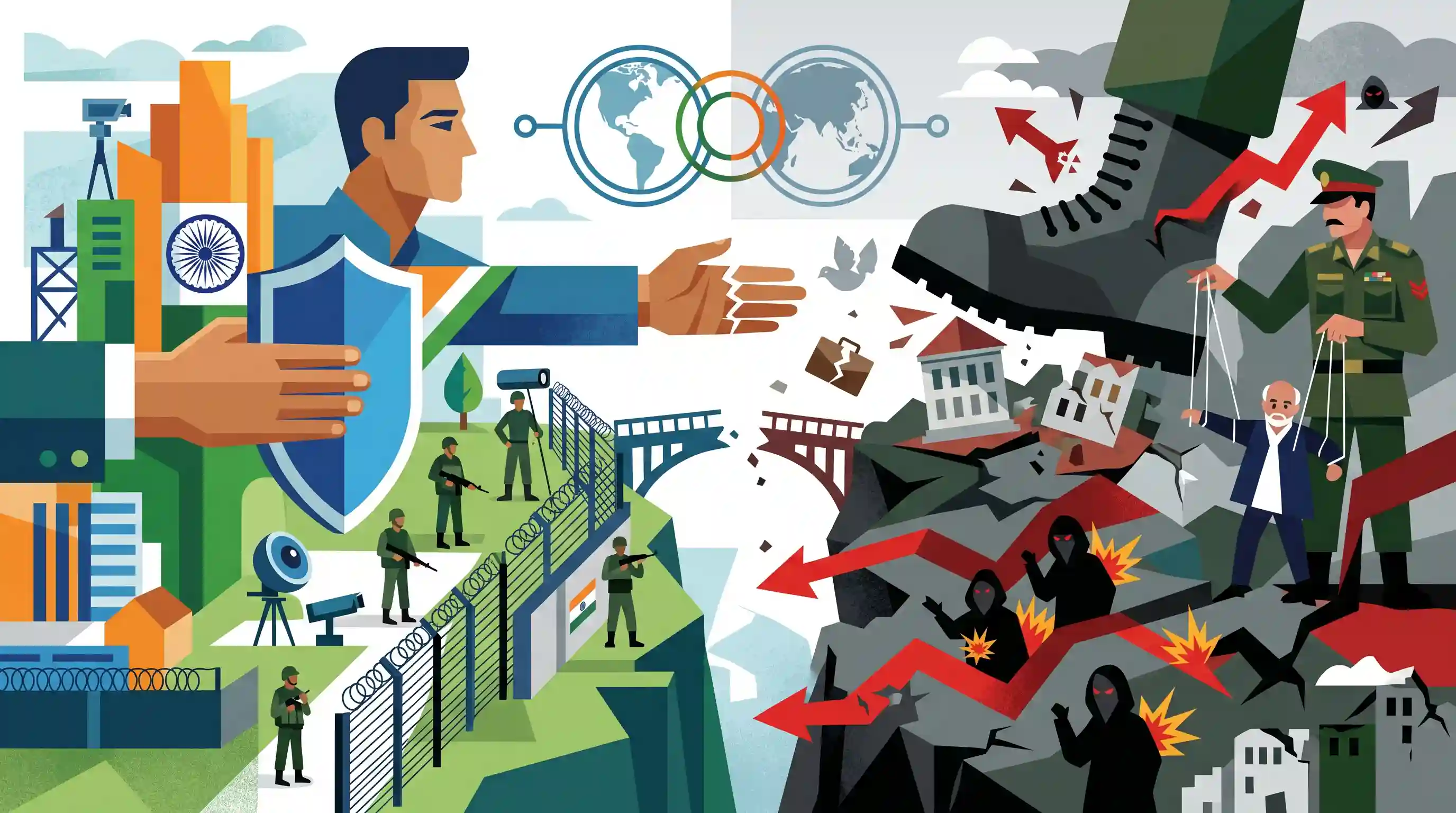
The article discusses India's strategic necessity in maintaining a tough stance toward Pakistan, arguing that New Delhi 'had no choice' given Pakistan's fragile democratic structures and ongoing support for cross-border terrorism. It highlights the challenges of engaging diplomatically with a nation where the military heavily influences civilian governance, asserting that genuine bilateral progress is unlikely until Pakistan establishes deeper democratic roots and abandons terrorism as a state policy.
Key Points
- Analyzes India's strategic and diplomatic posture toward Pakistan in light of the latter's internal political instability and fragile democratic setup (referred to as a 'bonsai democracy').
- Argues that India 'had no choice' but to maintain a firm defensive and diplomatic stance due to the persistent threat of cross-border terrorism.
- Highlights the fundamental difficulty of pursuing bilateral dialogue with a state where the military maintains disproportionate control over civilian policies and foreign relations.
- Emphasizes that meaningful engagement requires structural changes within Pakistan, specifically the deepening of democratic roots and the dismantling of terror infrastructure.
Important Terms
Shimla Agreement (1972)

A 1972 peace treaty where India and Pakistan committed to resolving disputes through bilateral negotiations, rejecting third-party mediation, and formalizing the Line of Control.
UPSC context
GS Paper 2 (International Relations). Foundations of India’s bilateralism and rejection of international intervention on Kashmir.
Cross-border Terrorism
The use of one country’s territory by state or non-state actors to launch or support terrorist activities in a neighboring country.
UPSC context
GS Paper 3 (Internal Security). Core obstacle to India-Pakistan dialogue and central to India’s security policy.
Hybrid Regime
A political system where democratic institutions coexist with an influential or dominant military establishment that exerts control over key state policies.
UPSC context
GS Paper 2 (International Relations). Analyzes Pakistan’s power structure and the challenges of identifying credible civilian negotiating partners.
Neighborhood First Policy
India’s diplomatic strategy prioritizing relations with its immediate neighbors to foster regional stability, economic connectivity, and security.
UPSC context
GS Paper 2 (International Relations). Evaluates regional leadership and the specific challenges of managing hostile neighbors.
Non-state Actors
Individuals or groups that operate independently of a sovereign state but possess the power to influence international security through violence or crime.
UPSC context
GS Paper 3 (Internal Security). Focuses on proxy warfare and asymmetric threats to India’s security.
SAARC
An 8-member regional intergovernmental organization established in 1985 to promote economic development and integration in South Asia.
UPSC context
GS Paper 2 (International Relations). Tests knowledge of regional groupings and the causes of diplomatic stalemates in South Asia.
Prelims Trap
India's shift to 'deterrence by punishment' signifies an official abandonment of its No First Use (NFU) nuclear policy against Pakistan.
Deterrence by punishment here refers to sub-conventional kinetic retaliations (surgical strikes) against terror launchpads, not a change in India's nuclear doctrine, which remains NFU.
Static Concepts Connected
Why has India strategically shifted its regional focus from SAARC to BIMSTEC?
- SAARC obstructionism: Pakistan's vetoes on key motor vehicle and connectivity agreements rendered SAARC dysfunctional, prompting India to seek alternatives.
- Terror and talks: The 2016 Uri terror attack led India to boycott the 19th SAARC summit, establishing the precedent that terror and regional cooperation cannot coexist.
- Act East alignment: BIMSTEC naturally integrates India's 'Neighborhood First' and 'Act East' policies by connecting South Asia with Southeast Asia.
How does Pakistan employ 'Asymmetric Warfare' against India?
- Proxy non-state actors: Pakistan uses terror groups like Lashkar-e-Taiba as strategic assets to wage a low-cost, deniable proxy war to bleed India with a thousand cuts.
- Nuclear umbrella leverage: Pakistan leverages its tactical nuclear weapons to deter Indian conventional military retaliation, attempting to shield its sub-conventional terror operations.
Cross-Topic Patterns
FATF grey-listing and terror financing
India's diplomatic isolation strategy successfully utilized FATF to impose severe economic costs on Pakistan for harboring terror networks, bridging GS-2 diplomacy with GS-3 internal security.
Indus Water Treaty modifications
India's recent notices to modify the 1960 Indus Water Treaty reflect a shift where continuous cross-border terror forces New Delhi to re-evaluate historically insulated bilateral pacts.

Expect a GS-2 Mains question linking Pakistan's civil-military imbalance to the stalling of SAARC and India's pivot to BIMSTEC.
Linked PYQs · 2
Linked PYQs · 2
- 2015MainsGS2
Terrorist activities and mutual distrust have clouded India-Pakistan relations. To what extent the use of soft power like sports and cultural exchanges could help generate goodwill between the two countries? Discuss with suitable examples.
- 2016MainsGS2
Increasing cross-border terrorist attacks in India and growing interference in the internal affairs of several member-states by Pakistan are not conducive for the future of SAARC (South Asian Association for Regional Cooperation)." Explain with suitable examples.
