Hate Speech Regulation and Freedom of Expression Boundaries
Source:Indian Express ↗
Why It Matters
Hate speech frequently tests the boundaries of Freedom of Speech and Expression under Article 19. For UPSC aspirants, understanding the fine line between free speech and hate speech, alongside the institutional mechanisms (like the Election Commission and Judiciary) needed to regulate it, is highly relevant for GS Paper II (Polity and Governance) and GS Paper III (Internal Security).
Summary
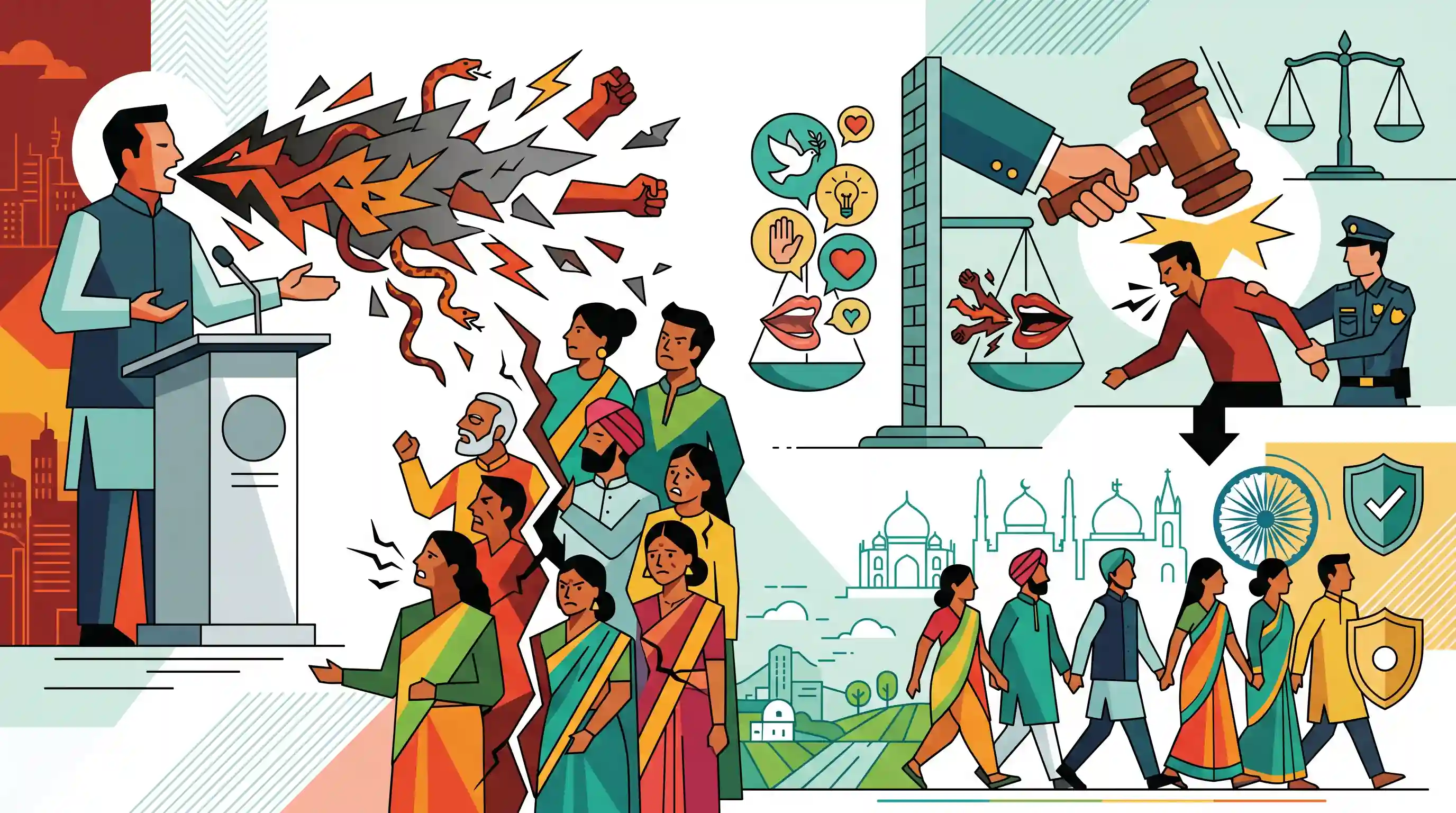
Tavleen Singh's column emphasizes that the rising normalization of hate speech, especially by political figures for electoral gains, poses a grave threat to India's social fabric and democratic ethos. The article argues that such rhetoric must not go unpunished, highlighting the distinction between free speech and hate speech. It calls for strict, impartial enforcement of laws and accountability to curb communal polarization and protect the constitutional principles of secularism and harmony.
Key Points
- Unchecked hate speech normalizes communal divisions and violence, severely threatening India's social harmony and secular fabric.
- Freedom of speech and expression (Article 19) is not absolute; it is subject to reasonable restrictions and does not provide a shield for hate speech.
- There is an urgent need for impartial and stringent enforcement of existing laws by the judiciary and the Election Commission to deter inflammatory rhetoric.
- Political leaders and public figures who weaponize hate speech for electoral mobilization must be held accountable to preserve democratic integrity.
Important Terms
Article 19 of the Constitution of India

Guarantees all citizens the right to freedom of speech and expression (19(1)(a)). It is not absolute and is subject to state-imposed 'reasonable restrictions' to maintain social order.
UPSC context
GS Paper II: Fundamental Rights. Essential for understanding the balance between civil liberties and state-imposed limitations on speech.
Hate Speech
Expression that incites hatred or violence against groups based on religion, caste, or identity. Though not statutorily defined in India, it is regulated under penal provisions and judicial guidelines.
UPSC context
GS Paper II: Polity/Governance. Tests knowledge of legal frameworks and the Supreme Court's 'suo motu' FIR directives to curb communal tension.
Reasonable Restrictions
Constitutional grounds under Article 19(2) allowing the State to limit free speech in the interest of public order, decency, morality, and sovereignty, among others.
UPSC context
GS Paper II: Fundamental Rights. Crucial for analyzing the constitutional validity of laws that criminalize or restrict specific forms of expression.
Model Code of Conduct (MCC)
A set of guidelines issued by the Election Commission of India to regulate political parties and candidates during elections, specifically prohibiting appeals to communal or religious sentiments.
UPSC context
GS Paper II: Elections/RPA. Tests understanding of the ECI's powers to ensure free and fair elections and prevent communal polarization.
Section 153A (IPC) / Section 196 (BNS)
A penal provision criminalizing acts that promote enmity between different groups on grounds of religion, race, or language. Under the new Bharatiya Nyaya Sanhita, this is Section 196.
UPSC context
GS Paper II: Criminal Justice System. Relevant for questions on legal accountability for communal violence and hate-mongering.
Secularism
The constitutional principle of 'Sarva Dharma Sama Bhava' (equal respect for all religions) and 'Dharmanirapaksata' (neutrality), considered a part of the Basic Structure of the Constitution.
UPSC context
GS Paper I (Society) & GS Paper II (Polity). Fundamental for evaluating threats to India’s pluralistic fabric and social harmony.
Election Commission of India (ECI)
The autonomous constitutional authority under Article 324 responsible for the superintendence, direction, and control of elections, including the enforcement of ethical campaigning standards.
UPSC context
GS Paper II: Constitutional Bodies. Focuses on the commission's role in penalizing political figures for inflammatory electoral rhetoric.
Prelims Trap
The term 'hate speech' is explicitly defined under the Representation of the People Act and Bharatiya Nyaya Sanhita.
Indian central laws do not formally define "hate speech." Instead, acts constituting hate speech are penalized under dispersed provisions regarding promoting enmity or electoral corrupt practices.
Static Concepts Connected
What are the reasonable restrictions on Freedom of Speech under Article 19(2)?
- State Security & Order: Restrictions apply to protect the sovereignty and integrity of India, security of the State, and public order.
- Decency & Morality: Speech can be restricted in the interests of decency, morality, or in relation to contempt of court.
- Foreign Relations & Offenses: Includes protecting friendly relations with foreign states, preventing defamation, and preventing incitement to an offense.
How does the Representation of the People Act, 1951 tackle electoral hate speech?
- Corrupt Practices: Sections 123(3) and 123(3A) classify appealing to religion, race, caste, or community, and promoting enmity as a "corrupt practice."
- Electoral Disqualification: Candidates found guilty of such corrupt practices by the High Court can be disqualified from contesting elections for up to six years.
Cross-Topic Patterns
BNS and Fundamental Rights overlap
The shift from IPC to BNS (Sec 196, Sec 299) penalizing enmity brings renewed focus to the constitutional limits of free speech under Article 19(2).
SC guidelines on Mob Violence
The Supreme Court's Tehseen Poonawalla judgment directly links the prevention of hate speech to internal security, mandating district nodal officers to prevent mob lynching.
MCC vs Statutory RPA powers
The ECI's enforcement mechanisms frequently highlight the gap between the non-statutory Model Code of Conduct and legally binding consequences under RPA Section 123.

Expect a 2026 multi-statement question merging Article 19(2) restrictions, RPA corrupt practices, and BNS provisions on enmity.
Linked PYQs · 4
Linked PYQs · 4
- 2014MainsGS2
What do you understand by the concept "freedom of speech and expression"? Does it cover hate speech also ? Why do the films in India stand on a slightly different plane from other forms of expression ? Discuss.
- 2024MainsGS3
Social media and encrypting messaging services pose a serious security challenge. What measures have been adopted at various levels to address the security implications of social media? Also suggest any other remedies to address the problem.
- 2016MainsGS3
Use of Internet and social media by non-state actors for subversive activities is a major security concern. How have these been misused in the recent past? Suggest effective guidelines to curb the above threat.
- 2022MainsGS1
Are tolerance, assimilation and pluralism the key elements in the making of an Indian form of secularism? Justify your answer.
