Urban Governance and Public Fund Utilization in India
Source:Indian Express ↗
Why It Matters
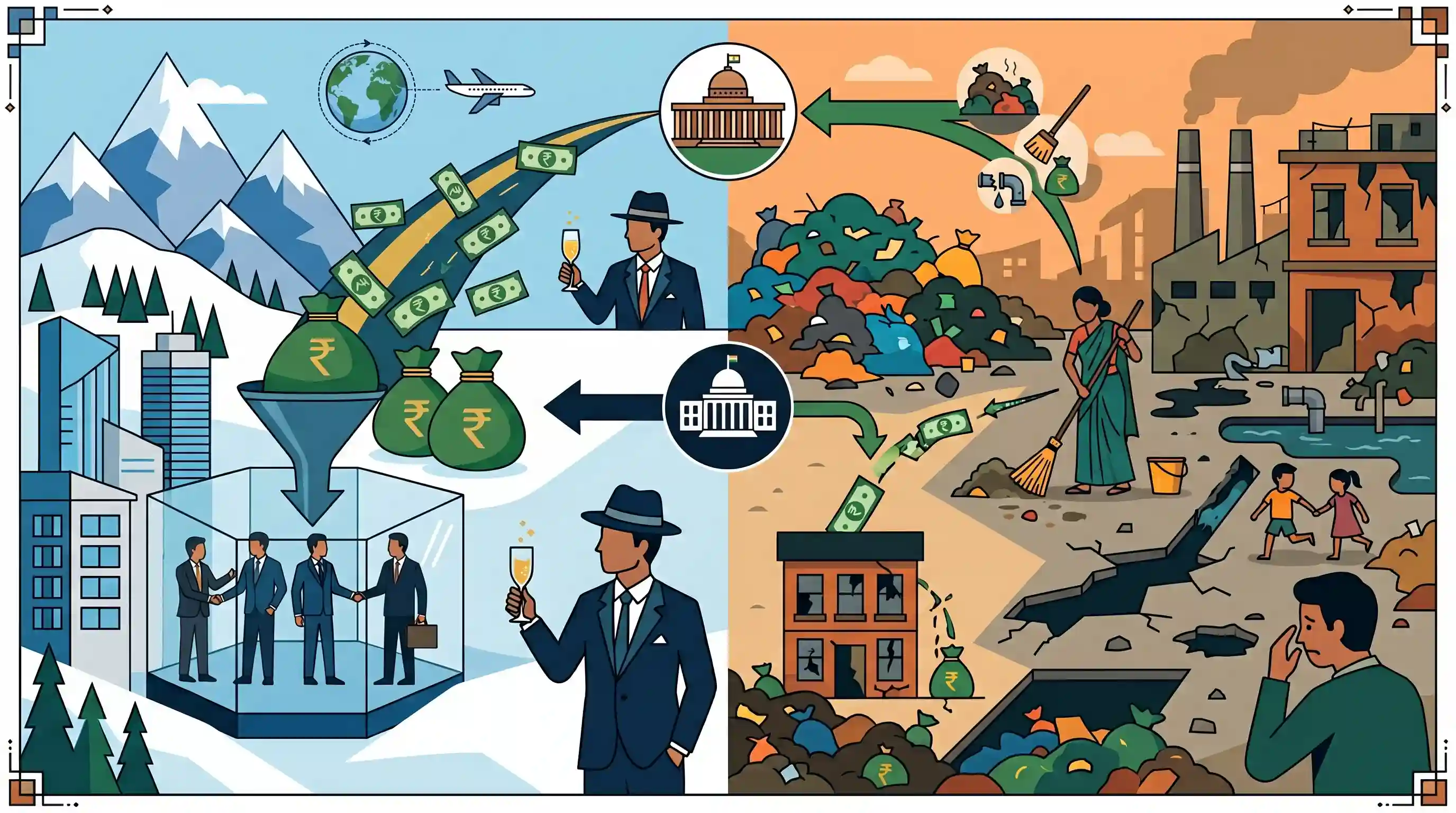
It draws a sharp contrast between elite international networking by public officials and the stark reality of poor urban sanitation at home, raising vital questions about ethical resource allocation, governance accountability, and the need to empower urban local bodies.
Summary
The article criticizes the participation of Indian politicians and bureaucrats in the World Economic Forum (WEF) at Davos, labeling it a wasteful expenditure of taxpayer money. The author contrasts the luxurious accommodations and elite networking of these officials in Switzerland with the deteriorating state of Indian cities, which are often plagued by poor sanitation, garbage dumps, and inadequate infrastructure. It argues that the funds squandered on such foreign trips would be far better spent on empowering urban local bodies and genuinely improving the quality of urban life, particularly through meaningful city clean-up and sanitation initiatives. The piece underscores a critical gap in governance accountability and highlights the misallocation of public resources.
Key Points
- The participation of Indian politicians and bureaucrats in the World Economic Forum (WEF) at Davos is criticized as a wasteful expenditure of taxpayer money.
- The author highlights a stark contrast between the pristine environment of Davos and the poor sanitation, garbage dumps, and inadequate infrastructure in Indian cities.
- Funds spent on elite foreign networking events could be better redirected toward improving urban sanitation and solid waste management.
- The article underscores the need for better financial accountability and functional empowerment of urban local bodies to address the deteriorating quality of urban life.
- The criticism reflects broader issues of 'VIP culture' and misaligned priorities in public administration.
Important Terms
World Economic Forum (WEF)

International non-profit based in Switzerland; promotes public-private cooperation via its annual Davos meeting to address global economic, social, and environmental challenges through elite networking.
UPSC context
GS Paper II (International Institutions) and GS Paper III (Economy); tests the role of global forums in shaping national policy and paradiplomacy.
Swachh Bharat Mission-Urban (SBM-U)
Flagship national campaign launched in 2014 to achieve 100% open-defecation-free status and scientific solid waste management across all urban statutory towns.
UPSC context
GS Paper II (Government Policies) and GS Paper III (Environment); tests the effectiveness of flagship schemes in solving public health crises.
Smart Cities Mission
Centrally sponsored urban renewal program using 'smart solutions' like ICT and sustainable infrastructure to improve quality of life across 100 selected Indian cities.
UPSC context
GS Paper III (Infrastructure/Economy); evaluates technology-led urban planning strategies and their implementation challenges in the Indian context.
Urban Local Bodies (ULBs)
Small-unit local government institutions, such as Municipal Corporations, constitutionalized via the 74th Amendment to provide essential civic services and manage local urban development.
UPSC context
GS Paper II (Polity/Governance); tests knowledge of local self-government, financial devolution, and administrative accountability in service delivery.
Solid Waste Management (SWM)
The systematic process of collecting, segregating, and treating municipal refuse; a critical pillar of Swachh Bharat Mission 2.0 and sustainable urban governance.
UPSC context
GS Paper III (Environment/Infrastructure); focuses on technical and administrative solutions to urban pollution and the 'waste-to-wealth' model.
Prelims Trap
The World Economic Forum is an intergovernmental organization or a specialized agency of the United Nations.
Aspirants often confuse WEF with UN or Bretton Woods institutions. The WEF is actually an international non-governmental organization (NGO) headquartered in Geneva.
Static Concepts Connected
How are Urban Local Bodies functionally and financially empowered under the 74th Amendment?
- 12th Schedule: Adds 18 functional items (including public health, sanitation, and solid waste management) to the municipal purview for localized civic governance.
- State Finance Commission: Article 243-Y mandates the Governor to constitute a commission to review municipal financial positions and recommend tax/toll/duty devolution.
- Ward Committees: Article 243-S requires the constitution of Wards Committees for cities with populations exceeding three lakhs to decentralize grassroots planning.
What are the core mandates for local authorities under the Solid Waste Management Rules 2016?
- Source Segregation: Waste generators are mandated to segregate waste into biodegradable, non-biodegradable, and domestic hazardous wastes before handing it to collectors.
- User Fees & Fines: Empowers local bodies to frame bye-laws to charge user fees for waste collection and levy spot fines for littering.
- EPR Integration: Introduces Extended Producer Responsibility (EPR) for packaging waste, requiring manufacturers to integrate with local authorities for waste recovery.
Cross-Topic Patterns
Public expenditure ethics vs. Local Governance
The ethical dilemma of misallocating taxpayer funds for luxury foreign trips (Davos) while fundamental civic duties (sanitation under 12th Schedule) remain unfunded highlights the gap in administrative accountability.
ULB functional gaps and Urban Flooding
Poor solid waste management directly exacerbates urban flooding by clogging municipal drains, linking the implementation gaps of the 74th Amendment to broader disaster management and urban resilience challenges.

Expect a 2026 Prelims statement mixing SWM Rules 2016 mandates with the financial devolution mechanisms of Urban Local Bodies.
Linked PYQs · 4
Linked PYQs · 4
- 2023MainsGS2
“The states in India seem reluctant to empower urban local bodies both functionally as well as financially.” Comment.
- 2016MainsGS1
With a brief background of quality of urban life in India, introduce the objectives and strategy of the 'Smart City Programme'.
- 2019PrelimsGS1
The Global Competitiveness Report is published by the
- 2019MainsGS4
"Non-performance of duty by a public servant is a form of corruption". Do you agree with this view? Justify your answer.
