Critique of AI Ambitions Amid Neglected Rural Education Infrastructure
Source:Indian Express ↗
Why It Matters
Offers a critical, balanced perspective against excessive techno-optimism. It is essential for writing nuanced answers in GS2 (Social Justice, Education), GS3 (Science and Tech realities), and Essays comparing technological advancement with foundational socio-economic development.
Summary
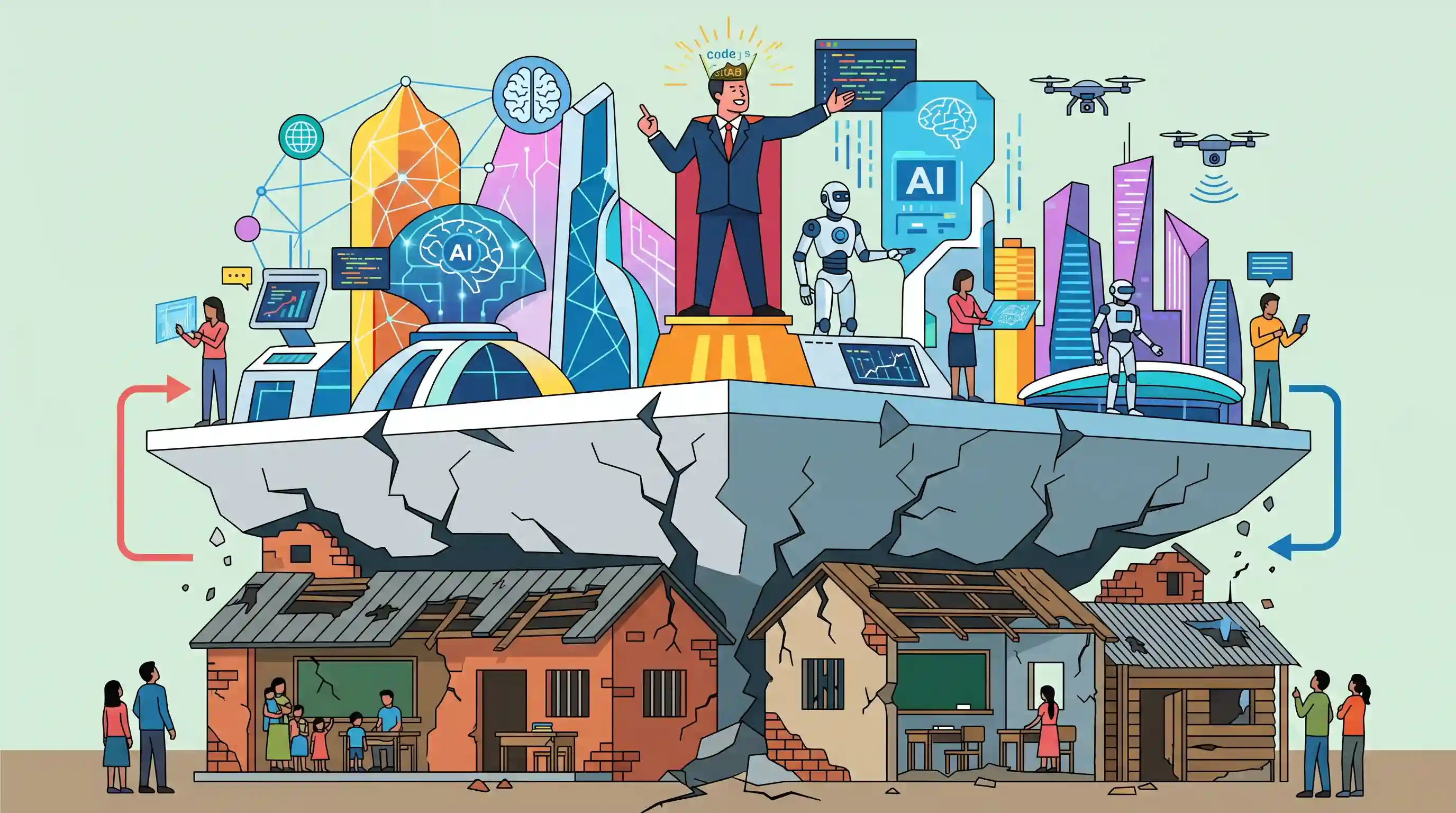
The article critiques the hype surrounding India's technological achievements, particularly in Artificial Intelligence, by contrasting it with the dismal state of foundational infrastructure like rural primary schools. The author argues that taking pride in top-tier tech successes amounts to 'hubris' if the country continues to neglect basic human capital formation. Relying on digital leapfrogging without fixing structural issues in education and social welfare creates a deceptive narrative of progress that leaves the most vulnerable behind.
Key Points
- Highlights the stark contrast between India's grand ambitions in Artificial Intelligence and the grim ground realities of rural infrastructure.
- Warns against governmental 'hubris' and the danger of believing technological rhetoric while basic services, such as primary education, remain chronically neglected.
- Uses the imagery of a 'leaking village school' to expose the fundamental gaps in human capital formation that advanced technology alone cannot fix.
- Argues that sustainable socio-economic development requires addressing foundational grassroots issues rather than relying entirely on digital leapfrogging.
Important Terms
Human Capital Formation

The process of increasing the skills, knowledge, and health of a population through investment in education and training to boost economic productivity and development.
UPSC context
GS Paper 3 (Economy); Paper 2 (Social Justice). Tests understanding of demographic dividend and social infrastructure.
Digital Divide
The gap between individuals and regions with access to modern information technology (internet, devices, literacy) and those without, often divided by geography, gender, or class.
UPSC context
GS Paper 2 (Governance); Paper 3 (S&T). Tests ability to analyze inclusive growth and service delivery barriers.
Artificial Intelligence in Governance
Strategic use of machine learning and data analytics in public administration to enhance service delivery, decision-making, and transparency in government operations.
UPSC context
GS Paper 3 (S&T); Paper 2 (E-Governance). Focuses on ethical adoption and technological intervention in public policy.
Digital India
A flagship government program launched in 2015 to transform India into a digitally empowered society and knowledge economy through infrastructure, digital literacy, and e-governance.
UPSC context
GS Paper 2 (Government Policies); Paper 3 (Economy/S&T). Tests knowledge of transformative public policy frameworks.
Digital Leapfrogging
The phenomenon where developing nations skip intermediate stages of development—like landlines—to adopt advanced technologies like mobile broadband and digital payments directly.
UPSC context
GS Paper 3 (Economy/Infrastructure). Tests conceptual understanding of non-linear developmental paths in emerging markets.
Technological Hubris
Overconfidence in technology's ability to solve complex social or structural problems without addressing the underlying human or institutional failures.
UPSC context
GS Paper 4 (Ethics); Paper 2 (Governance). Useful for critiques of techno-centrism in development and administration.
Prelims Trap
"Digital leapfrogging automatically bridges socio-economic disparities by bypassing traditional infrastructure stages."
Technology is an enabler, not a substitute. Without foundational human capital (health, basic literacy), advanced tech like AI worsens inequality rather than bridging it.
Static Concepts Connected
What are the core components of Human Capital Formation?
- Education & Health: Investments in basic education, skill development, and preventive/curative medicine to increase overall workforce productivity.
- On-the-job Training: Enhancing the specific technical skills of workers to help them adapt to evolving technological paradigms, such as AI.
- Migration & Information: Expenditure on migration to find better jobs and on acquiring information about labor markets and educational institutions.
What is the 'Digital Divide' in the context of Indian governance?
- Access Gap: The stark disparity in physical access to IT infrastructure, reliable internet bandwidth, and smart devices between urban and rural areas.
- Literacy Gap: The lack of skills required to meaningfully use digital platforms, which severely limits the inclusive efficacy of top-down e-governance initiatives.
Cross-Topic Patterns
AI threat to Demographic Dividend
India's youth bulge risks becoming a demographic disaster if AI automates entry-level jobs before rural populations attain necessary foundational and digital literacy.
E-Governance vs. Welfare Exclusion
Over-reliance on technology (e.g., mandatory biometric authentication for PDS) often creates exclusion errors, proving that high-tech solutions cannot replace grassroots institutional capacity.

Mains GS-3 will likely test 'digital leapfrogging' vs human capital: asking if AI exacerbates the digital divide without basic education.
Linked PYQs · 4
Linked PYQs · 4
- 2021MainsGS2
Has digital illiteracy, particularly in rural areas, coupled with lack of Information and Communication Technology (ICT) accessibility hindered socio-economic development? Examine with justification.
- 2023MainsGS3
Introduce the concept of Artificial Intelligence (AI). How does Al help clinical diagnosis? Do you perceive any threat to privacy of the individual in the use of Al in healthcare?
- 2025MainsGS2
e-governance projects have a built-in bias towards technology and back-end integration than user-centric designs. Examine.
- 2015MainsEssay
Technology cannot replace manpower.
