Delayed Implementation of Women Reservation and Political Optics
Source:Indian Express ↗
Why It Matters
The Nari Shakti Vandan Adhiniyam (106th Amendment) is a landmark development in Indian polity. Understanding the criticisms surrounding its delayed implementation (linked to census and delimitation) is crucial for answering Mains questions on women's political representation and the law-making process in Parliament.
Summary
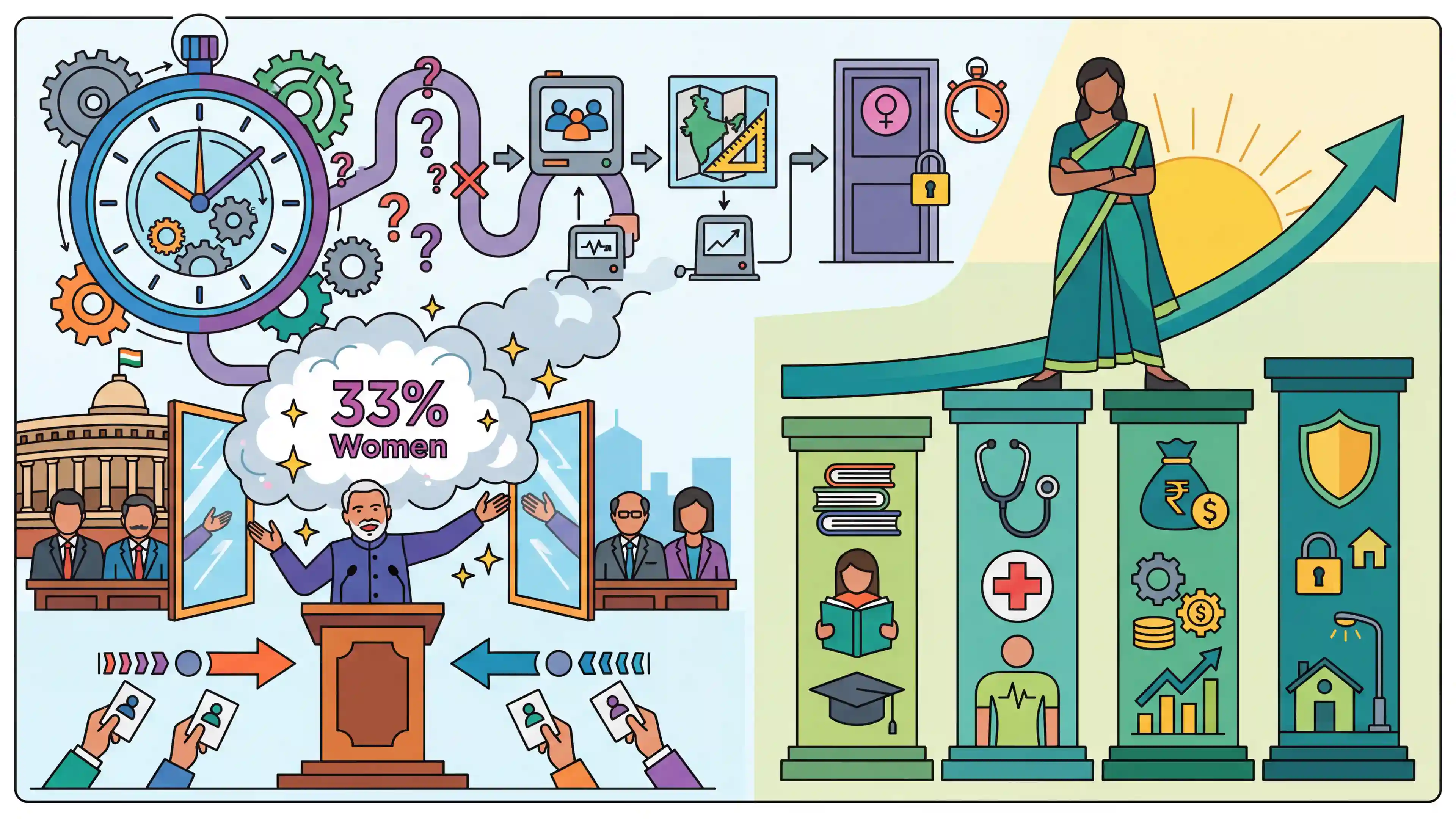
The article critically examines the passage of the Women's Reservation Bill (Nari Shakti Vandan Adhiniyam) in Parliament, characterizing it as a political 'charade' and an exercise in 'smoke and mirrors'. The author highlights that because the 33% reservation for women is contingent upon a future census and a subsequent delimitation process, its actual implementation is delayed indefinitely. Consequently, the bill is viewed more as a tool for political optics and electoral posturing than a genuine attempt at immediate political inclusion. The piece asserts that substantive women's empowerment cannot be achieved through token legislative quotas alone; it demands urgent action on foundational issues such as female literacy, health, economic independence, and safety.
Key Points
- The passage of the Women's Reservation Bill (Nari Shakti Vandan Adhiniyam) guarantees 33% reservation for women in the Lok Sabha and State Legislative Assemblies, but its delayed timeline faces criticism.
- Linking the implementation of the reservation to a future census and the subsequent delimitation exercise means the quotas will not take effect immediately, which the author describes as a political 'charade'.
- The article argues that the legislative move acts as 'smoke and mirrors' for political optics ahead of elections, rather than enacting an immediate change in political representation.
- True empowerment of women in India requires structural interventions focusing on fundamental issues like female education, economic independence, workforce participation, and safety, rather than mere legislative tokenism.
Important Terms
Nari Shakti Vandan Adhiniyam

The official name of the 2023 legislation reserving 33% of seats for women in the Lok Sabha, State Legislative Assemblies, and the Delhi Legislative Assembly to enhance political participation.
UPSC context
GS Paper II (Polity/Governance); tests knowledge of significant legislative reforms and women's political empowerment.
106th Constitutional Amendment Act
The law that amended the Constitution to provide women's reservation in directly elected legislatures, including SC/ST sub-quotas, with a 15-year sunset clause.
UPSC context
GS Paper II (Polity); tests knowledge of constitutional amendments and legislative processes.
Article 334A
A constitutional provision inserted by the 106th Amendment, stipulating that women's reservation will only commence after a delimitation exercise following the first census published after 2023.
UPSC context
GS Paper II (Polity); central to debates regarding the delayed implementation and procedural hurdles of the reservation.
Delimitation Commission
A statutory body (Articles 82/170) tasked with redrawing boundaries of territorial constituencies based on recent census data to ensure the principle of equal representation.
UPSC context
GS Paper II (Polity/Elections); relevant to the redrawing of electoral maps and its impact on federal balance.
33% Women's Reservation
The mandated quota for women in the Lok Sabha and State Assemblies, applied to total seats and horizontally within existing SC/ST reserved seats.
UPSC context
GS Paper I/II; focuses on gender parity, social justice, and political empowerment.
Census of India
The decennial population count; under the 106th Amendment, its publication is a mandatory prerequisite before the 33% quota can be legally operationalized.
UPSC context
GS Paper II/III; highlights how administrative data collection dictates the timing of political rights.
131st Constitutional Amendment Bill
A proposed bill defeated in 2026 that sought to expedite women's reservation by delinking it from the next census or using 2011 census data for delimitation.
UPSC context
GS Paper II (Polity); illustrates current political deadlocks and the complexities of constitutional amendment procedures.
Prelims Trap
The 106th Constitutional Amendment Act provides 33% reservation for women in both Houses of Parliament and State Legislatures.
The 106th CAA strictly applies to the Lok Sabha, State Legislative Assemblies, and the Delhi Assembly. It does NOT provide reservations in the Rajya Sabha or State Legislative Councils.
Static Concepts Connected
What are the key constitutional provisions of the 106th Amendment Act?
- Seat Reservation: Inserted Articles 330A and 332A to reserve 1/3rd of seats for women in Lok Sabha and State Assemblies, respectively.
- SC/ST Sub-quota: Mandates a sub-quota for women within existing SC and ST reserved constituencies, but explicitly lacks a separate quota for OBC women.
- Sunset Clause: The reservation is subject to a 15-year sunset clause from commencement, extendable only by a parliamentary law.
How is the Delimitation exercise procedurally frozen in India?
- 84th Amendment (2001): Froze the total number of Lok Sabha and State Assembly seats until the publication of the first Census taken after the year 2026.
- 87th Amendment (2003): Mandated the territorial readjustment of constituencies (without altering total seat counts) based on the 2001 Census figures, rather than 1991.
- Article 82: Article 82 requires Parliament to enact a Delimitation Act after every census to readjust allocation of seats and territorial boundaries.
Cross-Topic Patterns
Delimitation vs. Southern States' Representation
Post-2026 delimitation risks penalizing southern states for successful population control, making the women's reservation rollout a major flashpoint for federal friction and North-South political representation.
Political Quotas vs. Structural Parity
Mains GS1/GS2 frequently contrast legislative quotas with structural empowerment metrics like the declining Female Labour Force Participation Rate (LFPR), STEM representation, and the gender wage gap.

Expect a 2026 Prelims multi-statement question on the 106th CAA testing Rajya Sabha exclusion, the 15-year sunset clause, & OBC exclusion.
Linked PYQs · 3
Linked PYQs · 3
- 2024PrelimsGS1
Consider the following statements regarding 'Nari Shakti Vandan Adhiniyam' : 1. Provisions will come into effect from the 18th Lok Sabha. 2. This will be in force for 15 years after becoming an Act. 3. There are provisions for the reservation of seats for Scheduled Castes Women within the quota reserved for the Scheduled Castes. Which of the statements given above are correct?
- 2023MainsGS2
Discuss the contribution of civil society groups for women's effective and meaningful participation and representation in state legislatures in India.
- 2024MainsGS1
Distinguish between gender equality, gender equity and women's empowerment. Why is it important to take gender concerns into account in programme design and implementation?
