Tata Power commissions solar and battery storage plant in Bikaner
Source:the-tribune ↗
Why It Matters
Rajasthan is India's leading state for solar energy capacity. The evolution from basic solar parks to Firm and Dispatchable Renewable Energy (FDRE) systems with Battery Energy Storage Systems (BESS) represents a critical technological leap. Understanding these infrastructural upgrades—and their location in key hubs like Bikaner—is essential for RPSC RAS Prelims, especially in topics related to Rajasthan's economic geography, renewable energy targets, and initiatives like the Green Energy Corridor.
Summary
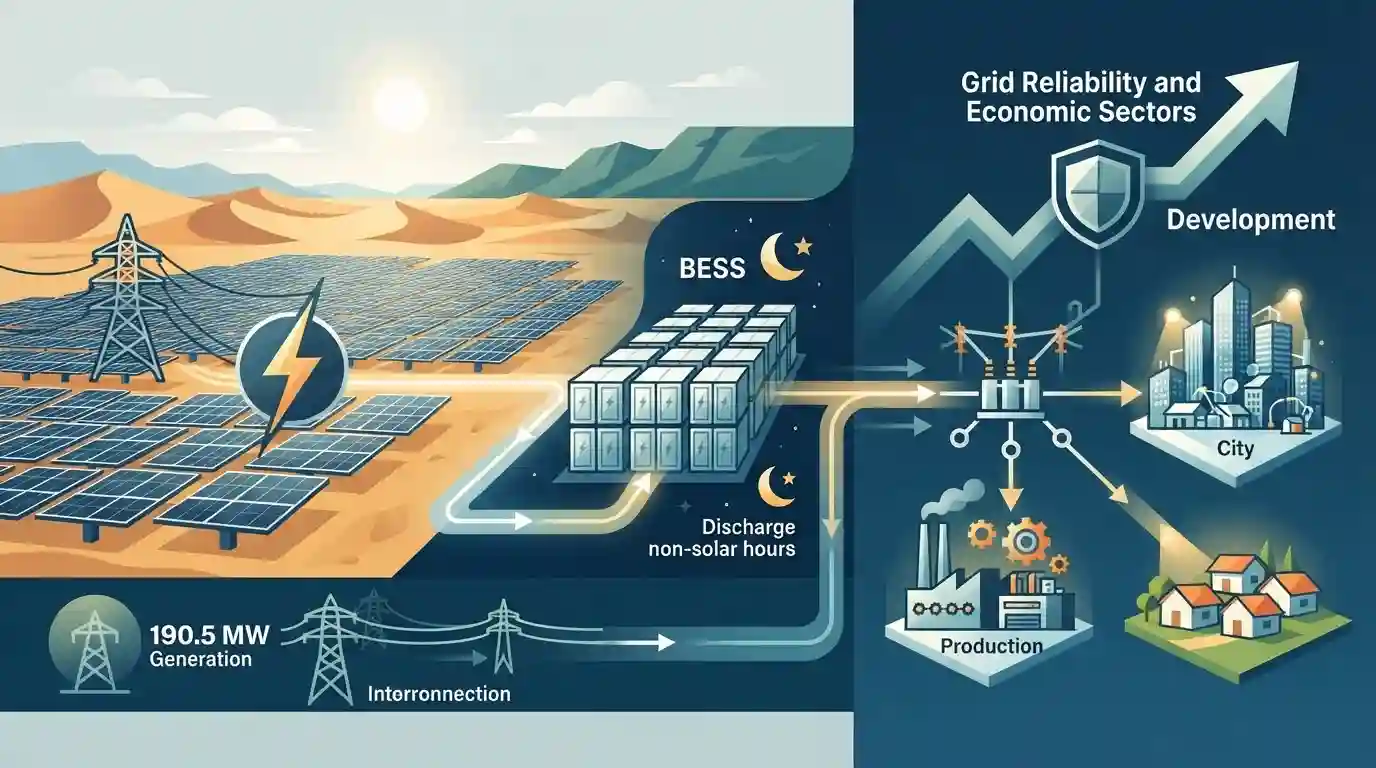
Tata Power Renewable Energy Limited (TPREL) has successfully commissioned a 190.5 MW solar project coupled with a 115 MWh Battery Energy Storage System (BESS) in Bikaner, Rajasthan. Developed under SJVN's Firm and Dispatchable Renewable Energy (FDRE) Tranche-1, the project is a significant advancement in renewable energy infrastructure. The integration of large-scale battery storage enables the plant to supply consistent electricity even during non-solar hours, directly addressing the intermittency issues associated with renewable generation and bolstering grid stability.
Key Points
- Tata Power Renewable Energy Limited (TPREL) has commissioned a 190.5 MW solar project in Bikaner, Rajasthan.
- The facility is integrated with a 115 MWh Battery Energy Storage System (BESS), forming a Firm and Dispatchable Renewable Energy (FDRE) project.
- This project was executed under SJVN's FDRE Tranche-1 auction.
- The large-scale battery storage is crucial for mitigating solar energy intermittency, allowing power supply during peak demand or non-solar hours to ensure grid reliability.
- Advanced technological features include a Harmonic Filter Bank and Static Var Generator systems to maintain high power quality.
Important Terms
Firm and Dispatchable Renewable Energy (FDRE)

A clean energy model combining renewable generation (like solar and wind) with energy storage. It ensures a stable, on-demand power supply to the grid, resolving the intermittency issues of traditional renewables.
UPSC context
Crucial for RAS GS Paper 3 (Economy). Tests knowledge of grid stability and Rajasthan's emerging renewable energy procurement models.
Battery Energy Storage System (BESS)
An advanced energy storage technology that captures surplus electricity—such as solar power generated during the day—and discharges it during peak demand or non-generation hours to maintain grid stability.
UPSC context
Relevant for RAS GS Paper 2 (Technology) and Paper 3. Tests understanding of how Rajasthan integrates massive solar capacities reliably.
SJVN Limited
A Navratna Central Public Sector Enterprise under the Ministry of Power. It acts as a nodal agency for renewable energy auctions and develops major hydro, solar, and wind infrastructure.
UPSC context
Important for RAS GS Paper 3 (Economy & PSUs). SJVN facilitates large-scale solar projects and investments in Rajasthan like Bikaner.
Tata Power Renewable Energy Limited (TPREL)
A subsidiary of Tata Power dedicated to green energy. It develops and operates utility-scale solar, wind, and hybrid projects, contributing heavily to India's clean energy targets and infrastructure.
UPSC context
Relevant for RAS GS Paper 3. Highlights private sector contributions to Rajasthan's renewable infrastructure and regional economic development.
Prelims Trap
The Kalasar FDRE project provides 100% standalone off-grid Round-the-Clock (RTC) solar power.
FDRE ensures reliable power supply during peak/non-solar hours using battery storage, but it remains a grid-integrated system, not a completely standalone 24x7 off-grid solution.
Static Concepts Connected
What are the key components of Rajasthan's solar energy infrastructure?
- Bhadla Solar Park: Located in Jodhpur, it is the world's largest solar park with a capacity of 2,245 MW, showcasing Rajasthan's mega-scale potential.
- Policy Target 2019: The Rajasthan Solar Energy Policy 2019 targets 30 GW of solar power by 2024-25, prioritizing Renewable Energy Zones (REZs) like Bikaner and Jaisalmer.
- Green Energy Corridor: Intra-state and inter-state transmission networks designed to evacuate large-scale renewable power from western Rajasthan to high-demand centers without grid instability.
Why is Battery Energy Storage System (BESS) critical for renewable grids?
- Intermittency Mitigation: BESS stores excess solar/wind energy generated during peak hours and releases it during non-generation periods, solving the issue of intermittent supply.
- Grid Stability: It helps in frequency regulation and voltage support, ensuring the grid does not trip due to sudden surges or drops in power generation.
- Peak Shaving: By supplying stored power during evening peak demand hours, BESS reduces the reliance on fossil-fuel-based peaker plants.
Cross-Topic Patterns
BESS integration + Green Energy Corridor
Intra-state transmission systems under the Green Energy Corridor (GEC) are being upgraded to evacuate power from Bikaner/Jaisalmer, making BESS crucial to prevent grid tripping during peak generation.
Battery storage + Critical Mineral Exploration
Scaling grid-level battery storage directly links to recent GSI explorations for lithium and rare earth elements in Rajasthan (e.g., Degana, Nagaur) to secure domestic BESS supply chains.

Expect multi-statement questions combining Rajasthan's solar capacity targets, BESS technology (FDRE model), and Bikaner's REZ status.
Linked PYQs · 3
Linked PYQs · 3
- 2021RPSC_PRELIMSGS1
'Green Energy Corridor' – Through which of the following districts will it pass in Rajasthan?
- 2023RPSC_PRELIMSGS1
Which agency has been given the responsibility of implementing the PM-KUSUM scheme (Component A) in Rajasthan, which involves the establishment of solar power plants with a capacity of 0.5 MW to 2 MW?
- 2024RPSC_PRELIMSGS1
In the question given below, two statements are followed by two arguments (I) and (II). Consider the statement to be true. Decide which of the arguments is STRONG. Statement: Should every home use renewable energy to reduce the need of electricity from the grid? Arguments: (I) Yes, it will conserve our natural resources and promote environmental compatibility. (II) No, all the home owners cannot afford it.
