Tata Power commissions captive solar energy project in Bikaner
Source:renewable-watch ↗
Why It Matters
This development underscores the transition of Rajasthan's Bikaner region into a critical solar power hub for both grid-scale and industrial captive projects. It highlights corporate-led decarbonisation strategies (e.g., Tata Steel's captive solar procurement) and showcases advancements in domestic solar module manufacturing and firm, dispatchable renewable energy (FDRE) configurations.
Summary
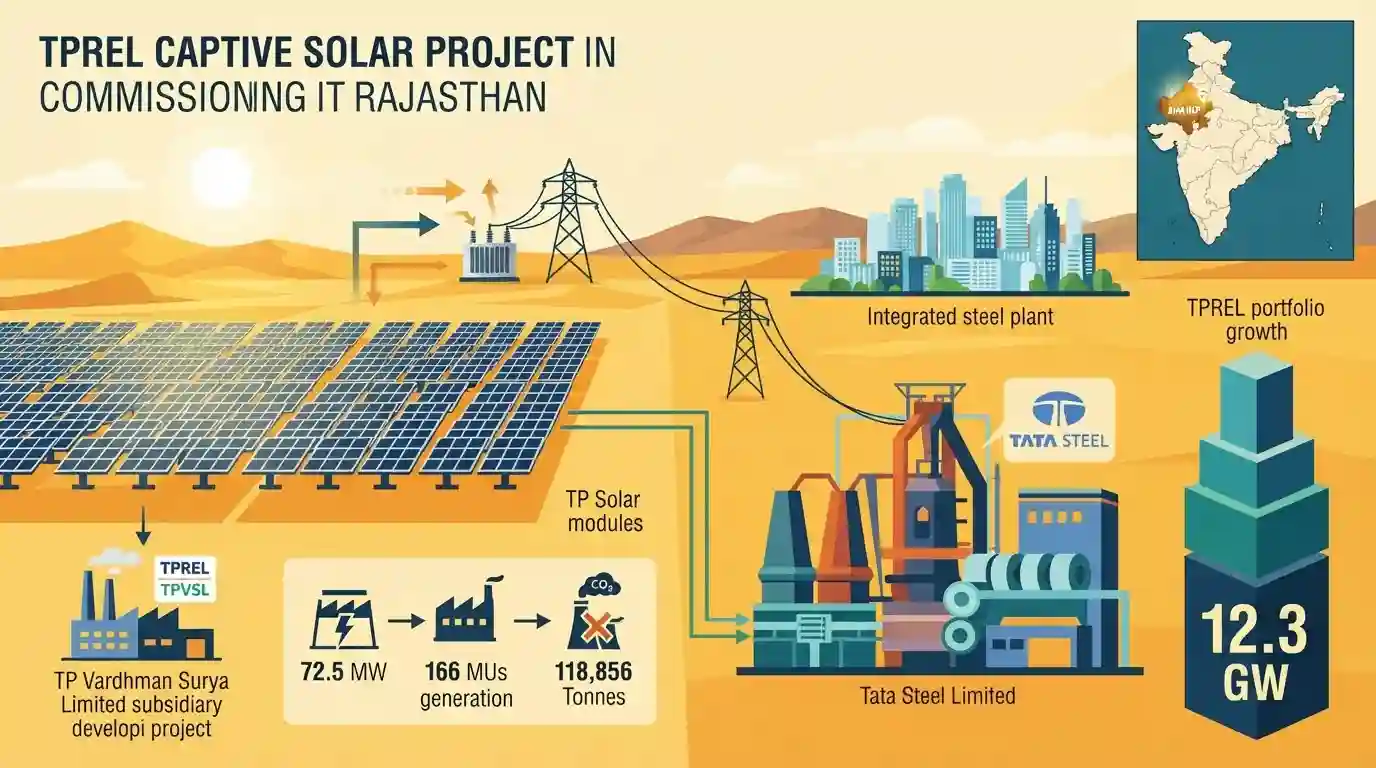
Tata Power Renewable Energy Limited (TPREL) has commissioned a 72.5 MW captive solar energy project at Kalasar in Bikaner, Rajasthan, to supply green power to Tata Steel Limited. Developed by TPREL subsidiary TP Vardhman Surya Limited using in-house manufactured TP Solar modules, the project will generate 166 MUs of electricity annually and offset around 118,856 tonnes of carbon emissions. The commissioning highlights Bikaner's rapid development as a renewable energy hub, adding to TPREL's growing portfolio of 12.3 GW of renewable assets.
Key Points
- Tata Power Renewable Energy Limited (TPREL) commissioned a 72.5 MW captive solar power project at Kalasar in Bikaner, Rajasthan, for Tata Steel Limited.
- The project was developed via TPREL's subsidiary, TP Vardhman Surya Limited, and is estimated to generate 166 Million Units (MUs) of clean energy annually.
- It is expected to reduce carbon dioxide emissions by approximately 118,856 tonnes every year.
- The plant utilizes 171,360 solar modules manufactured in-house by TP Solar Limited.
- This project pushes TPREL's total renewable capacity to 12.3 GW, with 7 GW operational (5.7 GW solar, 1.3 GW wind) and 5.3 GW under progress.
- Earlier in August 2026, TPREL also commissioned a 190.5 MW solar Firm and Dispatchable Renewable Energy (FDRE) project at the same location (Kalasar, Bikaner) under SJVN's FDRE Tranche-1.
Important Terms
SJVN Limited

A Navratna Central Public Sector Undertaking under the Ministry of Power, operating as a joint venture between the Indian Government and Himachal Pradesh to develop hydro, wind, solar, and transmission assets countrywide.
UPSC context
RPSC GS Paper-I (Economy); tests public sector undertakings, national-level clean energy programs, and central power intermediaries.
SJVN FDRE Tranche-1
A major contractual scheme by SJVN Limited for Firm and Dispatchable Renewable Energy, ensuring reliable round-the-clock supply by combining solar-wind hybrid generation with advanced battery energy storage systems.
UPSC context
RPSC GS Paper-I (Economy of Rajasthan); tests energy storage systems, hybrid tariffs, and dispatchable power grid solutions.
Tata Power Renewable Energy Limited (TPREL)
A leading developer and subsidiary of Tata Power managing utility-scale renewable portfolios (solar, wind, and hybrid) across India, playing a critical role in Rajasthan's expansion as a clean energy hub.
UPSC context
RPSC GS Paper-I (Rajasthan Economy); tests clean energy infrastructure, state investment, and utility-scale solar generation.
TP Vardhman Surya Limited
A special purpose vehicle (SPV) co-owned by TPREL and Tata Steel, established to implement and operate group-captive renewable power projects to drive corporate and industrial decarbonization.
UPSC context
RPSC GS Paper-I (Economy); tests special-purpose vehicles, corporate open access, and group captive infrastructure.
TP Solar Limited
The domestic manufacturing arm of Tata Power engaged in producing high-capacity solar cells and modules, supporting the localisation of India's renewable technology supply chain.
UPSC context
RPSC GS Paper-I (Economy); tests domestic manufacturing, "Make in India" targets, and solar technology infrastructure.
Tata Steel Limited
One of India's largest steel manufacturing companies, driving industrial decarbonisation as the sole commercial offtaker of green power from the Kalasar captive solar project in Bikaner.
UPSC context
RPSC GS Paper-I (Industrial Economy); tests industrial sustainable development and corporate transition to clean energy.
Prelims Trap
The Kalasar project is a state-utility solar park developed to supply grid electricity to Rajasthan state discoms.
Aspirants often confuse private 'captive' solar setups developed for specific industrial giants with public solar parks (like Bhadla) meant for state utility/discom grid distribution.
Static Concepts Connected
What are key provisions of Rajasthan's Solar Energy Policy 2019?
- Target Capacity: Aims to achieve a target of 30 GW (30,000 MW) solar power capacity in the state by FY 2024-25.
- Captive Use: Promotes captive solar plants by offering exemptions on electricity duty and facilitating third-party open access.
- Land Concessions: Simplifies land allocation of government wasteland at concessional rates, driving projects in districts like Bikaner and Jaisalmer.
What is Firm and Dispatchable Renewable Energy (FDRE)?
- Grid Stability: Combines solar or wind power with energy storage systems to deliver stable, non-intermittent renewable power.
- Demand Matching: Mimics conventional power generation, allowing distribution companies to meet peak demand hours reliably without grid fluctuations.
Cross-Topic Patterns
Captive RE + Industrial Decarbonisation
Captive solar projects in Rajasthan's wastelands enable heavy industries like steel to meet mandatory Renewable Purchase Obligations (RPO) and decarbonise energy-intensive manufacturing.
Western Wastelands + Green Transmission
Solar expansion into Bikaner highlights the geography of desert wasteland utilization coupled with the Phase-II Green Energy Corridor for interstate power evacuation.

RPSC may target Bikaner's emerging solar hubs and captive power exemptions in multi-statement questions on Rajasthan's energy sector.
Linked PYQs · 3
Linked PYQs · 3
- 2021RPSC_PRELIMSGS1
In which year was the Rajasthan Solar Energy Policy announced?
- 2012RPSC_PRELIMSGS1
Where will the first solar park (solar park) be set up in Rajasthan?
- 2023RPSC_PRELIMSGS1
Which agency has been given the responsibility of implementing the PM-KUSUM scheme (Component A) in Rajasthan, which involves the establishment of solar power plants with a capacity of 0.5 MW to 2 MW?
