Tata Power commissions renewable energy project in Bikaner
Source:renewablewatch ↗
Why It Matters
It demonstrates Rajasthan's continuing emergence as a key hub for utility-scale solar projects. The use of FDRE and Battery Energy Storage Systems (BESS) is crucial for addressing the intermittent nature of solar power, a critical topic in modern energy infrastructure discussions.
Summary
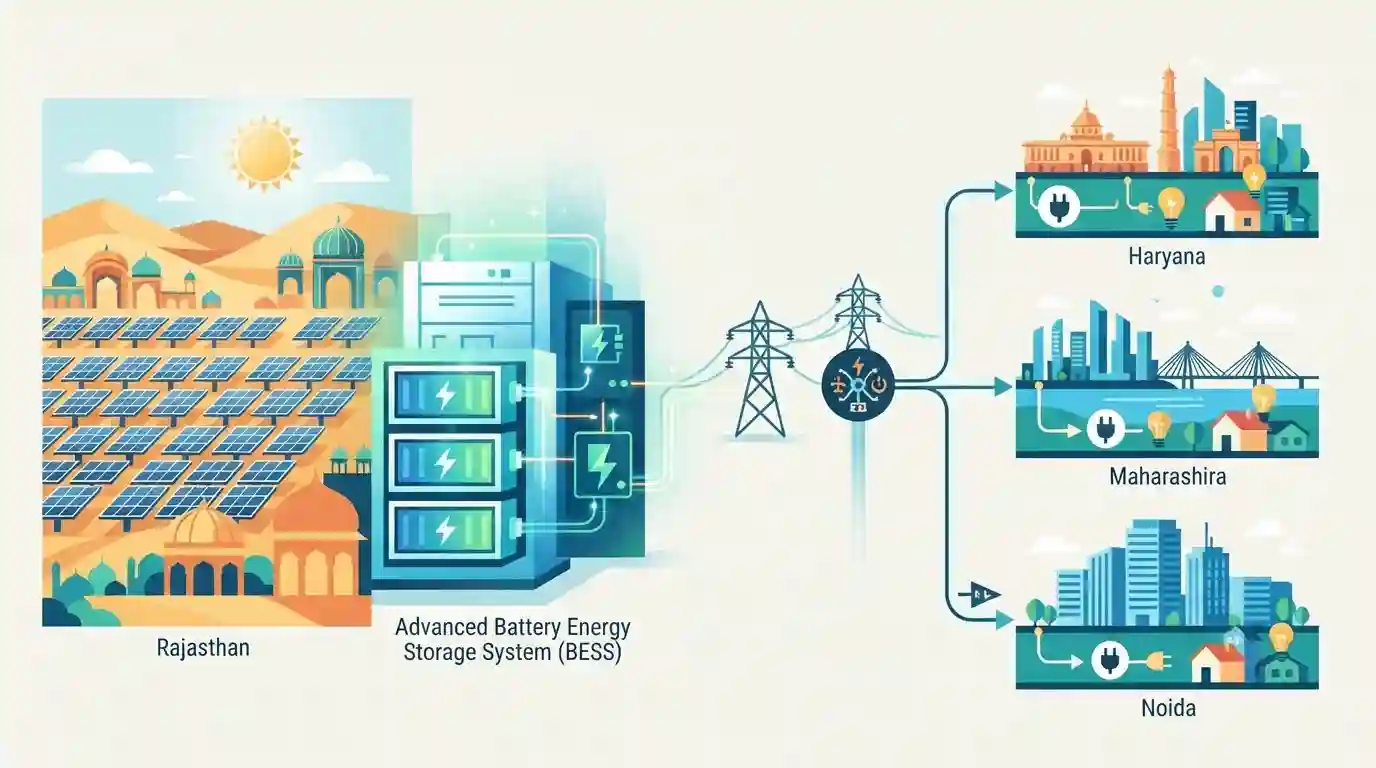
Tata Power Renewable Energy Limited has successfully commissioned a 190.5 MW solar firm and dispatchable renewable energy (FDRE) project in Bikaner, Rajasthan. Featuring advanced battery energy storage systems, the facility will provide stable renewable power to distribution companies in Haryana, Maharashtra, and Noida.
Key Points
- Tata Power Renewable Energy Limited (TPREL) commissioned a 190.5 MW solar firm and dispatchable renewable energy (FDRE) project in Kalasar, Bikaner, Rajasthan.
- The project falls under the SJVN FDRE Tranche-1 and is part of a larger 460 MW capacity commitment.
- The facility integrates advanced technologies like a Battery Energy Storage System (BESS), harmonic filter banks, and static var generator systems for grid stability and continuous power supply.
- Generated power will be supplied to DISCOMs in Haryana, Maharashtra, and Noida, addressing their renewable purchase obligations (RPO).
- With this commissioning, TPREL’s total renewable utility capacity reaches roughly 12.4 GW.
Important Terms
Tata Power Renewable Energy Limited (TPREL)

A green energy subsidiary of Tata Power. It recently commissioned a 190.5 MW solar Firm and Dispatchable Renewable Energy project in Bikaner, Rajasthan, integrating advanced battery storage to supply stable electricity.
UPSC context
RPSC GS Paper 1 (Rajasthan Economy) & GS Paper 3. Highlights private investments and advanced solar-storage infrastructure in Bikaner.
SJVN FDRE Tranche-1 Scheme
A framework administered by SJVN Limited that contracts developers to build Firm and Dispatchable Renewable Energy (FDRE) projects. These combine solar or wind generation with advanced battery storage to guarantee round-the-clock, stable power.
UPSC context
RPSC GS Paper 2 & 3. Tests knowledge of renewable energy schemes, energy storage frameworks, and grid stability mechanisms.
SJVN Limited
An Indian public sector energy company acting as the nodal agency for the FDRE Tranche-1 scheme. It facilitates large-scale solar-plus-storage projects across states like Rajasthan to provide firm, schedulable renewable power.
UPSC context
RPSC GS Paper 3 (Energy). Tests awareness of central public sector undertakings driving the transition to dispatchable renewable energy.
Maharashtra State Electricity Distribution Company Limited (MSEDCL)
Maharashtra's state-owned power distribution utility. It is one of the contracted discoms purchasing stable, dispatchable green electricity generated by Tata Power’s newly commissioned 190.5 MW solar-plus-storage FDRE plant in Bikaner.
UPSC context
RPSC GS Paper 3 (Energy). Tests understanding of inter-state power purchase agreements and how utilities fulfill renewable purchase obligations.
Haryana Power Purchase Centre (HPPC)
The nodal agency responsible for procuring electricity for Haryana’s distribution companies. It will receive dispatchable green power from the 190.5 MW Tata Power solar-storage project located in Bikaner, Rajasthan.
UPSC context
RPSC GS Paper 3 (Energy). Highlights Rajasthan's emerging role as a green energy exporter through inter-state power procurement bodies.
Prelims Trap
"Power generated by the Kalasar FDRE project is exclusively consumed by Rajasthan DISCOMs."
Aspirants often assume Rajasthan-based energy projects exclusively serve the state. However, power from this Bikaner project is exported to Haryana, Maharashtra, and Noida to meet their Renewable Purchase Obligations.
Static Concepts Connected
What are Renewable Purchase Obligations (RPO) and their statutory basis?
- Statutory backing: Mandated under the Electricity Act, 2003, obligating distribution companies and large consumers to purchase a minimum percentage of their electricity from renewable sources.
- Tradability: Shortfalls in physical procurement can be legally met by purchasing Renewable Energy Certificates (RECs) traded on national power exchanges.
How does Firm and Dispatchable Renewable Energy (FDRE) differ from standard solar plants?
- Intermittency solved: FDRE integrates generation with energy storage systems (like BESS) to provide round-the-clock, continuous power, unlike standard solar which fluctuates with weather and daylight.
- Grid stability: FDRE utilizes advanced technologies like Static Var Generators and harmonic filters to control reactive power, ensuring dynamic voltage stability during grid transmission.
Cross-Topic Patterns
Solar Geography + Inter-state Power Trade
Bikaner and Jodhpur’s vast arid lands make Rajasthan India’s leading solar generator, effectively turning the state into a net exporter of green electricity to industrial states like Maharashtra.
Battery Storage + Critical Minerals
Large-scale BESS relies on lithium-ion technology, linking India's FDRE targets to import dependencies for critical minerals and domestic exploration efforts (e.g., lithium blocks in Nagaur).

Expect a statement-based question linking Rajasthan's solar capacity to inter-state RPO fulfillment and FDRE's role in grid stability.
Linked PYQs · 4
Linked PYQs · 4
- 2021RPSC_PRELIMSGS1
'Green Energy Corridor' – Through which of the following districts will it pass in Rajasthan?
- 2021RPSC_PRELIMSGS1
In which year was the Rajasthan Solar Energy Policy announced?
- 2023RPSC_PRELIMSGS1
Which agency has been given the responsibility of implementing the PM-KUSUM scheme (Component A) in Rajasthan, which involves the establishment of solar power plants with a capacity of 0.5 MW to 2 MW?
- 2016RPSC_PRELIMSGS1
The photovoltaic cell is related to
