Bangladesh parliamentary election results and regional geopolitics
Source:The Hindu ↗
Why It Matters
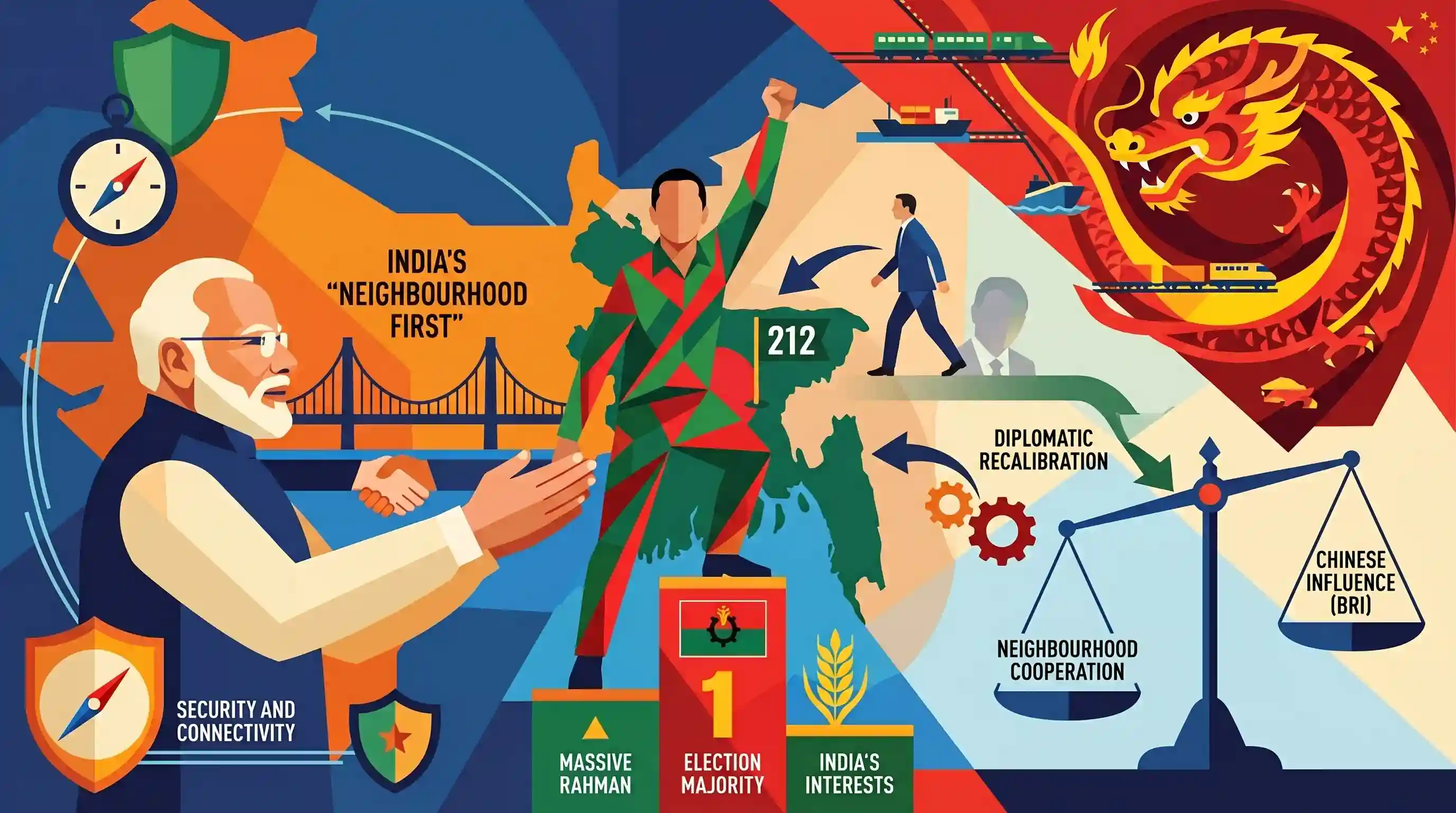
The political transition in Bangladesh from an Awami League to a BNP-led government fundamentally alters the geopolitical balance in South Asia. Given Bangladesh's strategic location, India must adapt its diplomatic engagement under the Neighbourhood First policy to secure its border, counter-terrorism, and connectivity interests, while navigating an increasingly assertive Chinese economic footprint via the BRI.
Summary
Tarique Rahman’s Bangladesh Nationalist Party (BNP) alliance won an absolute majority in Bangladesh's parliamentary elections, securing 212 seats and marking a historic political shift following the 2024 ouster of Sheikh Hasina. The victory paves the way for Rahman's return from exile and the end of Muhammad Yunus's interim government. The outcome drew immediate international attention, with India's PM Narendra Modi invoking the 'Neighbourhood First' policy to stress bilateral cooperation, while China emphasized its Belt and Road Initiative commitments. The shifting power dynamic in Dhaka will require careful diplomatic recalibration by New Delhi to balance China's growing influence and protect India's security and connectivity interests.
Key Points
- The Bangladesh Nationalist Party (BNP)-led alliance secured a sweeping victory in the parliamentary elections, winning 212 out of 300 seats and ending months of political uncertainty.
- The election follows the August 2024 mass student uprising that ousted the long-standing Sheikh Hasina-led Awami League government, leading to an interim administration led by Muhammad Yunus.
- The right-wing Jamaat-e-Islami-led 11-party alliance emerged as the second-largest bloc with 77 seats, cementing a major rightward shift in Bangladesh's political landscape.
- India\'s PM Narendra Modi congratulated Tarique Rahman, emphasizing India\'s \'Neighbourhood First\' policy and a desire to build a strong, mutually beneficial relationship.
- China also reaffirmed its comprehensive strategic cooperative partnership with Bangladesh, emphasizing ongoing collaboration under the Belt and Road Initiative (BRI).
Important Terms
Neighbourhood First policy

India's primary foreign policy framework since 2014, prioritizing diplomatic, economic, and connectivity engagement with immediate neighbors to ensure regional stability and prosperity.
UPSC context
GS Paper II (IR): Vital for questions on regional integration, 'connectivity' as a strategic tool, and balancing China's influence.
Bangladesh Nationalist Party (BNP)
A major center-right political party in Bangladesh, led by Tarique Rahman, which returned to power with an absolute majority in the 2026 elections after years of exile and political marginalization.
UPSC context
GS Paper II (IR): Testing India's 'Palace vs People' diplomacy and impact on security (insurgency, radicalization).
Belt and Road Initiative (BRI)
China's global infrastructure development strategy aimed at enhancing regional connectivity; in Bangladesh, it serves as a vehicle for Chinese strategic and economic penetration.
UPSC context
GS Paper II (IR): Central to 'String of Pearls' and India-China competition in South Asia.
Jamaat-e-Islami
Bangladesh's largest Islamist party, which emerged as the primary opposition in 2026; its rise raises concerns regarding religious extremism and regional security.
UPSC context
GS Paper II & III: Relevant to 'Internal Security' and the influence of radical actors on bilateral ties.
Awami League
The political party led by ousted PM Sheikh Hasina; traditionally India-friendly, it was barred from the 2026 elections following the 2024 mass uprising.
UPSC context
GS Paper II (IR): Analyzes the shift from India’s long-term reliance on a single leadership to broader engagement.
July National Charter
A 2026 referendum-approved reform package proposing constitutional changes, including PM term limits, bicameralism, and increased opposition powers to prevent authoritarianism.
UPSC context
GS Paper II: Impact of constitutional transitions in neighboring states on regional political stability.
National Citizen Party (NCP)
A new centrist party formed by 2024 student protest leaders (Gen Z), representing a shift toward youth-led politics and institutional reform.
UPSC context
GS Paper II: Understanding 'New Guard' actors in neighborhood diplomacy and their democratic aspirations.
Prelims Trap
"The 'Neighbourhood First' policy insists on strict reciprocity in trade and security agreements with bordering nations."
India’s neighborhood policies, drawing heavily from the Gujral Doctrine, operate on the principle of non-reciprocity—offering unilateral concessions to smaller neighbors to build trust.
Static Concepts Connected
What are the core pillars of India's 'Neighbourhood First' policy?
- Non-reciprocity: Derived from the Gujral Doctrine, India often provides asymmetric, unilateral concessions to smaller neighbors without demanding equal returns.
- Connectivity focus: Focus on regional integration through initiatives like the BBIN Motor Vehicle Agreement, energy grids, and cross-border rail links.
- Security cooperation: A mutual understanding that neighbors will not allow their sovereign territory to be used for activities inimical to India's security interests.
Which key transit projects connect India's Northeast through Bangladesh?
- Maitri Setu: A major bridge over the Feni river connecting Sabroom in Tripura directly to the Chittagong port in Bangladesh.
- PIWTT routes: The Protocol on Inland Water Transit and Trade allows Indian cargo vessels to use Bangladesh's river networks to reach Assam and Meghalaya.
- Akhaura-Agartala Rail: A strategic cross-border railway link establishing direct freight and passenger connectivity between Bangladesh and India's Tripura state.
Cross-Topic Patterns
Regime change and Northeast internal security
Regime changes in Dhaka directly impact India's GS-3 internal security matrix. Past right-wing administrations in Bangladesh have historically complicated India's counter-insurgency efforts, transit access, and border management in the Northeast.
BRI expansion vs Neighbourhood First policy
China's rapid reaffirmation of BRI commitments in Bangladesh highlights the geopolitical competition in the Bay of Bengal, contrasting India's 'Neighbourhood First' capacity-building approach with Beijing's heavy infrastructure footprint.

Expect a 2026 GS-2 question analyzing how domestic political transitions in neighboring countries challenge India's Neighbourhood First.
Linked PYQs · 4
Linked PYQs · 4
- 2024MainsGS2
Critically analyse India's evolving diplomatic, economic and strategic relations with the Central Asian Republics (CARs) highlighting their increasing significance in regional and global geopolitics.
- 2016MainsGS2
Evaluate the economic and strategic dimensions of India's Look East Policy in the context of the post Cold War international scenario.
- 2011MainsGS2
Compared to the South Asian Free Trade Area (SAFTA), the Bay of Bengal Initiative for Multisectoral Technical and Economic Cooperation Free Trade Area (BIMSTEC FTA) seems to be more promising." Critically evaluate.
- 2016MainsGS2
Increasing cross-border terrorist attacks in India and growing interference in the internal affairs of several member-states by Pakistan are not conducive for the future of SAARC (South Asian Association for Regional Cooperation)." Explain with suitable examples.
