Bangladesh Nationalist Party election victory and foreign policy
Source:The Hindu ↗
Why It Matters
Regime changes in neighboring countries directly impact India's foreign policy, border security, and regional standing. Understanding the historical context of the BNP and Awami League helps aspirants analyze shifts in Indo-Bangla relations, particularly concerning Northeast insurgency, transit corridors, and the broader China-India geopolitical competition in South Asia.
Summary
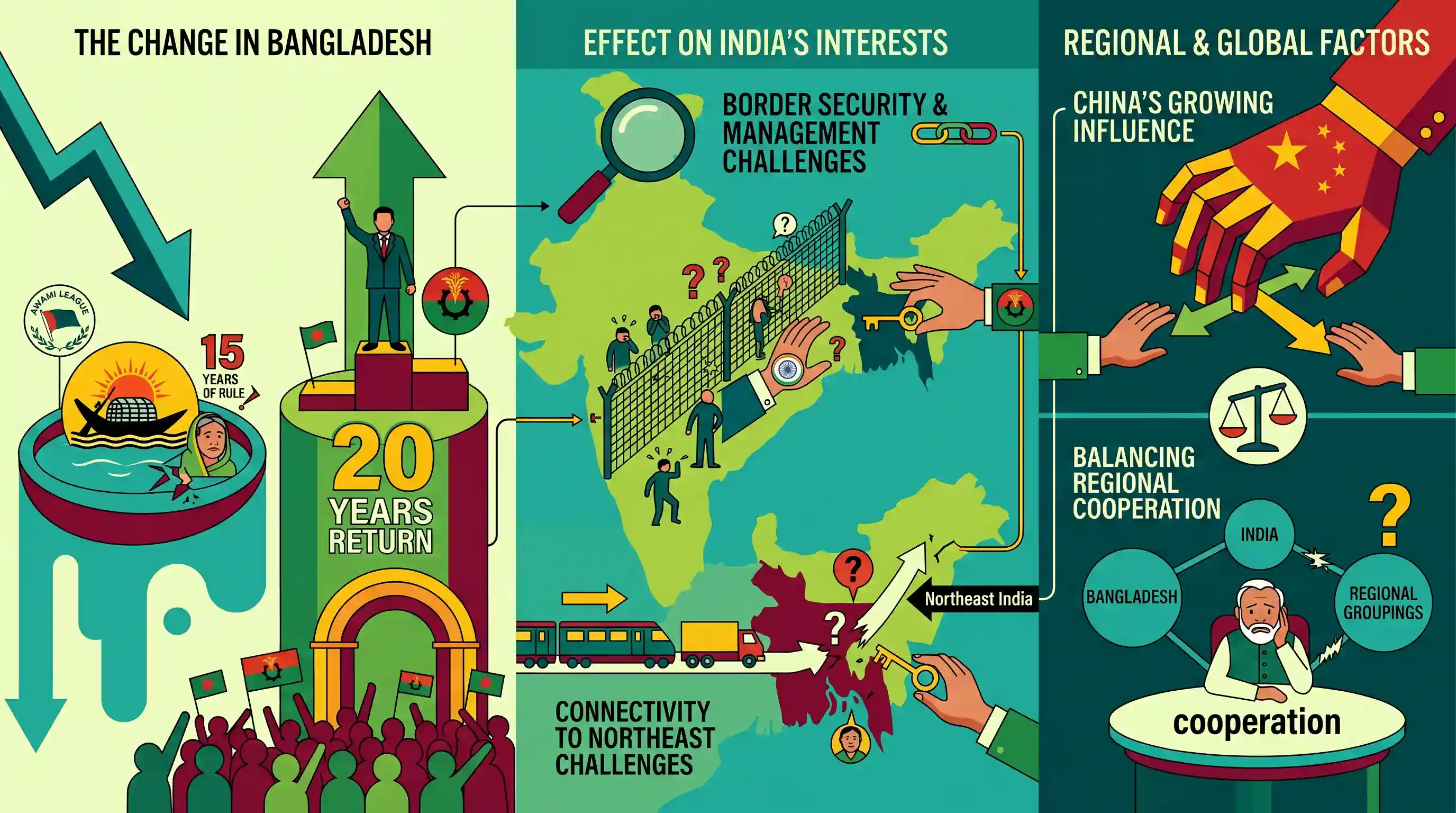
Tarique Rahman has successfully led the Bangladesh Nationalist Party (BNP) to a historic election victory, marking the party's return to power after 20 years. This regime change marks a crucial turning point for Bangladesh's domestic politics and the region's geopolitical landscape following the end of the Awami League's era. For India, the transition poses significant strategic challenges. New Delhi must now navigate a new diplomatic relationship with the BNP to safeguard its vital interests in border security, connectivity to the Northeast, and regional cooperation, while balancing the potential increase in influence of rival powers like China in South Asia.
Key Points
- Tarique Rahman, acting chairman of the Bangladesh Nationalist Party (BNP), has led his party to an election victory, returning the BNP to power after a hiatus of nearly 20 years.
- The electoral outcome signifies a major political shift in Bangladesh following the previous ouster of Sheikh Hasina's Awami League.
- For India, the BNP's return presents diplomatic challenges, as the Awami League historically demonstrated closer alignment with New Delhi's security and connectivity imperatives, whereas the BNP has traditionally maintained a more critical stance toward India.
- India will need to recalibrate its "Neighborhood First" policy to engage the new leadership in Dhaka, focusing on shared interests like border management, cross-border insurgency in the Northeast, and trade.
- The transition also carries geopolitical implications, as external powers like China may seek to expand their strategic and economic footprint in Bangladesh amid the regime change.
Important Terms
Bangladesh Nationalist Party (BNP)

A major center-right political party in Bangladesh advocating for "Bangladeshi nationalism" and sovereignty. Historically associated with a pivot toward China and strained security ties with India regarding Northeast insurgents.
UPSC context
GS Paper II (International Relations). Tests understanding of neighborhood politics and its direct impact on India's internal security and strategic interests.
Awami League
A center-left, secular political party that led Bangladesh's independence struggle. Under Sheikh Hasina, it maintained a "Golden Chapter" of relations with India, focusing on security cooperation and connectivity.
UPSC context
GS Paper II (Bilateral Relations). Relevant for analyzing shifts in regional stability and the evolution of India's "Neighborhood First" policy.
Tarique Rahman
Chairman of the BNP and Prime Minister-designate of Bangladesh as of 2026. After years in exile, his leadership marks a significant shift in Bangladesh’s domestic and pro-India foreign policy trajectory.
UPSC context
GS Paper II (International Relations). Important for assessing leadership-driven changes in bilateral diplomacy and potential security recalibrations in South Asia.
Neighborhood First Policy
India's foreign policy priority to manage relations with immediate neighbors. It emphasizes physical, digital, and economic connectivity while ensuring regional stability and "security and growth for all" (SAGAR).
UPSC context
GS Paper II (Foreign Policy). A core concept for evaluating India's diplomatic efficacy in maintaining influence within the South Asian subcontinent.
Act East Policy
A diplomatic initiative to promote economic, strategic, and cultural relations with the Asia-Pacific region. Bangladesh serves as a vital "bridge" for India to access Southeast Asian markets.
UPSC context
GS Paper II (International Relations). Tests the ability to link sub-regional cooperation (BIMSTEC, BBIN) with broader Indo-Pacific strategic goals.
Siliguri Corridor
A narrow stretch of land in West Bengal connecting mainland India to the Northeast. Connectivity through Bangladesh is strategically essential to reduce dependence on this vulnerable geographical bottleneck.
UPSC context
GS Paper III (Internal Security). Critical for discussing the "Chicken's Neck" vulnerability and the strategic necessity of transit rights through Bangladesh.
Prelims Trap
India’s engagement under the Neighbourhood First policy is conditional upon the host nation maintaining a pro-India stance.
India’s foreign policy is highly pragmatic. New Delhi engages with all de facto regimes (e.g., Myanmar junta, Taliban, or newly elected critical governments) to secure vital national and border interests.
Static Concepts Connected
How does Bangladesh's geography dictate India's internal security posture?
- Siliguri Corridor: The narrow 22-km 'Chicken's Neck' makes multi-modal transit rights through Bangladesh vital for securing continuous logistical and military access to the Northeast.
- Insurgent sanctuaries: Historically, porous borders and the Chittagong Hill Tracts provided strategic safe havens and training grounds for Northeast insurgent groups like ULFA and NDFB.
- Riverine borders: Complex, shifting riverine terrain complicates physical fencing, exacerbating transnational crimes like cattle smuggling, arms trafficking, and illegal migration.
What are the core principles driving India's 'Neighbourhood First' policy?
- Non-reciprocity: Drawing from the Gujral Doctrine, India aims to provide asymmetric, non-reciprocal benefits to its smaller neighbors in trade and connectivity.
- Security sensitivities: Mutual assurance that neither country's territory will be allowed to be used for activities inimical to the other's internal security.
- Seamless connectivity: Prioritizing physical and digital linkages (railways, inland waterways, energy grids) to integrate the South Asian regional economy.
Cross-Topic Patterns
Act East + North East Security
Multi-modal transit through Bangladesh directly impacts the economic integration of India's Northeast, fundamentally reducing the geographic isolation that fuels regional insurgencies.
String of Pearls + Maritime Security
A potential strategic tilt towards China could militarize dual-use facilities like Chittagong, directly challenging India's traditional maritime dominance and security architecture in the Bay of Bengal.

Expect a 2026 Mains question linking Dhaka's regime change to internal security challenges in India's Northeast and the Act East Policy.
Linked PYQs · 4
Linked PYQs · 4
- 2019MainsGS3
Cross-border movement of insurgents is only one of the several security challenges facing the policing of the border in North-East India. Examine the various challenges currently emanating across the India-Myanmar border. Also, discuss the steps to counter the challenges.
- 2016MainsGS3
Border management is a complex task due to difficult terrain and hostile relations with some countries. Elucidate the challenges and strategies for effective border management.
- 2016MainsGS2
Increasing cross-border terrorist attacks in India and growing interference in the internal affairs of several member-states by Pakistan are not conducive for the future of SAARC (South Asian Association for Regional Cooperation)." Explain with suitable examples.
- 2011MainsGS2
Compared to the South Asian Free Trade Area (SAFTA), the Bay of Bengal Initiative for Multisectoral Technical and Economic Cooperation Free Trade Area (BIMSTEC FTA) seems to be more promising." Critically evaluate.
