US Supreme Court strikes down unilateral executive tariffs under IEEPA
Source:The Hindu ↗
Why It Matters
Demonstrates how constitutional checks and balances within the US can curtail executive overreach, directly impacting global trade architectures and India's bilateral trade negotiations.
Summary
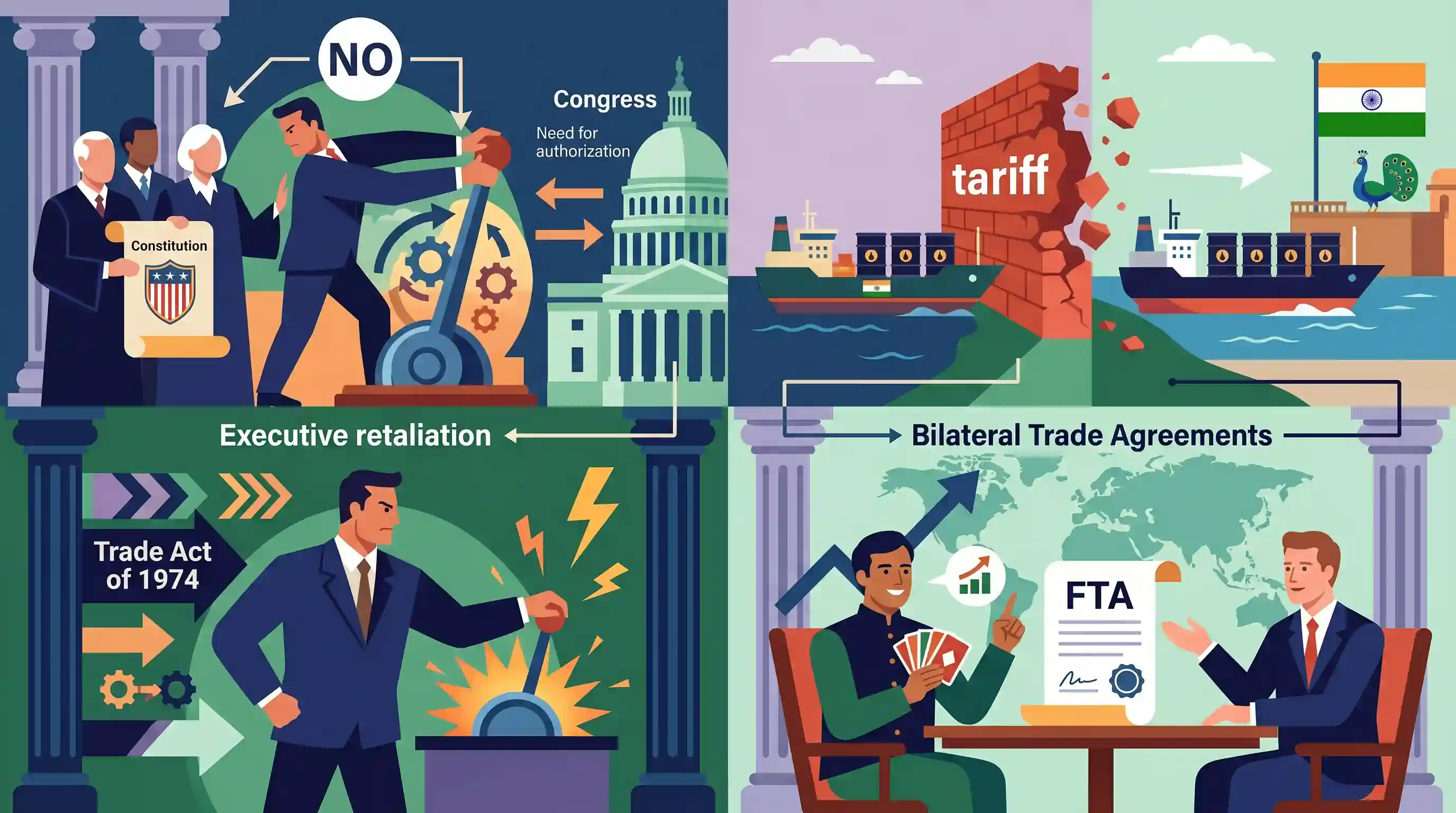
The U.S. Supreme Court struck down President Donald Trump's unilateral use of the International Emergency Economic Powers Act (IEEPA) to impose global tariffs, citing a lack of congressional authorization. While Trump retaliated by threatening alternative tariffs under the Trade Act of 1974, the ruling curtails executive overreach and reinforces democratic checks and balances. The decision alters bilateral trade dynamics, offering relief to countries like India—which previously faced 50% tariffs over Russian oil purchases—and potentially strengthening New Delhi's position in ongoing free trade agreement negotiations.
Key Points
- The US Supreme Court (SCOTUS) ruled 6-3 against President Donald Trump's unilateral imposition of tariffs under the International Emergency Economic Powers Act (IEEPA), citing the absence of congressional authorization.
- In response to the ruling, Trump threatened to impose a 15% global tariff rate under the Trade Act of 1974.
- The SCOTUS decision provides leverage to Indian negotiators in free trade agreement discussions by curbing Washington's punitive tariff capabilities, which had previously resulted in 50% tariffs on India over its purchase of Russian oil.
- The ruling is viewed as a significant reassertion of democratic checks and balances, halting the executive branch's overreach in domestic and international policy.
Important Terms
International Emergency Economic Powers Act (IEEPA)

A 1977 U.S. law granting the President authority to regulate international commerce and freeze assets during declared national emergencies involving external threats to national security, foreign policy, or the economy.
UPSC context
GS Paper II (Separation of Powers). Tests understanding of executive overreach and the limits of delegated authority in a presidential system.
Trade Act of 1974
U.S. legislation (notably Section 301) authorizing the government to investigate and retaliate unilaterally against foreign trade practices deemed unfair, unreasonable, or discriminatory to American commerce.
UPSC context
GS Paper II (India-US Relations). Relevant for analyzing unilateral trade measures and their impact on India’s exports and bilateral economic ties.
Trade Expansion Act of 1962
A law empowering the U.S. President (specifically Section 232) to impose trade barriers or tariffs on imports determined by the Department of Commerce to threaten national security.
UPSC context
GS Paper III (Economy). Tests knowledge of protectionist measures (Section 232) and their implications for global trade and Indian manufacturing.
Separation of Powers
A constitutional doctrine dividing government functions into legislative, executive, and judicial branches to provide checks and balances; applied more rigidly in the U.S. than in India.
UPSC context
GS Paper II (Comparison of Constitutions). Tests the ability to contrast the rigid U.S. model with India’s parliamentary fusion of powers.
U.S. Supreme Court
The highest federal court in the United States, possessing the power of judicial review to invalidate executive actions or laws that conflict with the U.S. Constitution.
UPSC context
GS Paper II (Comparative Constitution). Focuses on the role of the judiciary in maintaining democratic checks and balances across different constitutional models.
Protectionism
Economic policy of restricting imports through tariffs, quotas, or subsidies to shield domestic industries from foreign competition, often sparking trade wars.
UPSC context
GS Paper III (Indian Economy). Tests understanding of global trade barriers and their impact on India’s 'Make in India' initiative.
Prelims Trap
The US Constitution vests the power to levy tariffs and manage foreign commerce exclusively with the Executive branch.
False. The US Constitution explicitly vests taxing powers and the regulation of foreign commerce in Congress. The President only acts on delegated statutory authority.
Static Concepts Connected
How does the separation of trade/taxing powers compare between India and the US?
- US Congress: Holds explicit constitutional authority to levy taxes and regulate foreign commerce; presidential tariff power is strictly statutory and delegated.
- Indian Parliament: Enacts the Finance Bill and Customs Act, but delegates significant dynamic tariff adjustment powers (like sudden export duties) to the executive branch.
What are unilateral trade measures and how do they conflict with WTO rules?
- Unilateral action: Imposing retaliatory tariffs (like US Section 301) without WTO Dispute Settlement Body authorization violates the Most Favored Nation (MFN) principle.
- Bound rates: When a country arbitrarily hikes tariffs globally, it often breaches its committed 'bound tariff rates' negotiated under the GATT framework.
Cross-Topic Patterns
Executive limits and bilateral FTA leverage
Judicial checks on US executive power directly alter trade diplomacy. India can leverage this congressional bottleneck to secure more stable terms in ongoing FTA negotiations, shielded from arbitrary executive shocks.
Energy security vs. Trade retaliation
The 50% tariff threat over Russian oil purchases highlights the weaponization of domestic trade laws to enforce geopolitical alignment, linking India's strategic energy autonomy directly to export competitiveness.

2026 Mains may test comparative separation of powers (India vs US) regarding executive limits in economic and foreign trade policymaking.
Linked PYQs · 3
Linked PYQs · 3
- 2025MainsGS3
What are the challenges before the Indian economy when the world is moving away from free trade and multilateralism to protectionism and bilateralism? How can these challenges be met?
- 2018MainsGS3
How would the recent phenomena of protectionism and currency manipulations in world trade affect macroeconomic stability of India?
- 2020MainsGS2
Judicial Legislation is antithetical to the doctrine of separation of powers as envisaged in the Indian Constitution. In this context justify the filing of large number of public interest petitions praying for issuing guidelines to executive authorities.
