US Supreme Court Rules Against Unilateral Executive Tariffs
Source:The Hindu ↗
Why It Matters
The ruling provides an excellent case study of the separation of powers and judicial review in the US Constitution, while directly impacting India's macroeconomic stability, trade negotiations, and strategic autonomy in energy procurement amid rising global protectionism.
Summary
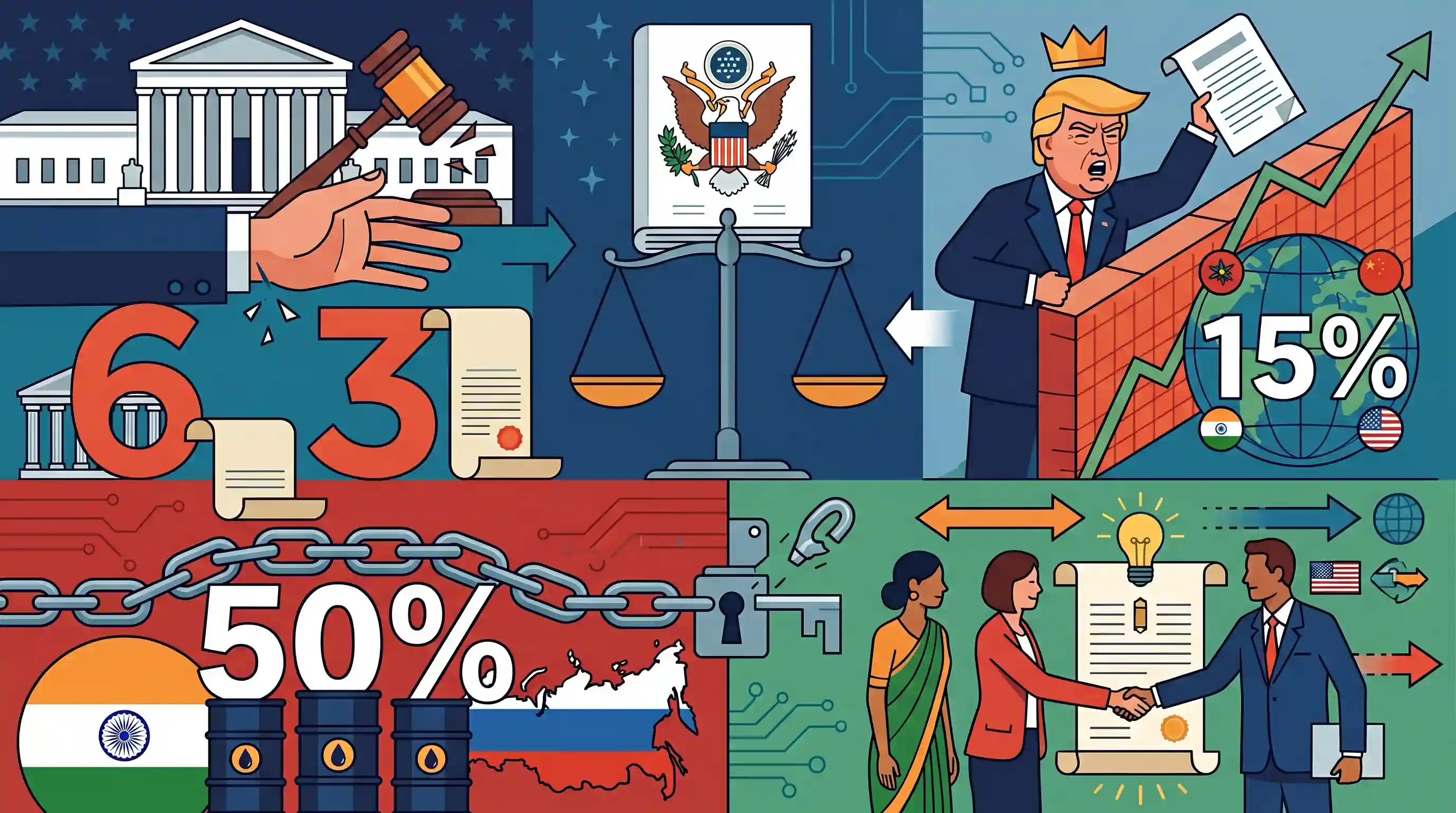
The U.S. Supreme Court has struck down President Donald Trump’s use of the International Emergency Economic Powers Act (IEEPA) to unilaterally impose sweeping tariffs, citing a lack of clear congressional authorization. In response to the 6-3 ruling, Trump indicated plans to raise global tariffs to 15% under the Trade Act of 1974. The court's decision curtails executive overreach and restores constitutional checks and balances. Crucially, it defangs some of Washington's punitive trade measures—such as the 50% tariffs previously imposed on India for purchasing Russian oil—potentially easing pressure on Indian negotiators seeking a Free Trade Agreement (FTA).
Key Points
- The U.S. Supreme Court ruled 6-3 that President Donald Trump's use of the International Emergency Economic Powers Act (IEEPA) to impose tariffs lacks congressional authorization and is unlawful.
- In response, Trump plans to invoke Section 122 of the Trade Act of 1974 to impose a 15% global tariff rate, while earlier tariffs on steel and aluminium under the Trade Expansion Act of 1962 remain unaffected.
- The U.S. had previously imposed 50% tariffs on India due to its purchase of Russian oil, severely complicating ongoing bilateral Free Trade Agreement (FTA) negotiations.
- The judicial ruling is viewed as a vital restoration of democratic checks and balances, curbing the executive's extraordinary claims to unilateral policymaking power.
Important Terms
International Emergency Economic Powers Act (IEEPA)

A 1977 U.S. law granting the President broad authority to regulate international commerce and freeze assets during a declared national emergency to address extraordinary foreign threats.
UPSC context
GS Paper 2 (International Relations); tests understanding of U.S. executive tools used for sanctions and trade wars affecting India.
Trade Act of 1974
U.S. legislation enabling the President to counter unfair trade practices (Section 301) or address balance-of-payment deficits (Section 122) through measures such as temporary global tariffs.
UPSC context
GS Paper 3 (Economy); relevant for studying global trade disputes, tariff mechanisms, and multilateral trade frameworks.
Trade Expansion Act of 1962
A law allowing U.S. tariffs on imports (via Section 232) if the Department of Commerce determines they threaten to impair national security, often used for industrial goods.
UPSC context
GS Paper 2/3; concerns India’s industrial exports and the use of 'national security' as a justification for protectionism.
Free Trade Agreement (FTA)
A formal pact between nations to reduce or eliminate trade barriers like tariffs and quotas, aimed at increasing cross-border trade and economic cooperation.
UPSC context
GS Paper 2 (Bilateral Agreements); central to India's strategic economic diplomacy with major trading partners like the U.S.
Separation of Powers
A constitutional doctrine dividing government functions into three branches—Legislative, Executive, and Judicial—to prevent the concentration of power and ensure mutual oversight.
UPSC context
GS Paper 2 (Polity); essential for comparing Indian and U.S. constitutional frameworks and limits on executive overreach.
Protectionism
Economic policy of shielding domestic industries from foreign competition through trade barriers like tariffs, quotas, or subsidies, often viewed as the opposite of free trade.
UPSC context
GS Paper 3 (International Trade); tests impacts of global inward-looking policies on India's 'Atmanirbhar Bharat' and export sectors.
Judicial Review
The power of the judiciary to review and invalidate laws or executive actions that are inconsistent with the constitution or exceed statutory authority.
UPSC context
GS Paper 2 (Judiciary); a core feature of the 'Basic Structure' doctrine in India and a check on executive power globally.
Prelims Trap
The US President lost all powers to unilaterally impose trade tariffs following the recent Supreme Court ruling.
False. The President can still invoke the Trade Act of 1974 (for balance-of-payments) or the Trade Expansion Act of 1962 (for national security) to impose targeted tariffs.
Static Concepts Connected
How does tariff-levying power differ between the US and Indian Constitutions?
- US Constitution: Article I vests the exclusive power to levy taxes and duties in Congress, strictly limiting the delegation of these powers to the President.
- Indian Constitution: While Article 265 mandates taxes require legislative authority, Parliament routinely delegates broad powers to the Executive to adjust tariff rates dynamically via the Customs Act.
What WTO exceptions allow countries to unilaterally impose or raise tariffs?
- National Security: GATT Article XXI allows members to breach WTO obligations and raise tariffs to protect essential security interests, a clause frequently invoked by the US.
- Balance of Payments: GATT Article XII permits members to restrict imports to safeguard their external financial position and address severe balance-of-payments deficits.
- Trade Remedies: WTO agreements allow specific, investigated unilateral actions like anti-dumping duties, countervailing duties, and safeguard measures against unfair trade practices.
Cross-Topic Patterns
Trade as a geopolitical weapon
Punitive tariffs linked to Russian oil purchases demonstrate how developed nations use domestic trade statutes to bypass multilateral WTO channels and enforce geopolitical compliance on developing nations.
Comparative Constitution: Separation of Powers
The invalidation of executive tariffs is a perfect comparative polity case study, highlighting the rigid US separation of powers versus India's parliamentary fusion where the executive frequently adjusts customs duties.

US-India trade barriers + GATT national security exceptions (Article XXI) + comparative separation of powers are ripe for 2026.
Linked PYQs · 5
Linked PYQs · 5
- 2020MainsGS2
Judicial Legislation is antithetical to the doctrine of separation of powers as envisaged in the Indian Constitution. In this context justify the filing of large number of public interest petitions praying for issuing guidelines to executive authorities.
- 2015MainsGS2
Resorting to ordinances has always raised concern on violation of the spirit of separation of powers doctrine. While noting the rationales justifying the power to promulgate ordinances, analyze whether the decisions of the Supreme Court on the issue have further facilitated resorting to this power. Should the power to promulgate ordinances be repealed?
- 2019MainsGS2
‘What introduces friction into the ties between India and the United States is that Washington is still unable to find for India a position in its global strategy, which would satisfy India's national self-esteem and ambitions.’ Explain with suitable examples.
- 2025MainsGS3
What are the challenges before the Indian economy when the world is moving away from free trade and multilateralism to protectionism and bilateralism? How can these challenges be met?
- 2018MainsGS3
How would the recent phenomena of protectionism and currency manipulations in world trade affect macroeconomic stability of India?
