Global Trade Upheaval and the Lasting Impact of Protectionism
Source:Indian Express ↗
Why It Matters
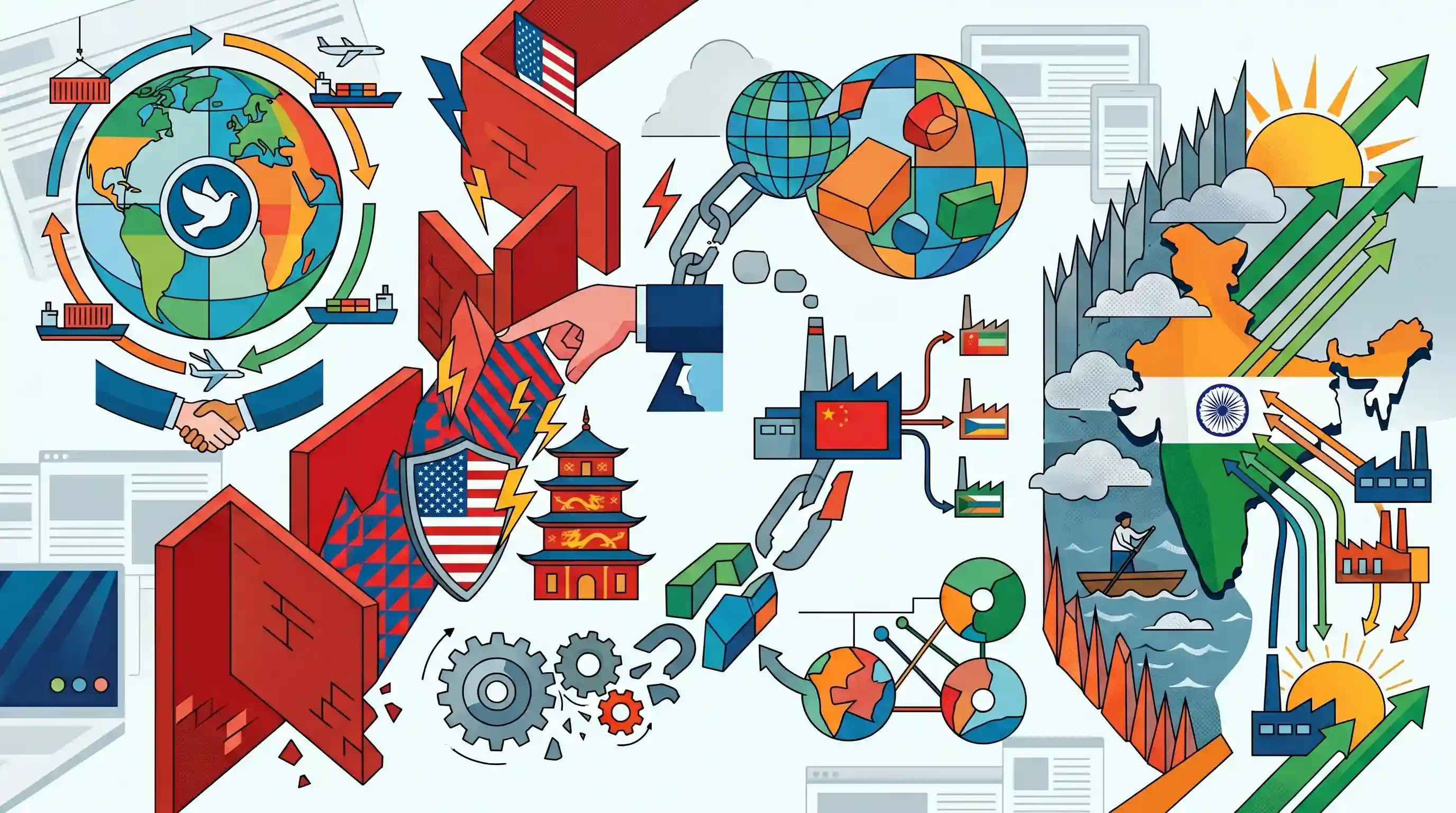
The transition from a multilateral rules-based trading system to one defined by protectionism and tariffs is a central theme in contemporary global economics. Understanding this structural shift is crucial for UPSC aspirants to analyze its impact on India's export potential, macroeconomic stability, and its strategic positioning as an alternative manufacturing hub.
Summary
The article analyzes the enduring impact of the trade protectionism initiated by the Trump administration, notably the sweeping tariffs and the ensuing trade war with China. This upheaval catalyzed a profound shift away from the WTO-led multilateral free trade regime toward a fragmented era of economic nationalism and supply-chain decoupling. The lasting fallout includes the acceleration of 'China plus one' strategies and 'friendshoring' as nations seek to de-risk their economies. For emerging markets like India, this geoeconomic fragmentation presents both challenges in navigating a protectionist world and strategic opportunities to position themselves as alternative manufacturing hubs in reshaping global supply chains.
Key Points
- Structural Shift in Global Trade: The Trump-era tariffs marked a permanent pivot away from multilateral free trade towards economic protectionism and nationalism.
- Supply Chain De-risking: Trade friction accelerated Western efforts to decouple from Chinese manufacturing, mainstreaming concepts like 'friendshoring' and 'China plus one'.
- Bipartisan Consensus: The retention of significant tariffs by subsequent US administrations underscores a lasting consensus on prioritizing strategic economic competition over open markets.
- Geoeconomic Implications for India: While a fragmented global trading system poses macroeconomic risks, it presents India with strategic opportunities to absorb relocating supply chains and boost domestic manufacturing.
Important Terms
China Plus One Strategy

A business strategy where companies diversify manufacturing away from exclusive reliance on China to nations like India or Vietnam to mitigate geopolitical and supply-chain risks.
UPSC context
GS Paper 3: Manufacturing, FDI, and India’s potential as a global alternative to China in supply chain resilience.
World Trade Organization (WTO)
The global international organization (est. 1995) governing rules of trade between nations, facilitating negotiations, and resolving disputes to ensure smooth, predictable, and free trade.
UPSC context
GS Paper 2 & 3: Multilateralism, trade disputes, and impacts of institutional paralysis on global economic governance.
Geoeconomic Fragmentation
A policy-driven reversal of global economic integration where trade and investment flows are redirected into rival geopolitical blocs, often leading to reduced global growth.
UPSC context
GS Paper 3: Economic Survey topics; tests understanding of deglobalization, trade barriers, and impacts on emerging markets.
Friendshoring
A trade strategy where nations prioritize supply chain partnerships and manufacturing in countries with shared values or geopolitical alliances to ensure economic security and resilience.
UPSC context
GS Paper 2 & 3: Geopolitical influence on trade and India's strategic positioning in Western-led economic blocs.
Economic Decoupling
The process of reducing mutual economic dependence between countries—notably the US and China—across trade, investment, and technology to minimize strategic and security vulnerabilities.
UPSC context
GS Paper 2: International Relations; analyzes the shift in US-China dynamics and its spillover effects on global trade.
Protectionism
Economic policy of shielding domestic industries from foreign competition through barriers like tariffs, quotas, and subsidies to protect local jobs and promote self-reliance.
UPSC context
GS Paper 3: Impact on Indian exports and the "Aatmanirbhar Bharat" initiative versus global market access.
Prelims Trap
The Most-Favoured-Nation (MFN) principle allows WTO members to grant exclusive tariff concessions to strategic allies.
MFN actually mandates non-discrimination; any concession given to one member must be unconditionally given to all. Exclusive concessions are only allowed under formally recognized FTAs.
Static Concepts Connected
What are the standard trade remedy measures under the WTO?
- Anti-dumping duty: Imposed on imports priced below fair market value in the exporting country to prevent domestic market distortion.
- Countervailing duty: Neutralizes the unfair advantage of specific financial subsidies provided by the exporting country's government to its producers.
- Safeguard measures: Temporary import restrictions applied to protect domestic industries from a sudden, unforeseen, and damaging surge in imports.
What are the permitted exceptions to the WTO's Most-Favoured-Nation (MFN) rule?
- Regional Trade Agreements: Preferential tariffs under formally notified Free Trade Agreements and Customs Unions are exempt under Article XXIV.
- GSP: The Generalized System of Preferences allows developed nations to grant non-reciprocal preferential tariffs to developing countries.
- Security Exception: Article XXI permits members to breach basic WTO obligations to protect their essential national security interests.
Cross-Topic Patterns
Friendshoring + Critical Minerals Partnership
The shift towards ally-shoring directly aligns with the Minerals Security Partnership (MSP), where Western nations and India seek to secure critical supply chains outside Chinese control.
Global Decoupling + India's PLI Scheme
Western protectionism provides the macroeconomic context for India's Atmanirbhar Bharat push, leveraging PLI schemes to capture migrating 'China Plus One' manufacturing hubs.

Expect a 2026 Prelims multi-statement question testing WTO exceptions (Article XXI) linked to 'friendshoring' and tariff barriers.
Linked PYQs · 2
Linked PYQs · 2
- 2025MainsGS3
What are the challenges before the Indian economy when the world is moving away from free trade and multilateralism to protectionism and bilateralism? How can these challenges be met?
- 2024MainsGS2
‘The West is fostering India as an alternative to reduce dependence on China's supply chain and as a strategic ally to counter China's political and economic dominance.’ Explain this statement with examples.
