US judicial review of executive tariff powers under IEEPA
Source:Indian Express ↗
Why It Matters
The article provides an excellent case study for comparative polity (GS2), illustrating how the US judiciary checks executive power and the use of 'national emergencies'. It also serves as a prime example of unilateral protectionist policies affecting global trade and WTO norms, which is highly relevant for GS3 questions on trade wars and macroeconomic stability.
Summary
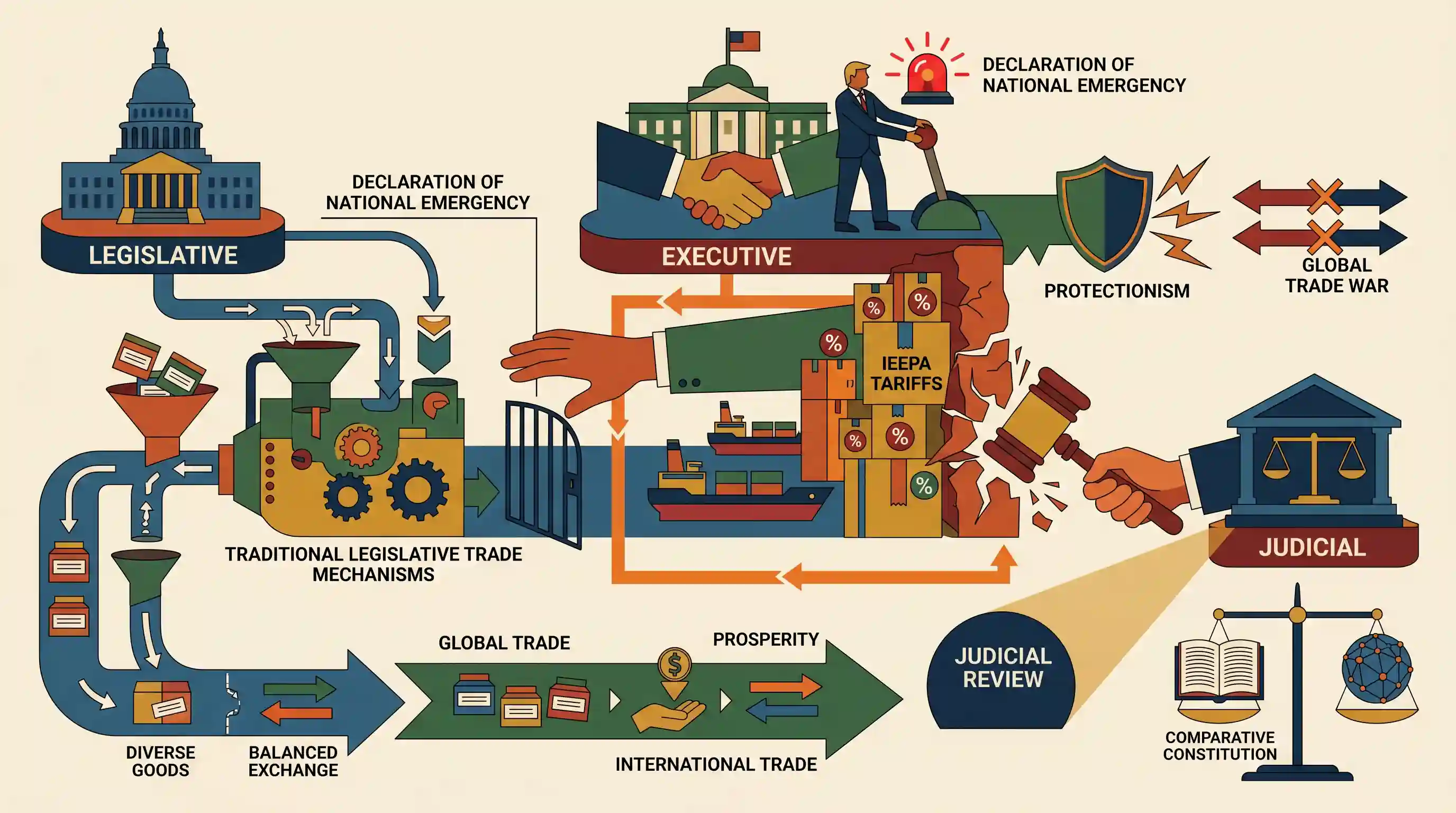
A recent US court decision has deemed tariffs imposed by former President Donald Trump under the International Emergency Economic Powers Act (IEEPA) as unlawful. The IEEPA allows the President to regulate international commerce following the declaration of a 'national emergency' to address an extraordinary foreign threat. By striking down the tariffs, the judiciary established limits on executive overreach, emphasizing that emergency powers cannot be arbitrarily used to bypass traditional legislative trade mechanisms or enforce protectionist economic policies. This case is a critical study in the separation of powers and the legal boundaries of global trade wars.
Key Points
- A US court ruling has held that certain tariffs imposed during Donald Trump's presidency using the International Emergency Economic Powers Act (IEEPA) were unlawful.
- The IEEPA grants the US President broad authority to regulate commerce after declaring a national emergency in response to an unusual and extraordinary foreign threat.
- The ruling underscores the role of judicial review in scrutinizing the executive's use of 'national emergency' powers for economic protectionism.
- This event highlights the tension between executive authority and legislative intent in trade policy, as well as the broader implications for international trade and tariff wars.
Important Terms
International Emergency Economic Powers Act (IEEPA)

A 1977 US law authorizing the President to regulate international commerce and freeze assets after declaring a national emergency to address extraordinary foreign threats.
UPSC context
GS-II (IR/Trade); highlights how domestic legislation of major powers shapes global economic order and executive trade authority.
Separation of Powers
A constitutional doctrine dividing government into legislative, executive, and judicial branches to prevent power concentration and ensure mutual checks and balances.
UPSC context
GS-II (Polity); tests understanding of the Indian functional overlap model versus strict models like the United States.
Judicial Review
The power of the judiciary to examine the constitutionality of legislative acts and executive orders, striking down those that violate the constitution.
UPSC context
GS-II (Polity); central to the 'Basic Structure' doctrine and the role of courts in preventing executive overreach.
Protectionism
Economic policy of shielding domestic industries from foreign competition through restrictive trade measures such as tariffs, quotas, and subsidies.
UPSC context
GS-III (Economy); essential for analyzing trade wars, deglobalization, and their impact on India’s export competitiveness.
National Emergency
A formal legal status triggered by extraordinary threats (security, economic, or health), allowing the executive to bypass normal procedures to address the crisis.
UPSC context
GS-II (Polity); examines the boundaries of state power and constitutional safeguards during exceptional circumstances.
Executive Overreach
Acts by the executive branch that exceed the specific powers granted to it by the constitution or legislative statutes.
UPSC context
GS-II (Polity/Governance); tests the judiciary’s role in maintaining the balance of power within a democracy.
Prelims Trap
The Constitution allows the President to unilaterally levy taxes and tariffs during a declared Financial Emergency.
False. Article 360 allows salary reductions and financial directives, but all taxation still requires statutory backing by Parliament under Article 265.
Static Concepts Connected
What is the constitutional basis of taxation in India?
- Article 265: Mandates that no tax shall be levied or collected except by authority of law, strictly prohibiting unilateral executive taxation or tariff creation.
- Delegated Legislation: While Parliament legislates taxes, statutes like the Customs Act, 1962 delegate power to the Executive to adjust tariff rates within strict statutory bounds during economic exigencies.
How does a Financial Emergency (Article 360) function?
- Proclamation: Declared by the President if financial stability or credit is threatened; requires simple-majority parliamentary approval within two months to remain in force.
- Executive Directives: The Centre can direct states to observe financial propriety, reserve state Money Bills for presidential consideration, and reduce salaries of public servants.
Cross-Topic Patterns
Protectionism vs. WTO Rules
Unilateral tariffs invoked under domestic 'national security' laws often exploit GATT Article XXI exceptions, effectively bypassing paralyzed WTO multilateral dispute settlement mechanisms.
Comparative Separation of Powers
The US ruling highlights its strict separation of powers for taxation, contrasting with India's parliamentary fusion which delegates significant tariff-adjustment powers to the Executive via statutory laws like the Customs Act.

Expect a GS2 question comparing the scope of emergency economic powers and legislative control over taxation in the US versus India.
Linked PYQs · 3
Linked PYQs · 3
- 2025MainsGS3
What are the challenges before the Indian economy when the world is moving away from free trade and multilateralism to protectionism and bilateralism? How can these challenges be met?
- 2018MainsGS3
How would the recent phenomena of protectionism and currency manipulations in world trade affect macroeconomic stability of India?
- 2018MainsGS2
What are the key areas of reform if the WTO has to survive in the present context of "Trade War', especially keeping in mind the interest of India?
