Global Economic Impact of Recent US Tariffs on Major Trade Partners
Source:Indian Express ↗
Why It Matters
The shift from free trade to protectionism and trade wars directly impacts global macroeconomic stability. For UPSC aspirants, understanding these dynamics is crucial for answering questions on the challenges to multilateralism (WTO), global inflation, and the spillover effects on India's export competitiveness and economic policies.
Summary
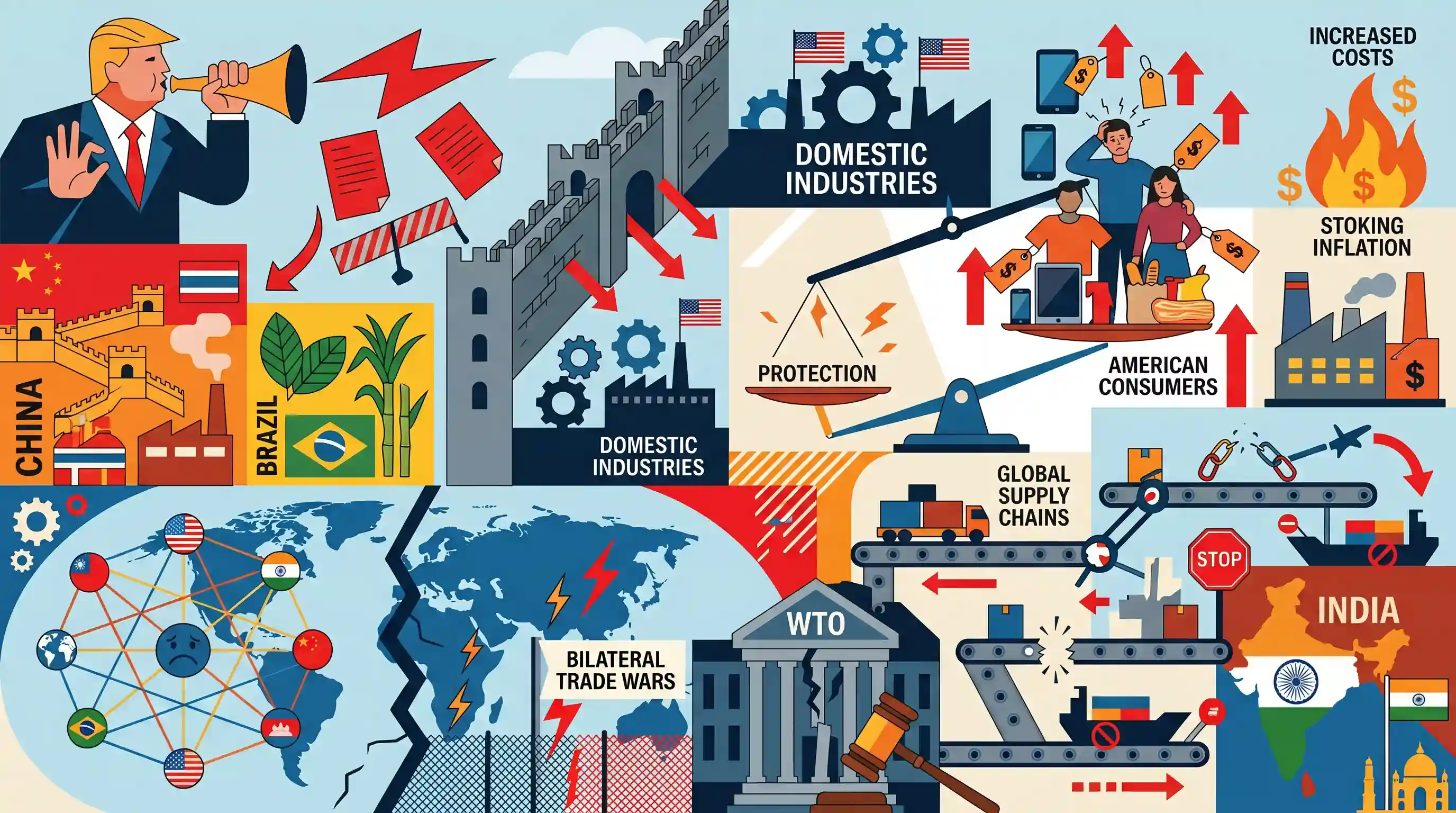
The article tracks recent tariff announcements made by Donald Trump targeting nations like China and Brazil, examining the initial economic fallout on the US economy. It highlights how these protectionist trade barriers aimed at protecting domestic industries can paradoxically increase costs for American consumers and stoke inflation. The announcements reflect a broader geopolitical shift away from multilateral free trade towards bilateral trade wars, carrying profound implications for global supply chains, international trade norms under the WTO, and emerging economies like India.
Key Points
- Former US President Donald Trump has announced significant new tariffs targeting major trading partners, particularly China and Brazil, signaling a potential return to aggressive protectionist policies.
- The article assesses the domestic economic impact in the US, highlighting that tariffs often act as a tax on domestic consumers, increasing the cost of imported goods and exacerbating inflationary pressures.
- Such tariff announcements threaten to disrupt global supply chains, forcing multinational corporations to alter their sourcing networks and accelerating the 'China Plus One' diversification strategy.
- The ongoing shift toward bilateral tariffs and trade wars undermines the multilateral, rules-based trading framework governed by the World Trade Organization (WTO).
Important Terms
World Trade Organization (WTO)

The only global international organization dealing with the rules of trade between nations, ensuring trade flows as smoothly, predictably, and freely as possible.
UPSC context
GS Paper-II (International Institutions); crucial for understanding rules-based global order, dispute settlement, and the impact of unilateral trade measures.
Protectionism
Economic policy of restricting imports from other countries through methods such as tariffs, quotas, or subsidies to shield domestic industries and workers from foreign competition.
UPSC context
GS Paper-III (Indian Economy); tests knowledge of trade barriers and their impact on domestic manufacturing and consumer pricing.
Trade War
A cycle of retaliatory economic conflict where nations impose escalating tariffs and trade barriers against each other, often disrupting global trade and cooperation.
UPSC context
GS Paper-II (International Relations); relevant to the effect of developed countries' policies on India’s interests and global macroeconomic stability.
Tariffs
A tax or duty imposed by a government on imported goods and services, intended to raise revenue and protect domestic producers by increasing import costs.
UPSC context
GS Paper-III (Indian Economy); tests understanding of fiscal tools in trade policy and their inflationary impact on the economy.
Global Supply Chains
The cross-border network of entities and activities involved in procurement, production, and delivery of products, often vulnerable to disruptions from trade conflicts or pandemics.
UPSC context
GS Paper-III (Economy/Infrastructure); central to discussions on supply chain resilience, decoupling strategies, and global manufacturing shifts.
Multilateralism
A framework of international relations where three or more countries cooperate based on agreed norms and institutions to address common interests or global challenges.
UPSC context
GS Paper-II (International Relations); tests concepts of rule-based global governance versus bilateralism or economic nationalism.
Prelims Trap
Import tariffs are directly paid by the exporting nation, thereby helping to reduce inflation in the importing country.
Economically, tariffs are a border tax paid by domestic importers, often passed onto consumers. They typically increase domestic prices, causing imported inflation rather than reducing it.
Static Concepts Connected
What are the standard Trade Remedy measures allowed under WTO?
- Anti-dumping duties: Levied on imports priced artificially below their normal value or production cost in the exporting country.
- Countervailing duties: Imposed to neutralize the negative effects of unfair government subsidies given to producers by the exporting country.
- Safeguard measures: Temporary restrictions (tariffs or quotas) on imports to protect a domestic industry from a sudden, unforeseen surge in imports.
How does the Most-Favored-Nation (MFN) principle work?
- Core Principle: A WTO member must treat all other members equally; a trade favor or tariff reduction granted to one must be granted to all.
- Key Exceptions: Allows for Free Trade Agreements (FTAs) and preferential treatment for developing nations under schemes like the Generalized System of Preferences (GSP).
Cross-Topic Patterns
Friend-shoring meets critical minerals
Supply chain diversification (China Plus One) directly overlaps with the Quad's strategy to secure critical mineral networks and semiconductor supply chains outside Chinese dominance.
Imported inflation & RBI policy
Protectionist tariffs raise global prices, leading to imported inflation in India. This complicates the RBI's inflation targeting framework, linking global trade wars to domestic monetary policy.

Expect a 2026 Prelims question linking WTO's MFN exceptions, 'friend-shoring' terminology, and imported inflation mechanisms.
Linked PYQs · 3
Linked PYQs · 3
- 2025MainsGS3
What are the challenges before the Indian economy when the world is moving away from free trade and multilateralism to protectionism and bilateralism? How can these challenges be met?
- 2018MainsGS3
How would the recent phenomena of protectionism and currency manipulations in world trade affect macroeconomic stability of India?
- 2018MainsGS2
What are the key areas of reform if the WTO has to survive in the present context of "Trade War', especially keeping in mind the interest of India?
