India US Bilateral Ties Navigated Amid Rising Tariff Frictions
Source:Indian Express ↗
Why It Matters
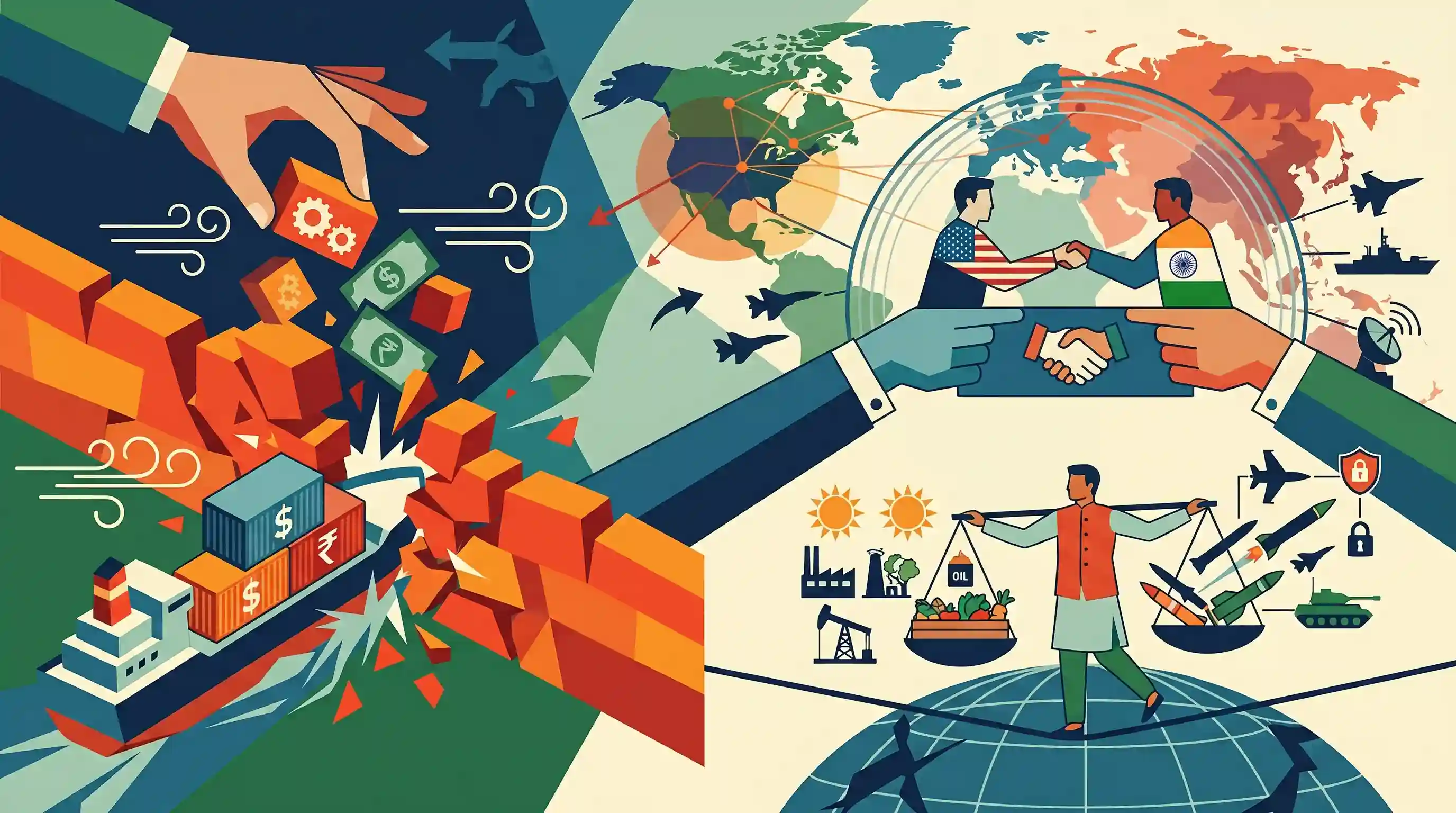
It illustrates the complexities of India-US relations, where deepening strategic and defense alignments coexist with persistent trade and economic frictions, requiring nuanced diplomatic management.
Summary
Amid rising tariff tensions with the United States, India has officially emphasized its desire to steer bilateral relations based on 'mutual respect and shared interests.' While trade frictions have created economic headwinds, New Delhi's diplomatic stance underscores the resilience of the broader comprehensive global strategic partnership. The situation highlights India's ongoing diplomatic balancing act—protecting its domestic economic and energy interests while sustaining crucial strategic and defense cooperation with Washington in a complex geopolitical landscape.
Key Points
- India and the US are experiencing trade frictions due to tariff tensions, creating challenges in the economic dimension of their bilateral ties.
- Despite economic disagreements, India maintains a stance of resolving issues through mutual respect and shared strategic interests.
- The broader India-US comprehensive global strategic partnership remains resilient, underpinned by cooperation in defense, technology, and Indo-Pacific security.
- India's foreign policy continues to balance defending its economic and energy interests with maintaining a robust strategic alliance with the US.
Important Terms
Comprehensive Global Strategic Partnership

The formal status of India-US relations since 2020, emphasizing deep cooperation across defense, technology, and global security, particularly in the Indo-Pacific region.
UPSC context
GS Paper II: Bilateral Relations. Tests understanding of high-level diplomatic designations and strategic convergence.
Strategic Autonomy
India's foreign policy pillar of making sovereign decisions in national interest without being constrained by external pressures or rigid alliance obligations.
UPSC context
GS Paper II: International Relations. Core concept for analyzing India’s 'multi-alignment' and balancing major power rivalries.
Trade Policy Forum (TPF)
The premier bilateral mechanism for trade dialogue between India and the US, co-chaired by India’s Commerce Minister and the US Trade Representative.
UPSC context
GS Paper II: Institutional Frameworks. Essential for analyzing resolution mechanisms in economic diplomacy.
Section 232 Tariffs
A provision of the US Trade Expansion Act of 1962 allowing the President to impose tariffs on imports deemed a threat to national security.
UPSC context
GS Paper III: Indian Economy (Trade Policy). Relevant for understanding technical barriers and national security-based trade protectionism.
Generalized System of Preferences (GSP)
A US trade preference program providing non-reciprocal duty-free entry for products from designated developing countries to promote economic growth.
UPSC context
GS Paper III: Global Trade Frameworks. Key for discussing trade disputes and market access barriers.
Ministry of External Affairs (MEA)
The Government of India department responsible for the conduct of foreign relations, representing New Delhi’s official stance on international developments.
UPSC context
GS Paper II: Structure & Functioning of Executive. Primary body for executing India’s foreign policy.
Prelims Trap
India is a founding member and actively participates in all four pillars of the US-led Indo-Pacific Economic Framework (IPEF).
India opted out of the Trade pillar (Pillar I) of IPEF to protect domestic interests regarding environment, labor, and digital trade, joining only the other three.
Static Concepts Connected
What are the four foundational defense agreements between India and the US?
- GSOMIA: General Security of Military Information Agreement (2002) allows sharing of classified military information between the two nations.
- LEMOA: Logistics Exchange Memorandum of Agreement (2016) permits both militaries to use each other's bases for resupply and repair.
- COMCASA: Communications Compatibility and Security Agreement (2018) facilitates the transfer of encrypted communication equipment and systems.
- BECA: Basic Exchange and Cooperation Agreement (2020) enables the sharing of high-end geospatial maps and classified satellite data for military accuracy.
What is the Generalized System of Preferences (GSP) in international trade?
- Core Concept: A preferential tariff system wherein developed countries grant zero or low import duties to specific products from qualifying developing countries.
- Objective: Designed to promote economic growth in the developing world by improving their export competitiveness. It is an exception to the WTO's MFN principle.
- India-US Context: The US revoked India's GSP beneficiary status in 2019, citing lack of equitable and reasonable access to Indian markets, a major trigger for recent tariff tensions.
Cross-Topic Patterns
Strategic Autonomy vs. Energy Security
India's continued procurement of discounted Russian crude despite US tariff threats tests the partnership, directly linking domestic energy security to its broader 'Strategic Autonomy' doctrine.
Tech-Diplomacy replacing traditional trade ties
While traditional goods trade faces tariff friction, bilateral ties are increasingly anchored by 'geotech' cooperation, specifically the iCET framework driving semiconductor and AI co-development.

Expect a multi-statement Prelims question contrasting India’s selective IPEF pillar participation with its active iCET defense commitments.
Linked PYQs · 3
Linked PYQs · 3
- 2025MainsGS2
"Energy security constitutes the dominant kingpin of India's foreign policy, and is linked with India's overarching influence in Middle Eastern countries.” How would you integrate energy security with India's foreign policy trajectories in the coming years?
- 2023MainsGS2
‘The expansion and strengthening of NATO and a stronger US-Europe strategic partnership works well for India.’ What is your opinion about this statement ? Give reasons and examples to support your answer.
- 2024PrelimsGS1
Which of the following statements about 'Exercise Mitra Shakti-2023' are correct? 1. This was a joint military exercise between India and Bangladesh. 2. It commenced in Aundh (Pune). 3. Joint response during counter-terrorism operations was a goal of this operation. 4. Indian Air Force was a part of this exercise. Select the answer using the code given below :
