Global Supply Chain Diversification and India Logistics Sector
Source:The Hindu ↗
Why It Matters
This article is highly relevant for UPSC aspirants as it connects global geopolitical phenomena with macroeconomic outcomes for India's logistics sector. It also underscores corporate engagement with India's pressing environmental challenges, integrating themes of supply chain resilience (GS3), water conservation practices like watershed management (GS1/GS3), and the real-world impact of ESG/CSR frameworks (GS4).
Summary
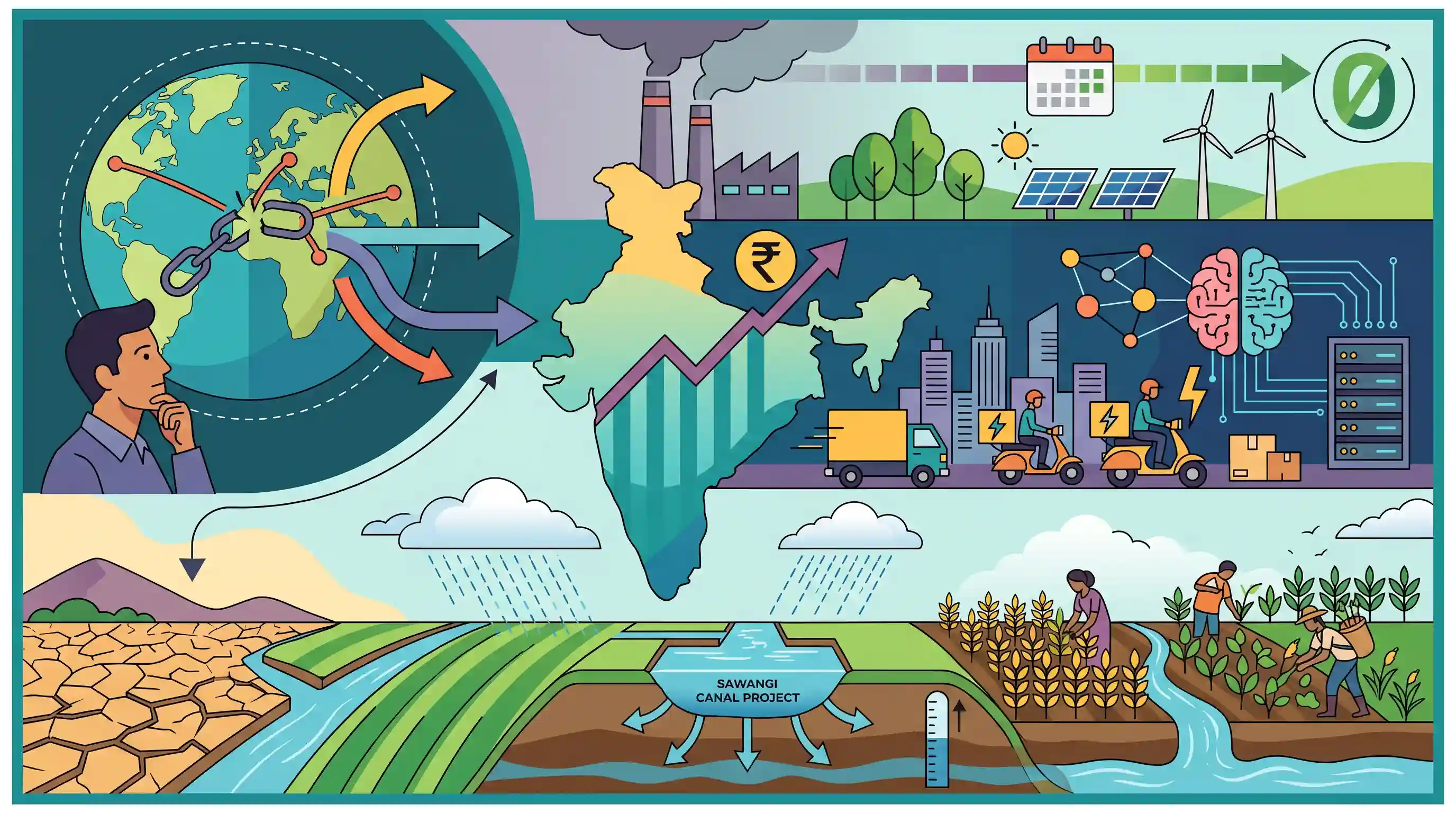
In a recent interview, Allcargo Group Founder Shashi Kiran Shetty discussed how global geopolitical realignments and tariff risks are compelling a structural reset in supply chains, offering India a strategic opportunity for economic gain. Domestically, India’s logistics sector is witnessing accelerated growth driven by quick commerce, e-commerce, and the integration of advanced technologies like AI and Big Data. The company is actively pursuing environmental sustainability goals, targeting net-zero carbon emissions by 2040. Furthermore, under its Corporate Social Responsibility (CSR), initiatives like the Sawangi Canal Project in Maharashtra’s Vidarbha region are demonstrating the vital role of rainwater harvesting and groundwater recharge in revitalizing rural agriculture and addressing water scarcity.
Key Points
- Geopolitical shifts, tariff risks, and economic uncertainties are creating an environment for global supply chain diversification, which will benefit India.
- The growth of e-commerce and quick commerce in India is accelerating demand for express distribution and contract logistics, supporting the logistics sector's expansion.
- Allcargo Group is strategically restructuring into specialized entities to manage express logistics, contract logistics, and international supply chain solutions more efficiently.
- The company aims to achieve carbon neutrality across its operations by 2040 through renewable energy use and shifting away from fossil fuel fleets.
- Through its CSR arm Avashya Foundation, Allcargo launched the Sawangi Canal Project in Maharashtra's Vidarbha region to address water scarcity via traditional rainwater harvesting and groundwater recharge, benefitting local agriculture.
Important Terms
IIM Mumbai

Formerly NITIE, this 2023-designated 'Institute of National Importance' is the 21st IIM. It focuses on techno-managerial education, specifically supply chain management, operations, and sustainability in the logistics sector.
UPSC context
GS Paper II (Education) and Paper III (Infrastructure); tests awareness of statutory educational reforms and sector-specific skill development.
Allcargo Group
A leading Indian multinational logistics conglomerate and global leader in Less-than-Container Load (LCL) consolidation. It plays a critical role in India’s domestic express distribution and international supply chains.
UPSC context
GS Paper III (Economy/Infrastructure); represents the role of private industry in enhancing India's logistics efficiency and global trade competitiveness.
Avashya Foundation
The Corporate Social Responsibility (CSR) arm of Allcargo Group. It implements community-focused projects in education, healthcare, and environmental sustainability, including rural water conservation and large-scale tree plantation.
UPSC context
GS Paper II (Governance) and Paper IV (Ethics); serves as a case study for corporate participation in rural development and social justice.
Logistics Sector
The network of transportation, warehousing, and inventory management. India aims to reduce its logistics costs (currently ~14-18% of GDP) to ~8% via the National Logistics Policy.
UPSC context
GS Paper III (Infrastructure); core to PM Gati Shakti, multimodal connectivity, and the 'Make in India' initiative.
Corporate Social Responsibility (CSR)
A legal obligation under Section 135 of the Companies Act, 2013, requiring companies with specific turnover or profit to spend 2% of their average net profit on social/environmental welfare.
UPSC context
GS Paper II (Governance) and Paper IV (Ethics); tests understanding of the legal framework for corporate accountability and social funding.
Rainwater Harvesting
The collection and storage of rain for reuse or groundwater recharge. It is a vital strategy for addressing water scarcity and ensuring sustainable irrigation in drought-prone regions.
UPSC context
GS Paper I (Geography) and Paper III (Environment/Agriculture); essential for water security, climate adaptation, and resource management.
Prelims Trap
"The 'China Plus One' strategy is a formal WTO-backed trade framework for supply chain diversification."
It is a corporate business strategy driven by geopolitical risks and tariff wars, not an official intergovernmental treaty or WTO mechanism.
Static Concepts Connected
What are the core targets of the National Logistics Policy (NLP) 2022?
- Cost Reduction: Lower logistics costs to global benchmarks by 2030, aiming for a single-digit percentage of GDP.
- Global Ranking: Elevate India's position in the World Bank's Logistics Performance Index (LPI) into the top 25 by 2030.
- Data Integration: Deploy the Unified Logistics Interface Platform (ULIP) to integrate multiple digital systems across transport ministries.
What constitutes the statutory CSR mandate under the Companies Act, 2013?
- Applicability Criteria: Applies to companies with a net worth of ₹500+ crore, turnover of ₹1000+ crore, or net profit of ₹5+ crore.
- Mandatory Spending: Requires spending at least 2% of the average net profits from the three preceding financial years on approved activities.
- Eligible Activities: Schedule VII lists permissible activities, explicitly including environmental sustainability, water conservation, and rural development projects.
Cross-Topic Patterns
Decarbonization + EU CBAM trade barriers
As Western nations implement carbon border taxes (like EU CBAM), decarbonizing Indian logistics isn't just an environmental goal but a critical trade necessity for export competitiveness.
Vidarbha geography + CSR micro-irrigation
Vidarbha's position in the Deccan rain-shadow region necessitates localized CSR-funded micro-watershed projects, shifting focus from macro-dams to localized aquifer recharge.

Expect a multi-statement prelims question linking 'China Plus One' supply chain shifts with PM Gati Shakti and India's Logistics Index.
Linked PYQs · 5
Linked PYQs · 5
- 2025MainsGS3
Elaborate the scope and significance of supply chain management of agricultural commodities in India.
- 2015MainsGS3
What are the impediments in marketing and supply chain management in developing the food processing industry in India? Can e-commerce help in overcoming these bottlenecks?
- 2022MainsGS4
In contemporary world, corporate sector's contribution in generating wealth and employment is increasing. In doing so, they are bringing in unprecedented onslaught on the climate, environmental sustainability and living conditions of human beings. In this background, do you find that Corporate Social Responsibility (CSR) is efficient and sufficient enough to fulfill the social roles and responsibilities needed in the corporate world for which the CSR is mandated? Critically examine.
- 2017MainsGS4
Corporate social responsibility makes companies more profitable and sustainable. Analyse.
- 2018MainsGS1
The ideal solution of depleting ground water resources in India is water harvesting system." How can it be made effective in urban areas?
