US Signs Tariff Letters Targeting Twelve Nations
Source:The Hindu ↗
Why It Matters
The U.S. shift towards aggressive protectionism and bilateral ultimatums directly impacts India's export competitiveness and macroeconomic stability. It requires civil services aspirants to understand the ripple effects of global trade wars, the decline of multilateral free trade, and how India must navigate strained bilateral relations and safeguard its economic interests amidst international volatility.
Summary
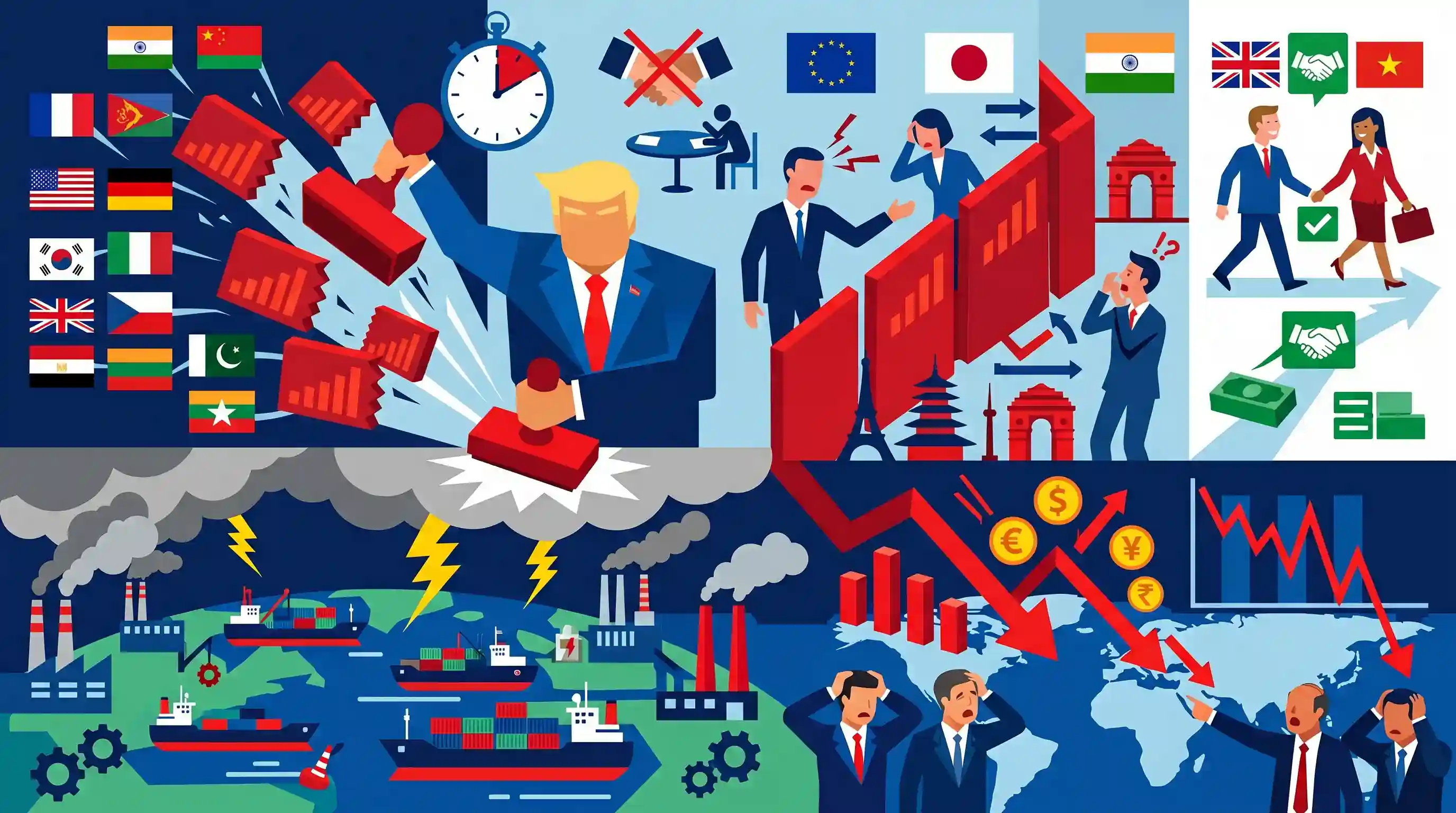
U.S. President Donald Trump has signed letters outlining new, unilateral tariff rates for 12 countries, abandoning traditional trade negotiations after facing setbacks with major partners like the EU, Japan, and India. The new tariffs, which could reach up to 70%, are set to take effect on August 1, ending a 90-day suspension of a 10% base rate. While deals were successfully reached with Britain and Vietnam, the failure to secure agreements with other key economies marks a significant shift towards aggressive protectionism. This "take it or leave it" approach threatens to escalate an ongoing global trade war, upending international financial markets and forcing policymakers worldwide to brace for economic fallout.
Key Points
- U.S. President Donald Trump has abandoned traditional trade negotiations in favor of unilaterally dictating tariff rates to 12 countries via letters.
- The new tariffs, which could reach up to 70%, are set to replace a suspended 10% base rate and will take effect on August 1.
- While the U.S. secured trade agreements with Britain and Vietnam, negotiations failed to produce deals with major partners such as India, the EU, and Japan.
- This unilateral "take it or leave it" approach signifies a sharp escalation in protectionist policies, threatening to intensify the global trade war and destabilize financial markets.
Important Terms
Protectionism

Economic policy of restricting imports through methods like tariffs and quotas to shield domestic industries from foreign competition.
UPSC context
GS-2 (Effect of policies of developed countries) and GS-3 (Industrial growth and self-reliance).
Trade War
An economic conflict where countries retaliate by raising trade barriers (usually tariffs) against each other, disrupting global supply chains.
UPSC context
GS-2 (International Relations) and GS-3 (Impact on global trade stability and Indian exports).
Unilateralism
An approach in international relations where a state acts independently without multilateral consensus or adherence to international frameworks like the WTO.
UPSC context
GS-2 (Bilateral/regional groupings) — specifically the erosion of the rules-based international order.
Tariffs
Taxes or duties imposed by a government on imported goods, making them more expensive to domestic consumers to favor local production.
UPSC context
GS-3 (Economy: taxation and trade balance) and GS-2 (Global trade negotiations).
European Union (EU)
A political and economic union of 27 member states that acts as a single market and a major global trade negotiator.
UPSC context
GS-2 (Bilateral/regional groupings) — tests India-EU trade relations and the BTIA negotiations.
Economic Liberalization
The removal or reduction of government restrictions on the free exchange of goods and capital between nations.
UPSC context
GS-3 (Effects of liberalization on the economy); often contrasted with current protectionist trends.
Prelims Trap
The new US tariff hikes are legal trade remedy measures permitted under the WTO's safeguard mechanisms.
These tariffs bypass WTO rules. They are unilateral, politically motivated duties, not rules-based trade remedies (like anti-dumping or countervailing duties) which require formal investigations.
Static Concepts Connected
What is the Most Favored Nation (MFN) principle under the WTO and its key exceptions?
- MFN Principle: Mandates equal, non-discriminatory treatment among WTO members; a tariff rate reduction given to one must be extended to all.
- FTA/RTA Exception: Countries can establish Free Trade Agreements (FTAs) or Customs Unions with special, lower rates bypassing standard MFN rules.
- GSP Exception: Developed countries can give unilateral preferential tariff treatment to developing nations without violating MFN through systems like GSP.
What are the three WTO-sanctioned trade remedial measures?
- Anti-Dumping Duty: Levied on imports priced below their fair market value or domestic production cost by the exporting country.
- Countervailing Duty: Imposed to offset unfair production or export subsidies provided by the exporting country's government.
- Safeguard Measures: Temporary tariffs or quotas applied to restrict a sudden, unforeseen surge of specific imports threatening domestic industries.
Cross-Topic Patterns
Weaponization of Trade and Currency
Unilateral tariffs often trigger competitive currency devaluations. UPSC may link this to the US Treasury's currency manipulator watchlist, a mechanism used alongside tariffs to counter trade-deficit imbalances.
Global Value Chains & PLI Schemes
Aggressive protectionism disrupts global supply chains, making India's Production Linked Incentive (PLI) scheme vital for capitalizing on the 'China-Plus-One' shift and absorbing redirected manufacturing.

The clash between WTO's MFN principle, unilateral protectionist tariffs, and trade remedies is a high-probability Prelims topic for 2026.
Linked PYQs · 3
Linked PYQs · 3
- 2012MainsGS2
Discuss the likely negative impact of the protectionist measures proposed by the US on India's software industry.
- 2018MainsGS3
How would the recent phenomena of protectionism and currency manipulations in world trade affect macroeconomic stability of India?
- 2025MainsGS3
What are the challenges before the Indian economy when the world is moving away from free trade and multilateralism to protectionism and bilateralism? How can these challenges be met?
