US Tariffs and Contracting Engineering Goods Exports from India
Source:Indian Express ↗
Why It Matters
Export performance directly impacts India's current account deficit, currency stability, and manufacturing employment. Understanding the real-world effects of protectionist tariffs is vital for analyzing India's trade policy, economic resilience, and bilateral relations.
Summary
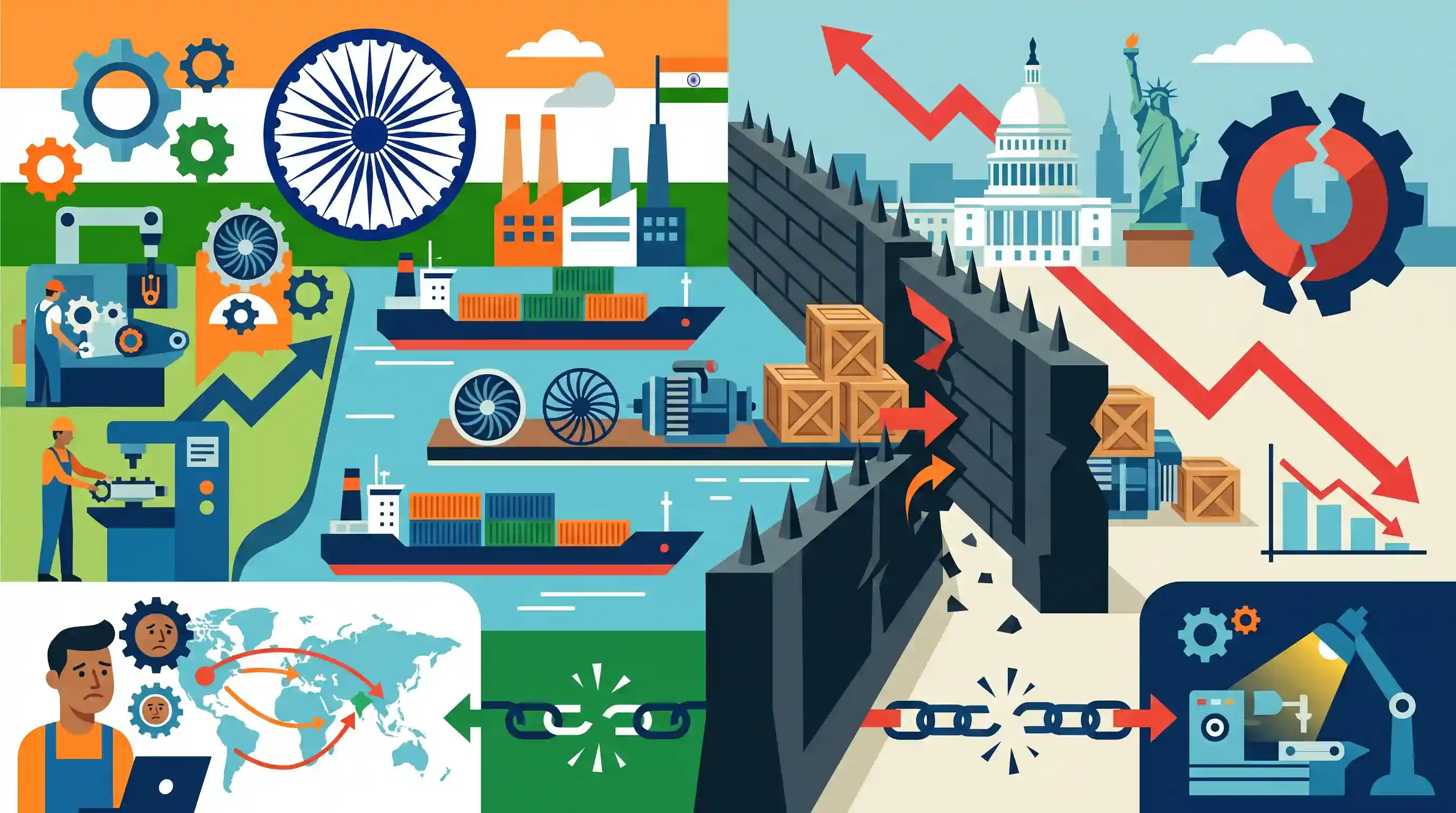
The article reports a 9% decline in India's engineering goods exports to the United States in September, driven by the impact of tariffs. As engineering goods make up a substantial portion of India's total merchandise exports, this contraction highlights the adverse effects of rising protectionism on Indian manufacturing and trade. The development underscores the vulnerability of Indian exporters to global policy shifts and emphasizes the necessity for market diversification and enhanced competitiveness to navigate trade barriers.
Key Points
- India's engineering goods exports to the United States contracted by 9% in September.
- The decline is primarily attributed to the adverse impact of tariffs and rising protectionist trade policies in the US market.
- Engineering goods constitute a major segment of India's overall merchandise exports, making this contraction a significant headwind for the trade balance.
- This trend underscores the vulnerability of Indian manufacturing exports to global trade barriers and highlights the need for market diversification.
- Policy interventions, such as the PLI scheme, remain crucial to enhance the cost-competitiveness of Indian goods amidst challenging global trade environments.
Important Terms
Engineering Export Promotion Council (EEPC) India

The premier trade and investment promotion body for India's engineering sector, established in 1955 under the Ministry of Commerce and Industry. It acts as an advisory link between exporters and government.
UPSC context
GS Paper 3 (Economy); important for institutional frameworks promoting merchandise exports and MSME competitiveness in global trade.
Production-Linked Incentive (PLI) Scheme
A policy providing financial incentives (4-6%) on incremental sales to manufacturers to boost domestic production, attract investment, and integrate India into Global Value Chains across 14 key sectors.
UPSC context
GS Paper 3 (Economy); crucial for topics on industrial growth, 'Atmanirbhar Bharat', and enhancing manufacturing export competitiveness.
Ministry of Commerce and Industry
The nodal Union ministry responsible for India's external trade and industrial policy, functioning through two departments: Department of Commerce and Department for Promotion of Industry and Internal Trade (DPIIT).
UPSC context
GS Paper 2 & 3; foundational for governance, foreign trade policy (FTP), and ease of doing business initiatives.
Protectionism
Economic policy that restricts imports through tariffs, quotas, or subsidies to shield domestic industries from foreign competition, often rising during global geopolitical tensions or trade wars.
UPSC context
GS Paper 3 (Economy); tests understanding of global trade barriers, WTO rules, and their impact on India’s export-led growth.
Prelims Trap
"Petroleum products constitute the largest single segment of India's merchandise exports."
Aspirants often assume petroleum or gems & jewellery are the top exports due to high visibility. In reality, engineering goods consistently account for over 25% of India's total merchandise export basket.
Static Concepts Connected
What characterizes the composition and direction of India's merchandise exports?
- Top Category: Engineering goods form the largest segment, consistently accounting for over 25% of the total merchandise export basket.
- Top Destination: The United States is India's largest export destination, exposing the manufacturing sector to concentration risks from US policy shifts.
- Import Reliance: Despite exporting finished engineering goods, India still heavily relies on imports for critical intermediate components and raw materials.
How does the PLI scheme aim to counter global trade barriers?
- Cost Competitiveness: It provides financial incentives based on incremental sales, helping offset infrastructural inefficiencies and making Indian goods cheaper globally.
- Scale of Manufacturing: By incentivizing large-scale production, it reduces per-unit costs, buffering exporters against sudden tariff hikes in traditional destination markets.
Cross-Topic Patterns
Western Protectionism + FTA Pivot
Rising tariffs in the US and EU (like CBAM) are forcing India to accelerate FTAs with alternative markets like the UAE, Australia, and Latin America to diversify risk.
Export Slump + Currency Pressures
Falling engineering exports widen the merchandise trade deficit. This exerts upward pressure on the Current Account Deficit (CAD) and risks depreciating the Rupee against the dollar.

Expect a 2026 Prelims multi-statement question testing India's merchandise trade composition, top destinations, and PLI's role.
Linked PYQs · 4
Linked PYQs · 4
- 2025MainsGS3
What are the challenges before the Indian economy when the world is moving away from free trade and multilateralism to protectionism and bilateralism? How can these challenges be met?
- 2018MainsGS3
How would the recent phenomena of protectionism and currency manipulations in world trade affect macroeconomic stability of India?
- 2020PrelimsGS1
With reference to the international trade of India at present, which of the following statements is/are correct? 1. India's merchandise exports are less than its merchandise imports. 2. India's imports of iron and steel, chemicals, fertilisers and machinery have decreased in recent years. 3. India's exports of services are more than its imports of services. 4. India suffers from an overall trade/current account deficit. Select the correct answer using the code given below:
- 2023PrelimsGS1
Consider the following statements: Statement-I: India accounts for 3.2% of global export of goods. Statement-II: Many local companies and some foreign companies operating in India have taken advantage of India's 'Production-linked Incentive' scheme. Which one of the following is correct in respect of the above statements?
