State Actions Against Think Tanks Threaten Independent Research Voices
Source:The Hindu ↗
Why It Matters
The issue of shrinking space for civil society organizations and academic research directly ties into GS2 topics like the role of NGOs, freedom of expression, and the importance of independent data for policy formulation and democratic accountability.
Summary
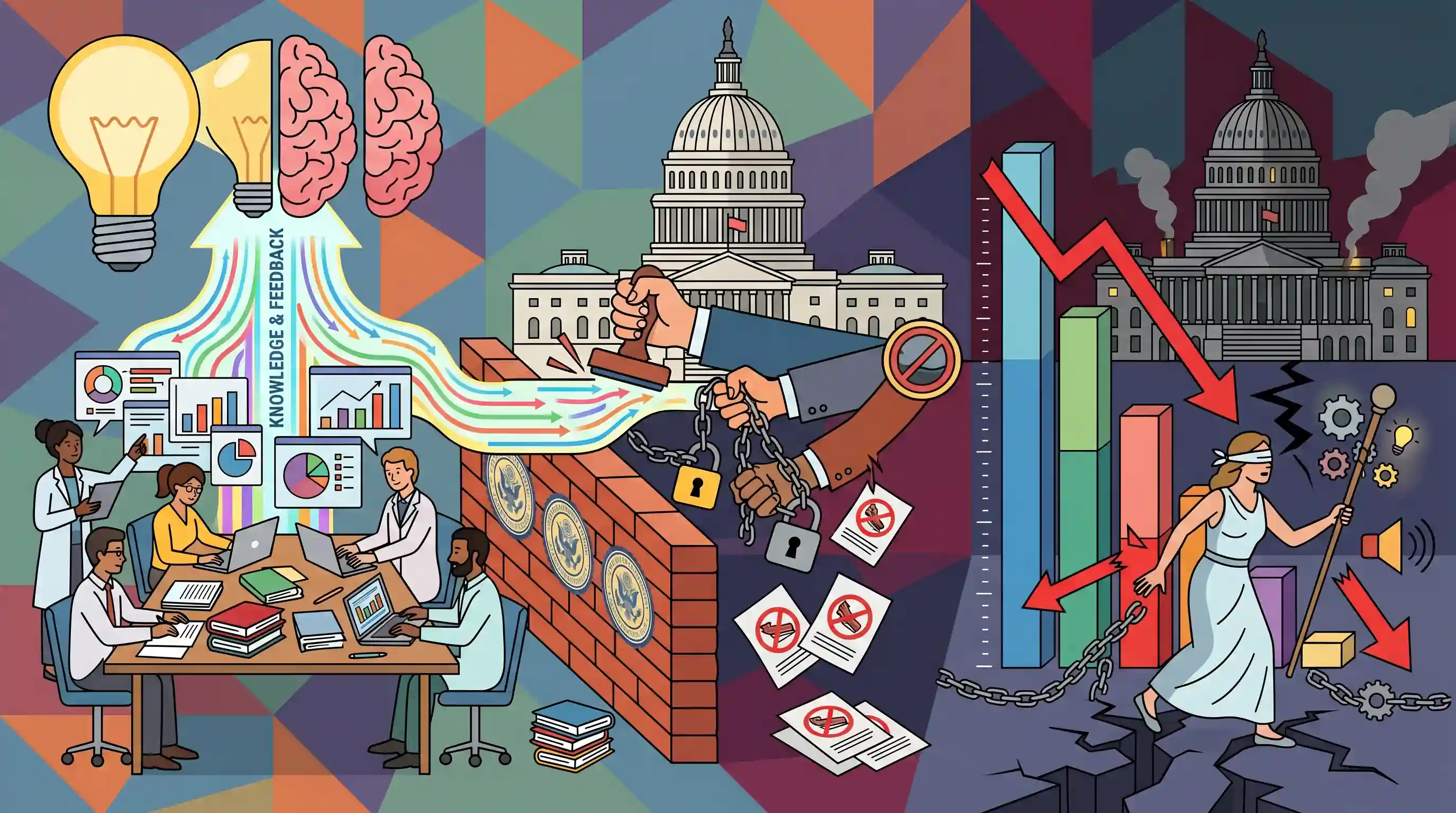
The editorial highlights the systematic targeting and silencing of independent research institutions in India, citing the recent state actions against the Centre for the Study of Developing Societies (CSDS) and the Centre for Policy Research (CPR). These actions, ranging from show cause notices by funding bodies (ICSSR) to the cancellation of FCRA licences and tax exemptions, reflect a shrinking space for academic freedom, as evidenced by India's declining rank in the V-Dem Academic Freedom Index. The piece argues that suppressing independent data collection and research deprives the state of crucial feedback necessary for democratic functioning and effective policymaking.
Key Points
- Independent research institutions in India, such as CSDS and CPR, are facing state pressure, resulting in the silencing of independent empirical research.
- The ICSSR issued a show cause notice to CSDS following an erroneous post on X by a researcher regarding electoral roll deletions, which led to politically motivated FIRs.
- The CPR has previously been targeted with tax surveys and the cancellation of its foreign funding (FCRA) licence and tax-exempt status.
- India's rank in the 2024 Academic Freedom Index dropped to 104th out of 179 countries, reflecting a deteriorating environment for academic freedom.
- The editorial argues that suppressing independent data gathering and analysis impairs democratic feedback and hampers effective policy formulation.
Important Terms
Foreign Contribution (Regulation) Act (FCRA)

Legislation regulating foreign donations to individuals and NGOs in India to prevent foreign influence on internal affairs. It is administered by the Ministry of Home Affairs and requires periodic license renewals.
UPSC context
GS Paper II: Role of NGOs, Civil Society, and Government Policies. Tests understanding of regulatory frameworks for development and internal security.
Indian Council of Social Science Research (ICSSR)
An autonomous body established in 1969 under the Ministry of Education to promote, fund, and coordinate social science research in India through grants, fellowships, and support to research institutes.
UPSC context
GS Paper II: Statutory and autonomous bodies. Relevant for discussions on institutional autonomy and the state's role in education.
Academic Freedom Index
An annual report measuring global academic freedom across five indicators: freedom to research/teach, exchange/dissemination, institutional autonomy, campus integrity, and academic expression. India’s rank has recently declined significantly.
UPSC context
GS Paper II: International indices and India's standing. Useful for essays and questions on democratic backsliding or governance quality.
Centre for Policy Research (CPR)
A premier New Delhi-based public policy think tank established in 1973. It conducts high-quality research on governance and policy, but recently faced license revocation under the FCRA.
UPSC context
GS Paper II: Role of civil society and think tanks in policymaking. Important case study for NGO-State relations.
Centre for the Study of Developing Societies (CSDS)
An autonomous social science research institute founded in 1963 by Rajni Kothari. It is renowned for its empirical research on Indian democracy, elections, and political behavior through its Lokniti program.
UPSC context
GS Paper II: Pressure groups and formal/informal associations. Tests knowledge of institutions contributing to democratic discourse and data collection.
V-Dem Institute
A Swedish research institute that produces the "Varieties of Democracy" dataset. It provides multi-dimensional measures of democracy and academic freedom, often cited in global governance debates.
UPSC context
GS Paper II: Global governance and international reports. Relevant for analyzing India's democratic health in an international context.
Prelims Trap
"The right to academic freedom is explicitly guaranteed as a fundamental right under Article 19 of the Constitution."
Unlike some global constitutions, the Indian Constitution does not explicitly codify 'academic freedom'. It is implicitly protected under Article 19(1)(a) and subject to Article 19(2) reasonable restrictions.
Static Concepts Connected
What are the key restrictions introduced by the FCRA Amendment Act 2020?
- Transfer of funds: Completely prohibits the sub-granting or transfer of foreign contribution to any other person or NGO.
- Administrative cap: Reduces the limit on utilizing foreign funds for administrative purposes from 50% to 20%.
- Aadhaar mandate: Makes Aadhaar mandatory for all office bearers, directors, or key functionaries of an NGO.
- SBI Account: Mandates receiving foreign funds exclusively in a designated SBI account at the New Delhi main branch.
How is academic freedom addressed within the Indian Constitutional framework?
- Implicit Right: It is not explicitly mentioned but is read into Article 19(1)(a) safeguarding Freedom of Speech and Expression.
- Reasonable Restrictions: It remains subject to grounds like sovereignty, public order, and security of the State under Article 19(2).
Cross-Topic Patterns
NGOs: Internal Security vs. Governance
The tightening of FCRA is often justified under anti-terror financing and FATF compliance, creating a constant tension between GS-III security mandates and GS-II developmental civil society functions.
Democratic indices as GS-II fodder
V-Dem's Academic Freedom Index sits alongside its controversial Democracy Report (classifying India as an 'electoral autocracy'), making the institute's metrics a frequent touchpoint for GS-II critical analysis on democratic backsliding.

FCRA 2020 amendments + NGOs' role in evidence-based policymaking will likely form a hybrid GS-II Mains question in 2026.
Linked PYQs · 4
Linked PYQs · 4
- 2025MainsGS2
Civil Society Organizations are often perceived as being anti-State actors than non-State actors. Do you agree? Justify.
- 2015MainsGS2
Examine critically the recent changes in the rules governing foreign funding of NGOs under the Foreign Contribution (Regulation) Act (FCRA), 1976.
- 2021MainsGS2
Can Civil Society and Non-Governmental Organizations present an alternative model of public service delivery to benefit the common citizen? Discuss the challenges of this alternative model.
- 2014MainsGS2
What do you understand by the concept "freedom of speech and expression"? Does it cover hate speech also ? Why do the films in India stand on a slightly different plane from other forms of expression ? Discuss.
