India Solar Manufacturing Growth Faces Emerging Export Glut Challenges
Source:The Hindu ↗
Why It Matters
This article covers core GS-3 themes surrounding India's climate commitments (Panchamrit targets of 50% non-fossil capacity by 2030) and the practical challenges of Make in India in the renewable sector. It also offers a potent GS-2 International Relations perspective, illustrating how domestic schemes (PM KUSUM) and platforms (International Solar Alliance) can be used as tools of soft power and economic diplomacy in Africa.
Summary
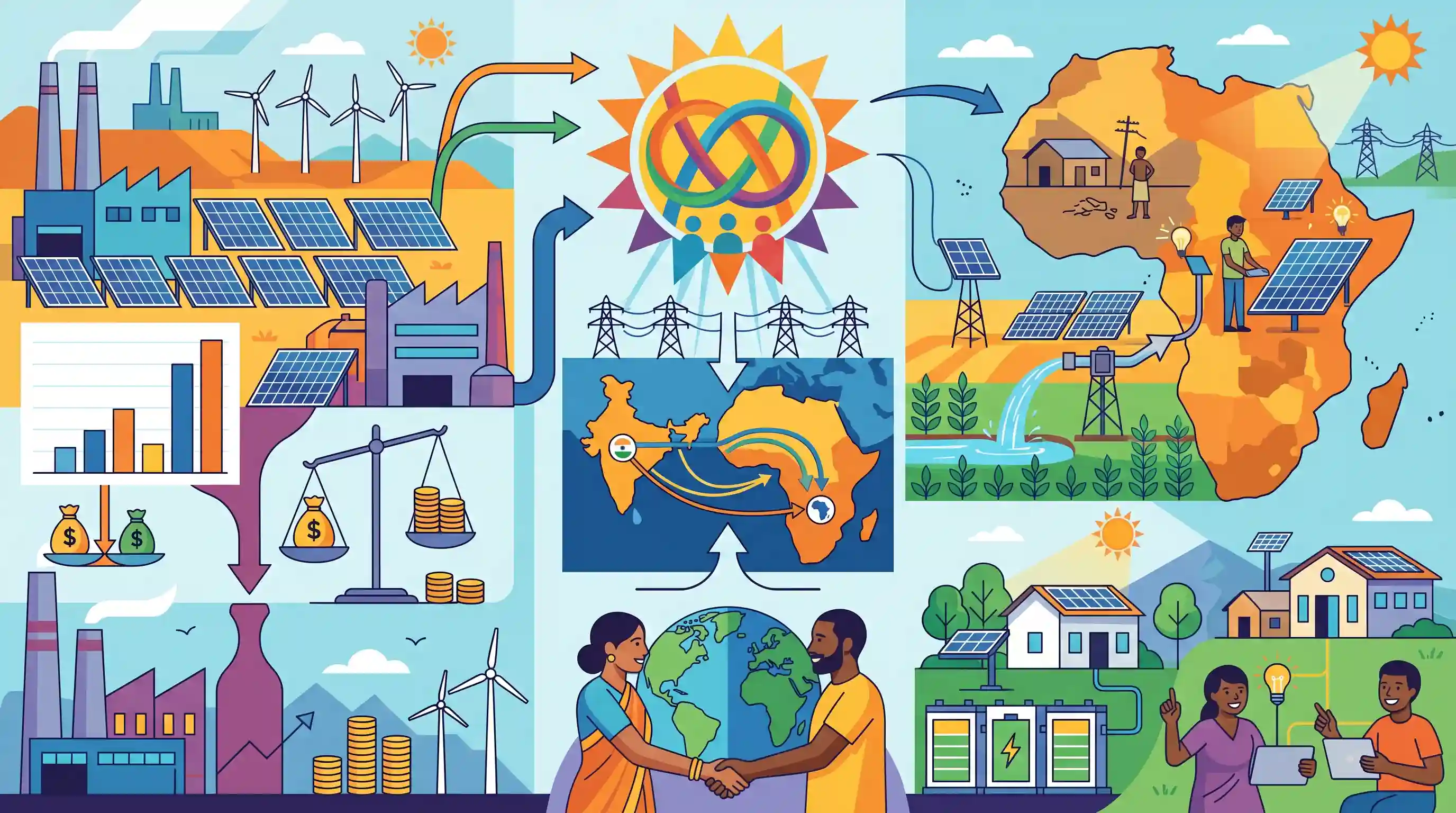
The editorial highlights India's impressive growth in domestic solar power capacity but points out the emerging challenge of a manufacturing supply glut. While solar module manufacturing capacity has surged to 100 GW, actual annual capacity addition lags behind the 30 GW target, and domestic modules remain significantly costlier than Chinese alternatives. To sustain the domestic industry without relying solely on domestic absorption or protective tariffs, India must seek new export markets. By leveraging the International Solar Alliance (ISA) and replicating successful rural schemes like PM KUSUM, India has a strategic opportunity to establish itself as a credible alternative supplier to Africa. This would address Africa's critical rural electrification and irrigation needs while bolstering India's role in South-South cooperation and balancing China's market dominance.
Key Points
- India has become the world's third-largest solar energy producer, increasing its module manufacturing capacity from 2 GW in 2014 to 100 GW in 2025.
- To meet its 2030 climate commitments (50% power from non-fossil sources), India needs to add 30 GW annually, but current additions are only 17-23 GW.
- Indian solar modules remain 1.5 to 2 times more expensive than Chinese modules due to China's scale and control over raw materials.
- With a looming domestic manufacturing glut, India needs new export markets beyond the US (where it exported ~4 GW in 2024).
- Through the International Solar Alliance (ISA), India can export its solar technology to Africa by replicating schemes like PM KUSUM for solar-powered irrigation, positioning itself as a strategic alternative to China.
Important Terms
International Solar Alliance (ISA)

A treaty-based intergovernmental organization launched by India and France to scale solar energy deployment and reduce financing costs for sunshine-rich nations.
UPSC context
GS Paper II/III: India's leadership in global climate diplomacy and energy security.
PM KUSUM
A scheme aimed at ensuring energy security for farmers through subsidies for standalone solar pumps and solarization of grid-connected pumps.
UPSC context
GS Paper II/III: Government schemes for agriculture and renewable energy targets.
PM Surya Ghar: Muft Bijli Yojana
A flagship rooftop solar scheme launched in 2024 to provide free electricity (up to 300 units) to 1 crore households via subsidized installations.
UPSC context
GS Paper II: Social welfare policies and decentralized renewable energy infrastructure.
Approved List of Models and Manufacturers (ALMM)
A quality-and-reliability framework mandating certified domestic solar components in government-supported projects to promote local manufacturing and reduce imports.
UPSC context
GS Paper III: Industrial policy, manufacturing sector, and Atmanirbhar Bharat.
South-South Cooperation
A framework for the exchange of technology, knowledge, and resources between developing nations to achieve collective self-reliance and shared development.
UPSC context
GS Paper II: India's foreign policy and leadership in the Global South.
Prelims Trap
The PLI scheme has made India completely self-reliant in the upstream solar supply chain.
While India's module assembly capacity reached 100 GW, it remains heavily dependent on imports (especially from China) for upstream raw materials like polysilicon, ingots, and wafers.
Static Concepts Connected
What are the primary components of the PM-KUSUM scheme?
- Component A: Grid-connected renewable power plants (up to 2 MW) installed by farmers on barren or fallow land.
- Component B: Installation of standalone, off-grid solar-powered agriculture pumps to replace diesel variants.
- Component C: Solarisation of existing grid-connected agriculture pumps, allowing farmers to sell surplus power back to the grid.
What is the mandate and membership structure of the International Solar Alliance (ISA)?
- Origin & HQ: Launched by India and France at COP21 (2015) in Paris. Its headquarters are in Gurugram, India.
- Universal Membership: Initially restricted to countries between the Tropics, the framework was amended to allow all UN member states to join.
- Core Objectives: To mobilize $1 trillion in investments by 2030, deploy 1,000 GW of solar capacity, and reduce technology costs.
Cross-Topic Patterns
Domestic Content Requirements & WTO disputes
India's Approved List of Models and Manufacturers (ALMM) for solar modules risks WTO scrutiny. The US previously won a WTO dispute against India's Domestic Content Requirements (DCR) in the National Solar Mission.
Clean energy as South-South diplomacy
India is actively leveraging digital public infrastructure and renewable technology (ISA, solar pumps) to build non-debt-trap partnerships in Africa, countering China's Belt and Road Initiative.

Expect a GS2/GS3 Mains question linking India's solar manufacturing glut to South-South diplomacy in Africa via the ISA in 2026.
Linked PYQs · 5
Linked PYQs · 5
- 2022MainsGS3
Do you think India will meet 50 percent of its energy needs from renewable energy by 2030 ? Justify your answer. How will the shift of subsidies from fossil fuels to renewables help achieve the above objective ? Explain.
- 2020MainsGS3
Describe the benefits of deriving electric energy from sunlight in contrast to the conventional energy generation. What are the initiatives offered by our Government for this purpose?
- 2016MainsGS3
Give an account of the current status and the targets to be achieved pertaining to renewable energy sources in the country. Discuss in brief the importance of National Programme on Light Emitting Diodes (LEDs).
- 2025PrelimsGS1
Consider the following statements about 'PM Surya Ghar Muft Bijli Yojana': I. It targets installation of one crore solar rooftop panels in the residential sector. II. The Ministry of New and Renewable Energy aims to impart training on installation, operation, maintenance and repairs of solar rooftop systems at grassroot levels. III. It aims to create more than three lakhs skilled manpower through fresh skilling, and up-skilling, under scheme component of capacity building. Which of the statements given above are correct?
- 2025MainsGS2
India-Africa digital partnership is achieving mutual respect, co-development and long-term institutional partnerships. Elaborate.
