Epigraphical Evidence of Indo Roman Maritime Trade Networks
Source:Indian Express ↗
Why It Matters
Understanding ancient maritime trade routes and the spread of Indian scripts provides critical context for questions on ancient history, port cities (like Muziris or Poompuhar), and the role of epigraphy in reconstructing India's historical global connections.
Summary
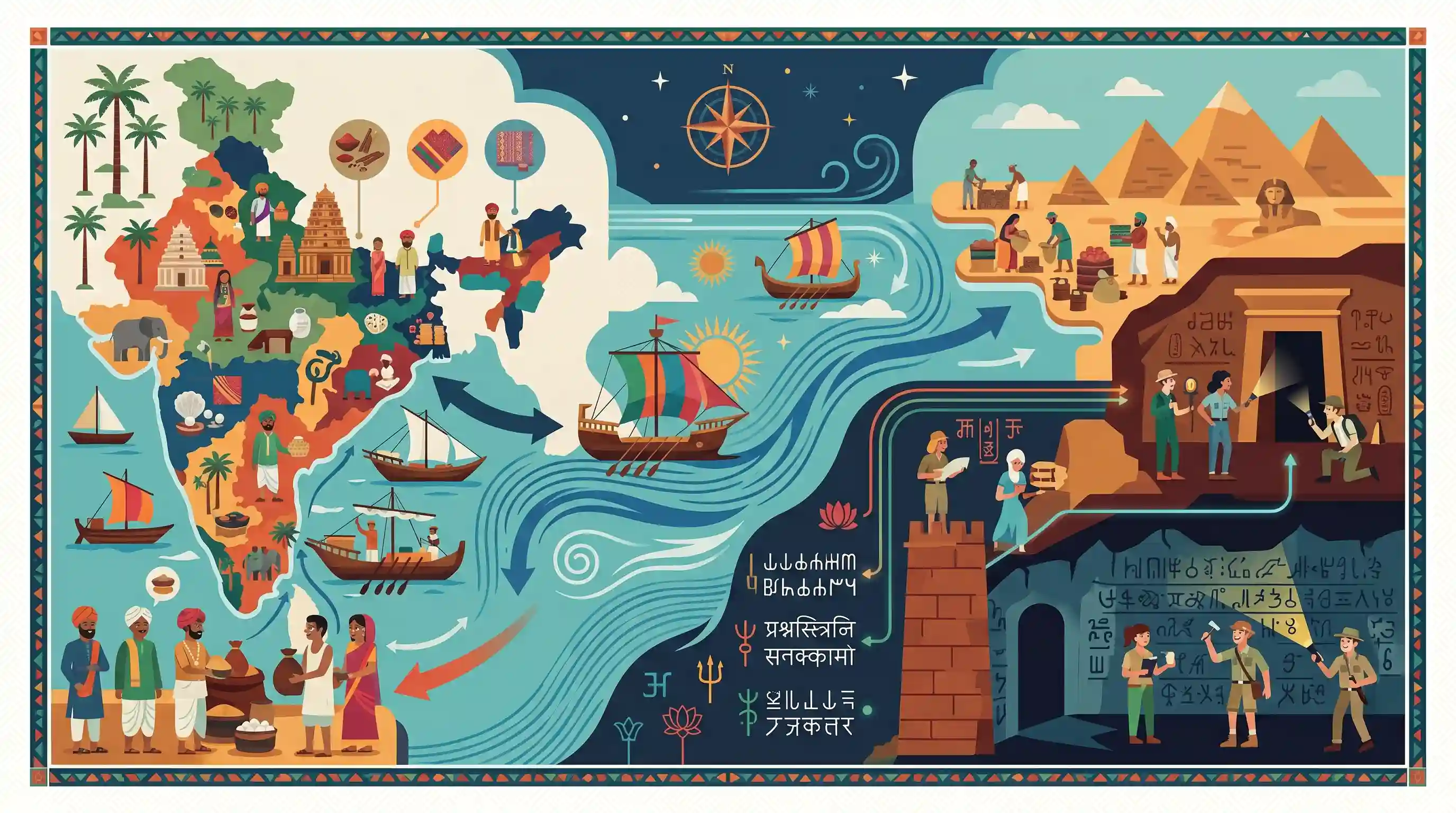
The presence of Tamil, Sanskrit, and Prakrit graffiti on the walls of Egyptian Pharaohs' tombs and at ancient Red Sea ports stands as a testament to the extensive maritime connections between ancient India and the Mediterranean world. These epigraphical findings reveal that Indian merchants and travelers from diverse linguistic regions—both North and South India—navigated the Indian Ocean to participate in lucrative trade networks. The discovery underscores the importance of ancient Indian ports in global commerce and highlights how inscriptions serve as invaluable historical sources for tracing cultural and economic exchanges in antiquity.
Key Points
- Archaeological discoveries in Egypt have revealed graffiti in ancient Indian scripts, including Tamil-Brahmi, Sanskrit, and Prakrit, on the walls of Pharaohs' tombs and at Red Sea port sites.
- These inscriptions provide concrete epigraphical evidence of robust maritime trade and cultural exchange between ancient India and the Greco-Roman world via the Red Sea route.
- The diverse languages indicate that merchants, sailors, and travelers from both South India (using Tamil) and North India (using Sanskrit/Prakrit) actively participated in this trans-oceanic commerce.
- The findings highlight the historical significance of ancient Indian ports (such as Muziris and Poompuhar) and underscore epigraphy as a vital source for reconstructing early global trade networks.
Prelims Trap
"Only Tamil-Brahmi inscriptions are found in Egypt, indicating exclusive South Indian participation in Indo-Roman trade."
Excavations in Egypt reveal a mix of Tamil, Sanskrit, and Prakrit graffiti, proving that merchants from both North and South India actively engaged in Red Sea trade.
Static Concepts Connected
What were the major ancient Indian ports driving Indo-Roman maritime trade?
- West Coast ports: Included Muziris (Muchiri) in Kerala, Barygaza (Broach) in Gujarat, and Sopara. These handled spices, pearls, and precious stones exported to Rome.
- East Coast ports: Included Arikamedu (Poduke), Poompuhar (Kaveripoompattinam), and Korkai. These were vital for textiles and acted as transit hubs for Southeast Asian goods.
How do formal and informal ancient inscriptions differ as historical sources?
- Formal royal epigraphy: Like the Ashokan edicts (Prakrit/Brahmi), these were commissioned by states to broadcast royal decrees, dharma, and administrative policies to the public.
- Informal graffiti: Like merchant graffiti on pottery sherds or cave walls, these reveal the socio-economic life, literacy levels, and cross-cultural movements of commoners and non-elites.
Cross-Topic Patterns
Geography: Monsoon winds & trade routes
The 1st-century CE boom in Red Sea graffiti coincides directly with the discovery of the monsoon winds by Hippalus, which enabled direct open-ocean navigation from Egypt to India's western coast.
Epigraphy validating Sangam literature
Tamil-Brahmi graffiti in Egypt provides hard epigraphic proof for the vibrant 'Yavana' (Greco-Roman) maritime trade described extensively in Sangam literary epics like the Silappatikaram.

Expect a pair-matching question linking ancient ports (Muziris, Korkai, Berenike) to their respective coasts or associated trade networks.
Linked PYQs · 3
Linked PYQs · 3
- 2023PrelimsGS1
With reference to ancient South India, Korkai, Poompuhar and Muchiri were well known as
- 2016PrelimsGS1
Who of the following had first deciphered the edicts of Emperor Ashoka?
- 2024PrelimsGS1
Consider the following information (Archaeological Site — State — Description): 1. Chandraketugarh — Odisha — Trading port town 2. Inamgaon — Maharashtra — Chalcolithic site 3. Mangadu — Kerala — Megalithic site 4. Salihundam — Andhra Pradesh — Rock-cut cave shrines In which of the above rows is the given information correctly matched?
