Tamil Nadu Government Proposes Gradual Increase in Women Grants
Source:The Hindu ↗
Why It Matters
It illustrates the ongoing tension between executing expansive welfare guarantees and maintaining sound state fiscal health. Furthermore, it highlights the operational challenge of converging state-level unconditional cash transfers with targeted Central social security schemes to rationalize public expenditure.
Summary
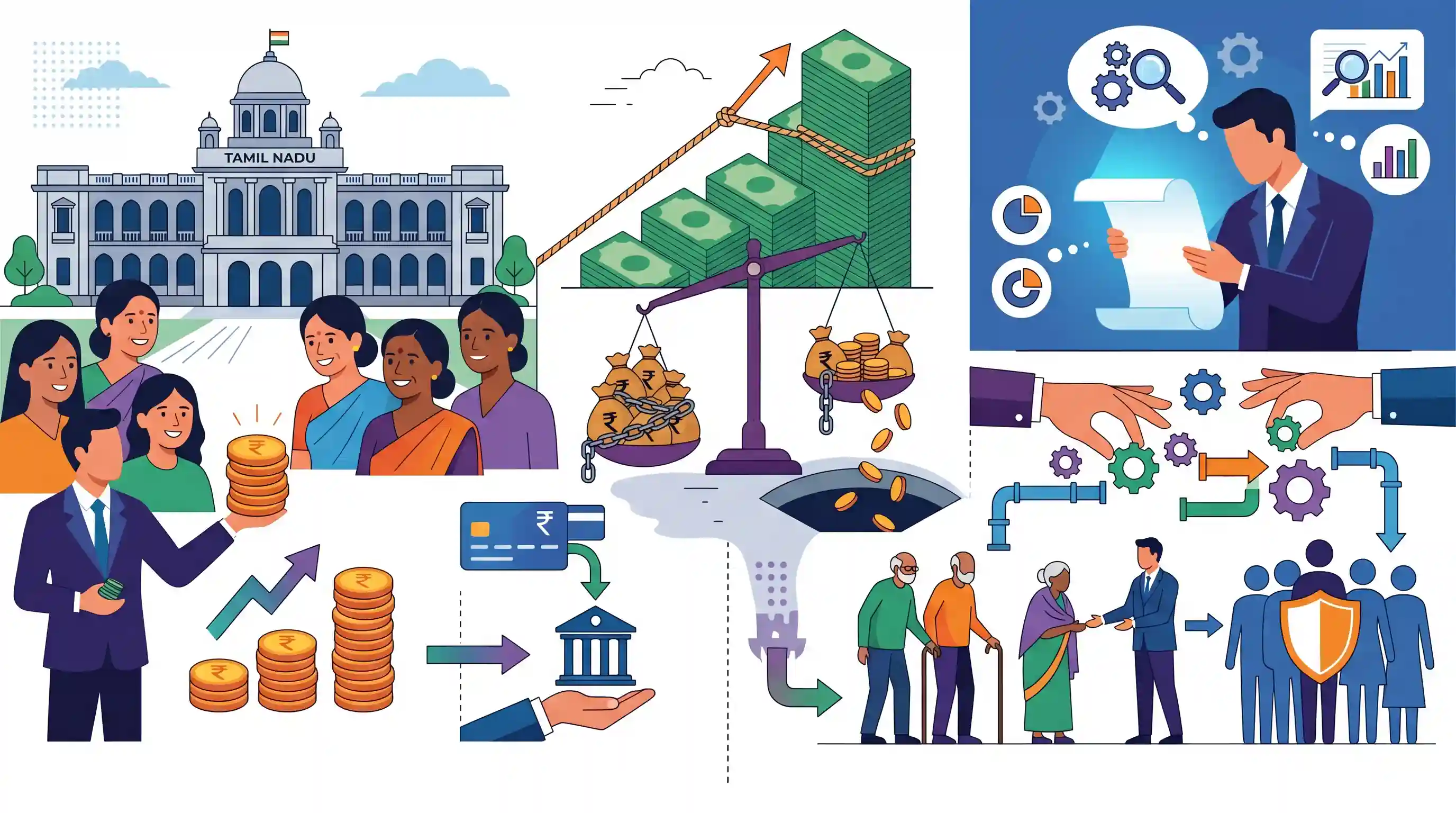
The newly-formed Tamil Nadu government plans to revamp its existing women's basic income scheme, renaming it 'Madhippumigu Magalir Thittam' and potentially increasing the monthly grant from ₹1,000 to ₹1,500. While the proposed hike aims to fulfill election promises, it will substantially increase the state's fiscal burden to ₹23,400 crore annually. To responsibly manage state finances and plan the rollout, the government will release a White Paper on the state's financial health. Additionally, officials are exploring the integration of senior citizen beneficiaries with the centrally-supported Old Age Pension scheme to rationalize expenditure.
Key Points
- The Tamil Nadu government intends to restructure its flagship women's basic income scheme into the 'Madhippumigu Magalir Thittam', gradually raising the payout from ₹1,000 to ₹1,500.
- Increasing the financial aid for roughly 1.3 crore women will elevate the scheme's annual expenditure from ₹15,600 crore to ₹23,400 crore.
- A forthcoming White Paper on state finances will be used to calibrate the implementation of the ruling party’s manifesto promises against current fiscal realities.
- With about 15% of the current beneficiaries aged over 60, policymakers are exploring whether to migrate them to the Old Age Pension (OAP) scheme to leverage central funding and optimize state resources.
Important Terms
Madhippumigu Magalir Thittam

The proposed revamped name for Tamil Nadu’s women’s basic income scheme, aiming to provide monthly financial assistance (up to ₹2,500) to women heads of households.
UPSC context
GS-II: Welfare schemes for vulnerable sections. Tests knowledge of state-level social security and gender-budgeting initiatives.
Kalaignar Magalir Urimai Thogai (KMUT)
The original flagship scheme of the previous DMK government providing ₹1,000 monthly to eligible women heads of families to recognize unpaid household labor.
UPSC context
GS-II/III: Social Justice and Inclusive Growth. Focuses on women's empowerment through unconditional cash transfers.
Indira Gandhi National Old Age Pension Scheme (IGNOAPS)
A non-contributory central pension scheme under the National Social Assistance Programme (NSAP) providing financial support to BPL elderly citizens aged 60 and above.
UPSC context
GS-II: Social Justice. Understanding the Centre-State architecture for social security and elderly care.
White Paper
An authoritative government report detailing the status of a specific issue, typically used to provide transparency on state finances or public debt before major policy changes.
UPSC context
GS-III: Indian Economy. Relates to fiscal management, transparency, and government accountability in managing public debt.
Direct Benefit Transfer (DBT)
A governance mechanism that transfers subsidies or cash directly to beneficiaries' bank accounts to eliminate intermediaries, reduce leakages, and ensure transparency.
UPSC context
GS-II/III: Governance and Economy. Central to discussions on welfare efficiency and the use of technology in social justice.
Prelims Trap
Women's basic income grants are classified as capital expenditure since they build human capital.
These grants are recurring revenue expenditures. They neither create physical/financial assets for the government nor reduce its liabilities.
Static Concepts Connected
How are unconditional cash transfers classified in government budgets?
- Revenue Expenditure: Unconditional DBTs are recurring expenses that do not create physical or financial assets for the state.
- Fiscal Impact: High revenue expenditure limits the fiscal space available for capital expenditure like infrastructure creation.
Which Constitutional provisions mandate social security schemes like Old Age Pensions?
- Article 41: Directs the State to secure public assistance in cases of unemployment, old age, sickness, and disablement.
- Implementation: The National Social Assistance Programme (NSAP) acts as the welfare mechanism operationalizing this Directive Principle.
Cross-Topic Patterns
Welfare DBTs vs. State Fiscal Capacity
Rising state-level cash transfers severely constrain capital expenditure, reviving Supreme Court and RBI debates on 'irrational freebies' versus 'merit goods' in electoral democracy.
Monetising Unpaid Care Work
Basic income for women is increasingly framed as structural economic compensation for unpaid domestic labor, connecting directly to GS1/GS3 debates on Female Labour Force Participation.

Expect a 2026 Mains question analyzing the trade-off between targeted DBTs for women's empowerment and state capital expenditure limits.
Linked PYQs · 4
Linked PYQs · 4
- 2025MainsGS3
Explain how the Fiscal Health Index (FHI) can be used as a tool for assessing the fiscal performance of states in India. In what way would it encourage the states to adopt prudent and sustainable fiscal policies?
- 2019MainsGS2
Performance of welfare schemes that are implemented for vulnerable sections is not so effective due to absence of their awareness and active involvement at all stages of policy process. Discuss.
- 2025MainsGS2
Women's social capital complements in advancing empowerment and gender equity. Explain.
- 2020MainsGS2
In order to enhance the prospects of social development, sound and adequate health care policies are needed particularly in the fields of geriatric and maternal health care. Discuss.
