Women-led panchayats in Tamil Nadu and political reservation impact
Source:Indian Express ↗
Why It Matters
Provides an excellent positive case study for Mains GS2 answers concerning women's reservation in PRIs and state/national legislatures. It can be directly used to evaluate the impact of the 73rd Amendment and the potential of the Nari Shakti Vandan Adhiniyam.
Summary
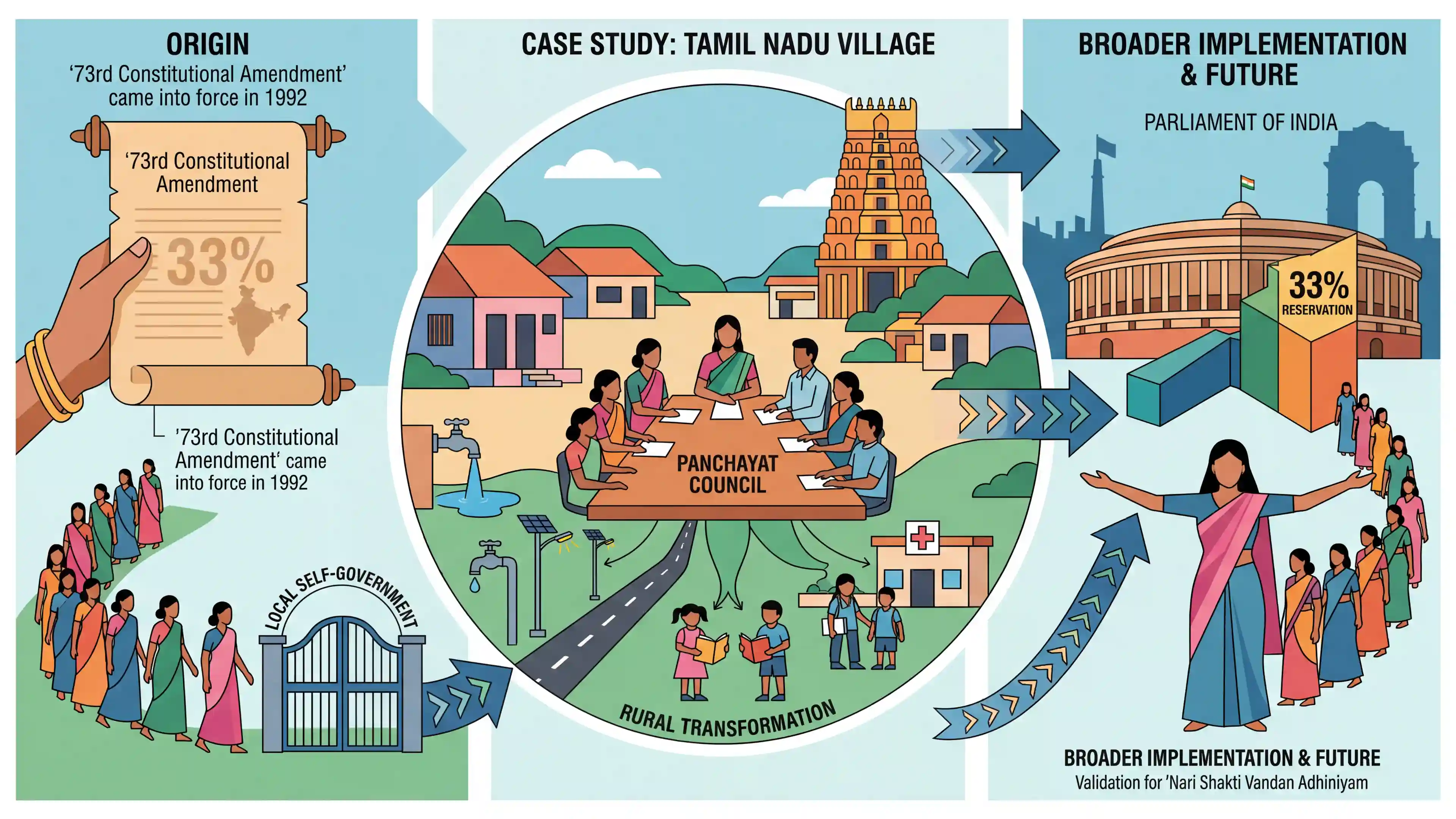
A small village in Tamil Nadu, led by a woman President and featuring a panchayat council with 6 female members out of 8, has become a model for local governance and rural transformation. This success story highlights the practical benefits and empowering potential of women in grassroots politics, tracing back to the 73rd Constitutional Amendment. It serves as a compelling case study demonstrating women's effectiveness in leadership roles, offering strong validation for the broader implementation of women's reservation in state and national legislatures through the Nari Shakti Vandan Adhiniyam.
Key Points
- A village panchayat in Tamil Nadu, led by a woman President and comprising 6 female members out of 8, has emerged as a successful model for grassroots transformation.
- The predominantly women-led council effectively demonstrates the positive on-ground impact of political reservation for women in local self-governance.
- This success story counters narratives surrounding the 'Sarpanch Pati' syndrome, showcasing genuine female leadership and administrative capability in rural India.
- It serves as an encouraging precedent and strong validation for the broader objectives of the Women's Reservation Bill (Nari Shakti Vandan Adhiniyam) aimed at higher legislative bodies.
Important Terms
Nari Shakti Vandan Adhiniyam

The 106th Constitutional Amendment Act (2023) reserving one-third of seats for women in the Lok Sabha, State Legislative Assemblies, and the Delhi Assembly for 15 years.
UPSC context
GS Paper II: Polity and Governance; tests knowledge of legislative reforms for gender parity and constitutional amendments.
73rd Constitutional Amendment Act
The 1992 legislation that institutionalized Panchayati Raj in India, mandating a three-tier rural governance structure and reserving at least 33% of seats for women.
UPSC context
GS Paper II: Local Self-Government; critical for understanding the evolution of grassroots democracy and women's political empowerment.
Panchayati Raj Institutions (PRIs)
A three-tier system of rural local self-government (Gram Panchayat, Panchayat Samiti, Zila Parishad) established to ensure economic development and social justice at the village level.
UPSC context
GS Paper II: Governance; focuses on the devolution of powers, funds, and functionaries to local bodies.
Gram Sabha
The foundational body of the Panchayati Raj system, consisting of all registered voters in a village, exercising direct democracy and supervising local development.
UPSC context
GS Paper II: Local Governance; tests understanding of participatory democracy and the accountability of village executives.
Democratic Decentralization
The process of devolving political, administrative, and fiscal powers from central/state governments to local authorities to increase citizen participation in decision-making.
UPSC context
GS Paper II: Governance; core concept for questions on federalism and empowering local units of self-government.
Prelims Trap
The 106th Amendment mandates 33% reservation for women in the Lok Sabha, Rajya Sabha, and all State Legislative Assemblies.
The reservation under the 106th Amendment applies ONLY to the Lok Sabha, State Legislative Assemblies, and NCT of Delhi. It does NOT extend to the Rajya Sabha or State Legislative Councils.
Static Concepts Connected
What are the constitutional provisions for women's reservation in Panchayats?
- Article 243D: Mandates at least one-third (33%) reservation of total seats for women, including within the SC and ST quotas.
- Chairperson Quota: Not less than one-third of the total number of offices of Chairpersons in Panchayats at each level must be reserved for women.
- State Discretion: State legislatures have the authority to increase this reservation. Several states, including Tamil Nadu and Bihar, have raised the women's quota in PRIs to 50%.
What are the key mechanisms of the 106th Constitutional Amendment Act?
- New Articles: Inserts Articles 330A and 332A to provide 33% reservation for women in the Lok Sabha and State Legislative Assemblies, respectively.
- Delimitation Contingency: Under Article 334A, the quota will only come into effect after a delimitation exercise is undertaken based on the first census published after the Act's passage.
- Sunset Clause: The reservation is provided for a period of 15 years from its commencement, though Parliament can extend it by law.
Cross-Topic Patterns
De jure vs De facto empowerment
The success of women in PRIs counters the 'Sarpanch Pati' proxy phenomenon, directly linking political reservations to GS1 Society (patriarchy) and GS4 (administrative ethics in proxy governance).
Women's Quota tied to Delimitation
The operationalization of the Nari Shakti Vandan Adhiniyam is constitutionally bound to upcoming census and delimitation exercises, merging gender justice with complex electoral federalism.

Expect a multi-statement Prelims question testing the exact Articles (330A, 332A, 334A) and exceptions (Rajya Sabha) of the 106th CAA.
Linked PYQs · 2
Linked PYQs · 2
- 2019MainsGS2
“The reservation of seats for women in the institutions of local self-government has had a limited impact on the patriarchal character of the Indian Political Process.” Comment.
- 2023MainsGS2
Discuss the contribution of civil society groups for women's effective and meaningful participation and representation in state legislatures in India.
