Supreme Court Stays High Court Order on MLA Voting
Source:The Hindu ↗
Why It Matters
The judgment reaffirms the constitutional principle that electoral disputes are insulated from general writ jurisdiction (Article 226) and must follow statutory procedures (Election Petitions). This prevents unwarranted judicial interference in legislative proceedings, such as floor tests, which are essential for democratic stability.
Summary
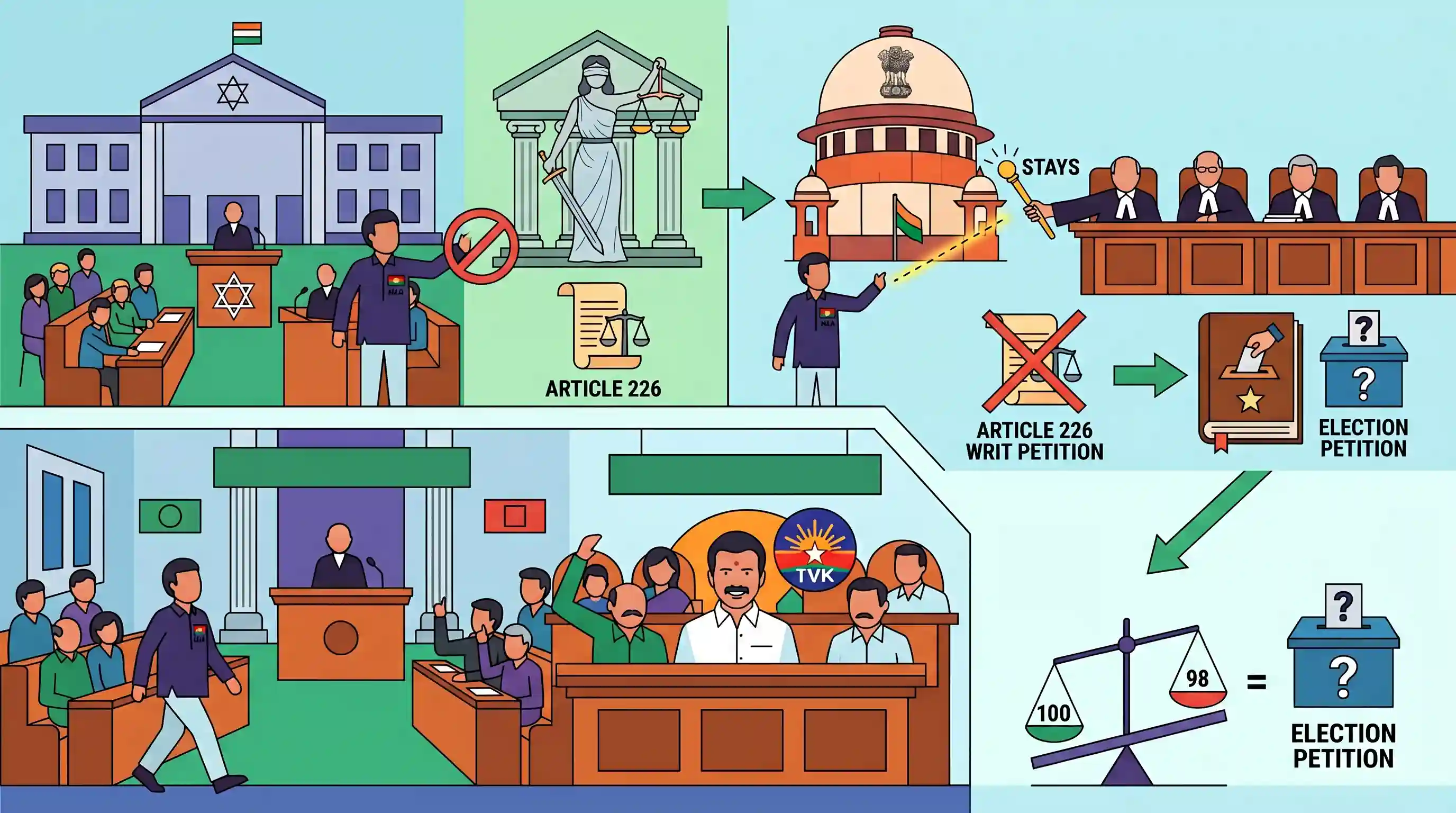
The Supreme Court stayed a Madras High Court order that barred TVK MLA R. Sreenivasa Sethupathi from voting in a Tamil Nadu Assembly floor test. The SC strongly criticized the High Court for entertaining a writ petition under Article 226, reiterating that electoral disputes must be addressed through election petitions under the Representation of the People Act. The stay allowed the MLA to participate in the confidence motion, preserving the razor-thin majority of the newly formed TVK government led by Chief Minister C. Joseph Vijay.
Key Points
- TVK MLA R. Sreenivasa Sethupathi won the Tiruppattur constituency by a margin of one vote against DMK's K.R. Periakaruppan.
- The Madras High Court entertained a writ petition under Article 226 regarding EVM and postal ballot disputes, barring Sethupathi from voting in a crucial floor test.
- The Supreme Court stayed the High Court's order, terming the intervention 'atrocious' because electoral disputes must exclusively be challenged via election petitions under the Representation of the People Act.
- The Supreme Court's stay allowed Sethupathi to participate in the trust vote, ensuring the newly formed TVK government (led by C. Joseph Vijay) maintained its razor-thin majority in the Tamil Nadu Assembly.
- The case reinforces the constitutional boundaries of judicial review, emphasizing that High Courts cannot use writ jurisdiction to bypass established electoral dispute mechanisms.
Important Terms
Article 226

Empowers High Courts to issue writs for the enforcement of fundamental rights and other legal purposes. It is part of the basic structure of the Constitution.
UPSC context
GS-II (Polity/Judiciary); tests understanding of High Courts' writ jurisdiction and its comparison with Article 32.
Article 329
Bars courts from interfering in electoral matters, mandating that an election can only be challenged via an 'election petition' after the process is complete.
UPSC context
GS-II (Elections); covers constitutional limitations on judicial review during active electoral processes.
Representation of the People Act, 1951
The primary statute regulating the conduct of elections, candidate qualifications/disqualifications, and the adjudication of disputes in India.
UPSC context
GS-II (Statutory Provisions); central to the 'Salient features of the Representation of People’s Act' syllabus topic.
Election Petition
A statutory remedy under the RPA 1951 to challenge the validity of an election result, filed exclusively in the High Court.
UPSC context
GS-II (Elections); tests knowledge of the specific legal mechanism for redressing electoral grievances.
Floor Test
A constitutional mechanism where a Chief Minister proves majority support in the Legislative Assembly, usually directed by the Governor.
UPSC context
GS-II (State Legislature); relevant for understanding executive accountability and legislative procedures.
Tamilaga Vettri Kazhagam (TVK)
A regional political party in Tamil Nadu founded by actor-politician C. Joseph Vijay, emphasizing social justice and secularism.
UPSC context
GS-II (Political Parties); relevant for studying regionalism and the evolution of state-level political dynamics.
Prelims Trap
"High Courts can entertain election disputes through writ petitions under Article 226."
High Courts hear election disputes ONLY via statutory "Election Petitions" under RPA 1951. Article 329(b) expressly bars courts from interfering in electoral matters using standard writ jurisdiction (Article 226).
Static Concepts Connected
How are election disputes resolved in India?
- Article 329(b): Bars interference in electoral matters by any court except through an election petition presented to the prescribed authority.
- High Court Jurisdiction: Under the Representation of the People Act, 1951, High Courts have original jurisdiction to hear and decide election petitions.
- Supreme Court Appeal: Appeals against the High Court's decision on an election petition lie directly to the Supreme Court.
What are the rules governing Floor Tests and MLA voting rights?
- Collective Responsibility: Under Article 164(2), the Council of Ministers is collectively responsible to the Legislative Assembly, necessitating a floor test to prove majority.
- Bommai Precedent: As established in the S.R. Bommai case (1994), a government's majority must be tested on the assembly floor, not subjectively by the Governor.
- Voting Rights: Unless formally disqualified or their election is set aside, an elected MLA retains absolute legislative rights, including voting in confidence motions.
Cross-Topic Patterns
Article 329(b) vs Judicial Review
The constitutional bar on judicial interference in elections (Article 329) limits writ jurisdiction (Article 226), creating a rare constitutional boundary on judicial review, which is otherwise a 'basic structure' feature.
Governor's discretion + Floor tests
Frequent state-level political realignments tie the legality and timing of floor tests to the Governor's discretionary powers under Article 163, a recurring theme linked to S.R. Bommai guidelines.

Expect a 2026 prelims question merging Article 329(b) limits on writ jurisdiction with the statutory rules of Election Petitions under RPA.
Linked PYQs · 2
Linked PYQs · 2
- 2022MainsGS2
Discuss the procedures to decide the disputes arising out of the election of a Member of the Parliament or State Legislature under The Representation of the People Act, 1951. What are the grounds on which the election of any returned candidate may be declared void ? What remedy is available to the aggrieved party against the decision ? Refer to the case laws.
- 2019MainsGS2
On what grounds a people's representative can be disqualified under the Representation of Peoples Act, 1951? Also mention the remedies available to such person against his disqualification.
