Tamil Nadu Urban Development and Policy Stability Framework
Source:The Hindu ↗
આ શા માટે મહત્વનું છે
The article serves as an excellent case study of how a highly urbanized Indian state is planning to manage rapid urban growth. It touches upon crucial UPSC themes such as sustainable urban development, public-private partnerships in infrastructure, transparent governance, and the integration of climate resilience (e.g., green buildings and stormwater management) into urban planning.
સારાંશ
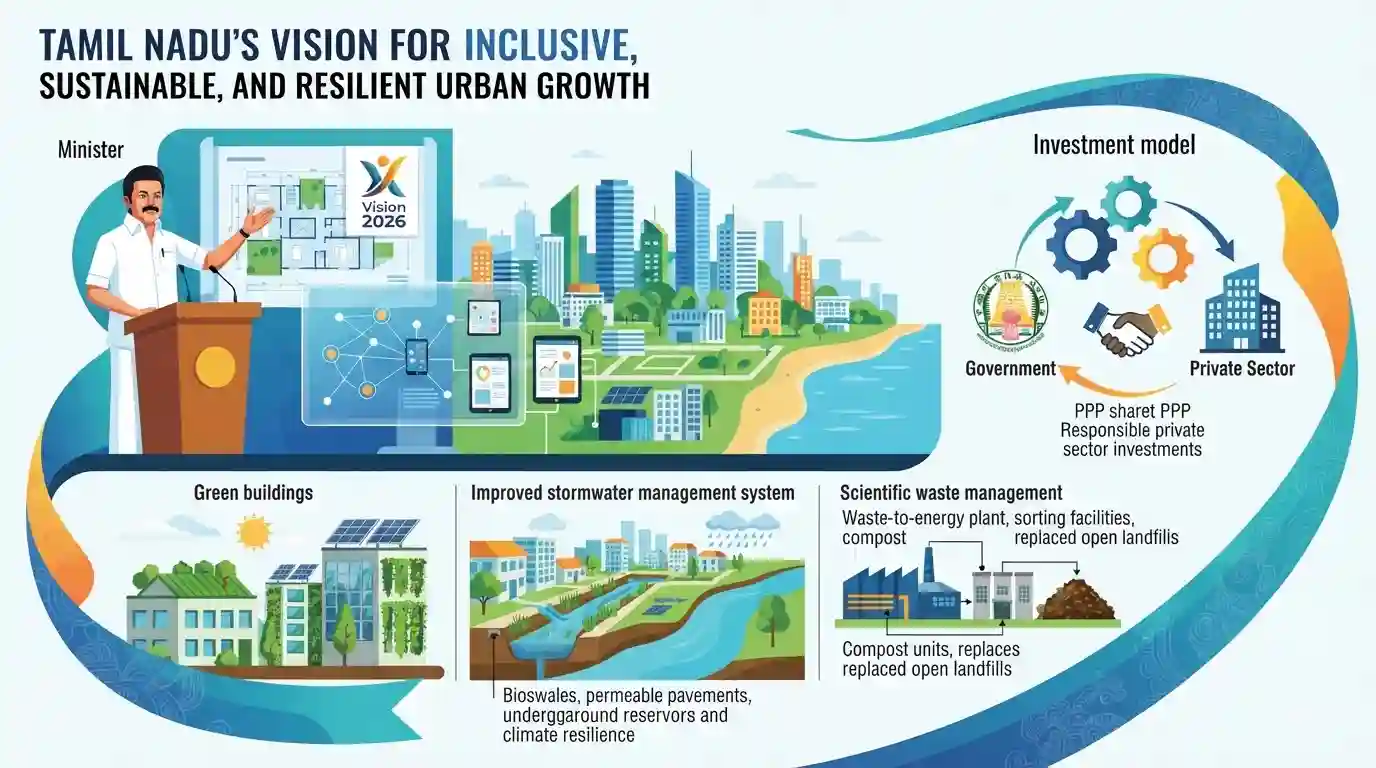
Tamil Nadu's Housing and Urban Development Minister, B. Rajkumar, outlined the State's vision for inclusive, sustainable, and resilient urban growth at 'The Hindu Real Estate and Urban Infrastructure Summit 2026'. Acknowledging that over half of Tamil Nadu's population resides in urban areas, the government under Chief Minister C. Joseph Vijay is focusing on policy stability, transparent technology-driven governance, and rapid planning approvals. Key environmental interventions highlighted include climate-resilient infrastructure, green buildings, improved stormwater management, and scientific waste management. The Minister also emphasized that achieving world-class cities requires strong public-private partnerships (PPP) and responsible private sector investments, ensuring that rapid economic development does not compromise environmental sustainability.
મુખ્ય મુદ્દા
- Tamil Nadu is among India's most urbanized states, with over 50% of its population living in urban areas, necessitating sustainable and inclusive urban planning.
- The State government is committed to transparent, technology-driven, and citizen-friendly urban governance, including faster planning approvals and integrated mobility.
- There is a strong focus on sustainable urban development, encompassing green buildings, energy-efficient construction, water conservation, climate-resilient infrastructure, and scientific waste management to mitigate urban climate challenges like flooding.
- The Minister underscored the importance of Public-Private Partnerships (PPP), welcoming responsible private sector investments in infrastructure, manufacturing, and renewable energy to build world-class cities.
- Economic and urban growth must be balanced and should not come at the expense of environmental integrity.
મહત્વપૂર્ણ શબ્દો
Public-Private Partnership (PPP)

A collaborative framework between a government entity and private developers to finance, build, and operate public projects, sharing both risk and resources to bridge critical funding gaps.
UPSC context
GS Paper III (Investment Models). Tests understanding of resource mobilization, risk-sharing, and infrastructure development strategies.
Climate-Resilient Infrastructure
Infrastructure systems planned, designed, and constructed to withstand extreme weather events, adapt to climate change, and recover quickly, minimizing economic and social disruptions.
UPSC context
GS Paper III (Environment & Disaster Management). Tests knowledge of sustainable development, adaptation planning, and disaster mitigation strategies.
Urban Flooding
The submergence of built-up areas caused by heavy rainfall that overwhelms municipal drainage capacities, typically aggravated by rapid concretization, unplanned urban growth, and loss of wetlands.
UPSC context
GS Paper III (Disaster Management). Tests understanding of urban planning failures, anthropogenic disaster causes, and mitigation mechanisms.
Green Buildings
Structures designed and operated to optimize the efficient use of energy, water, and materials while minimizing their negative impact on human health and environment.
UPSC context
GS Paper III (Environment & Sustainable Development). Tests knowledge of sustainable architecture, emission reduction, and green rating systems like GRIHA.
Government of Tamil Nadu
The governing state authority of Tamil Nadu, comprising an executive branch led by the Governor and Chief Minister, a unicameral Legislative Assembly, and the judiciary.
UPSC context
GS Paper II (Polity & Federalism). Tests understanding of state-level executive functions, regional policy-making, and federal structures in India.
પ્રિલિમ્સ ટ્રેપ
The Water and Sanitation Pooled Fund (WSPF) of Tamil Nadu issued India's first-ever municipal bond in 2003.
Ahmedabad Municipal Corporation issued India's first individual municipal bond in 1998. WSPF issued India's first *pooled* municipal bond, which grouped multiple small municipalities.
સંલગ્ન સ્થિર ખ્યાલો
What is a Pooled Municipal Bond and how does it assist Urban Local Bodies?
- Credit Aggregation: Combines multiple small or medium ULBs into a single debt-issuing entity to achieve scale.
- Cost Reduction: Reduces high bond issuance transaction costs and enhances creditworthiness through shared risk pools.
- Institutional Success: Tamil Nadu's WSPF pioneered this in 2003, inspiring the national Pooled Finance Development Fund.
How do Sponge Cities mitigate urban flooding and restore local water tables?
- Natural Absorption: Replaces impervious concrete surfaces with permeable pavements, rain gardens, and bioswales to absorb stormwater.
- Aquifer Recharge: Directs harvested surface runoff into underground aquifers, naturally replenishing depleting groundwater reserves.
- Blue-Green Integration: Combines natural water bodies (blue) and green spaces (green) to balance the hydrological cycle.
આંતર-વિષય પેટર્ન
Traditional Hydrology + Modern Disaster Mitigation
Reviving ancient gravity-fed tank cascades (Eris) acts as natural sponge infrastructure, offering low-cost resilience against climate-induced urban deluge.
Fiscal Decentralization + Capital Markets
The 74th Amendment's devolution of functional powers remains incomplete without financial autonomy tools, making pooled municipal bonds vital for local self-governance.

Sponge city designs and the structural mechanics of pooled municipal bonds (WSPF vs PFDF) are likely 2026 multi-statement Prelims targets.
સંલગ્ન PYQ · 4
સંલગ્ન PYQ · 4
- 2025MainsGS1
How does smart city in India, address the issues of urban poverty and distributive justice?
- 2024MainsGS3
Flooding in urban areas is an emerging climate-induced disaster. Discuss the causes of this disaster. Mention the features of two such major floods in the last two decades in India. Describe the policies and frameworks in India that aim at tackling such floods.
- 2022MainsGS3
Why is Public Private Partnership (PPP) required in infrastructural projects ? Examine the role of PPP model in the redevelopment of Railway Stations in India.
- 2021PrelimsGS1
The 'Common Carbon Metric', supported by UNEP, has been developed for
