Tamil Nadu Basic Science Research Funding for Green Technology
Source:The Hindu ↗
Why It Matters
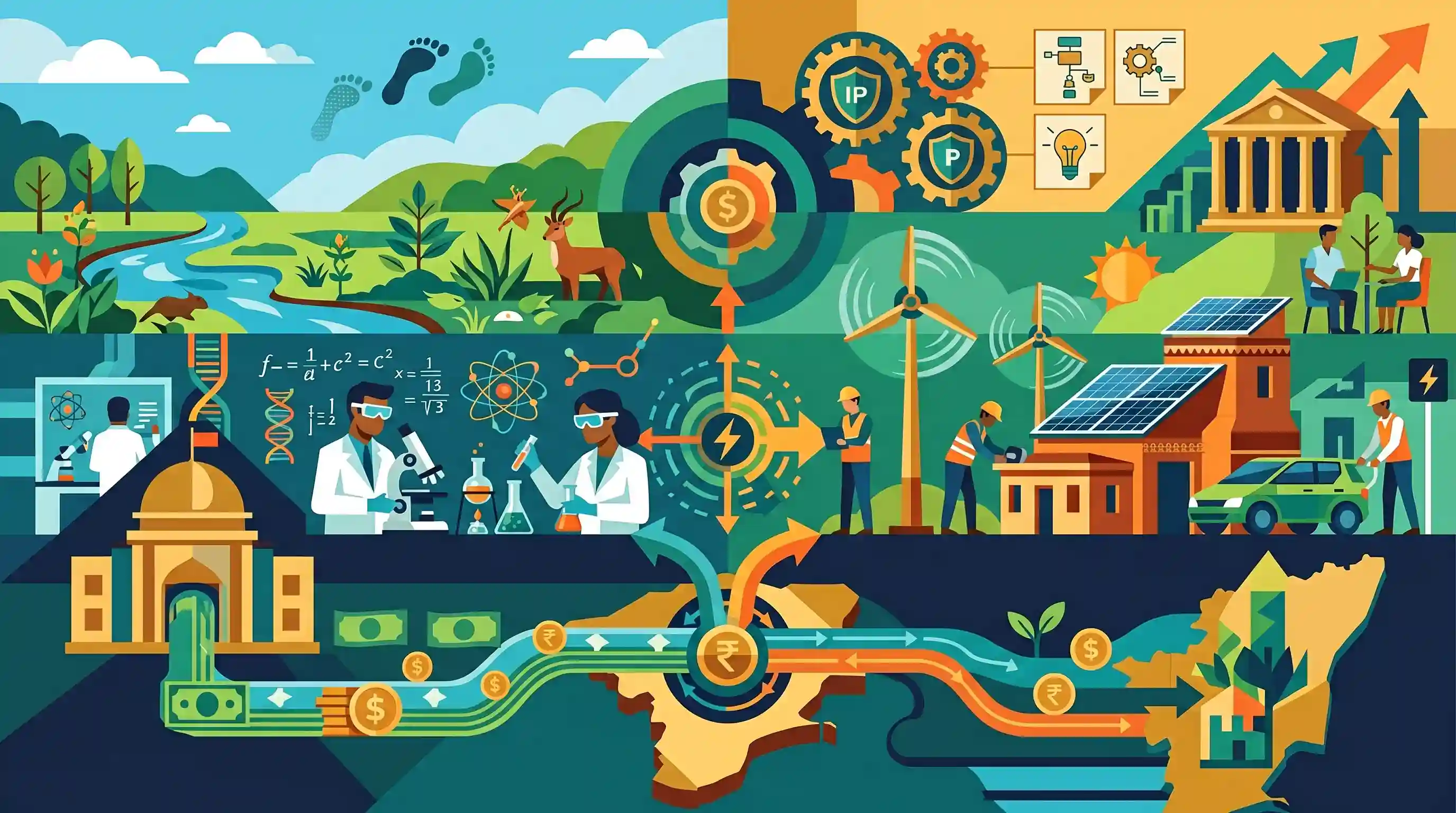
Highlights the intrinsic link between fundamental scientific research funding and the development of applied green technologies, which is a critical area for India's sustainable development and climate commitments.
Summary
The article argues that Tamil Nadu must significantly increase its funding for basic science research to drive the development of indigenous green technologies. Emphasizing that applied sustainable solutions root from strong foundational science, it advocates for robust state-level investment in research and development. This approach is positioned as essential not only for effective climate change mitigation and environmental sustainability but also for fostering localized innovation, creating intellectual property, and ensuring long-term economic resilience.
Key Points
- Emphasizes the critical need for increased funding in basic sciences to foster innovation in green technologies.
- Suggests that state-level investment (specifically in Tamil Nadu) in research and development is vital for developing localized and sustainable solutions to climate change.
- Highlights that applied technologies for environmental mitigation often stem from robust foundational research in basic sciences.
- Points out that creating intellectual property and home-grown green tech can aid in both economic growth and achieving climate goals.
Important Terms
Basic Science Research

Fundamental research aimed at understanding natural phenomena and basic principles without immediate practical application.
UPSC context
GS Paper III: Science & Technology foundation. Tests understanding of the innovation cycle and long-term R&D investment.
Applied Science
The application of scientific knowledge and principles to solve specific problems and develop tangible products or technologies.
UPSC context
GS Paper III: Technology development. Focuses on the transition from lab-scale discovery to industrial-scale utility.
Green Technology
Sustainable technologies, products, or processes that utilize renewable resources and minimize greenhouse gas emissions and environmental impact.
UPSC context
GS Paper III: Environment & S&T. Central to climate change mitigation and India's Net Zero commitments.
Indigenization of Technology
The process of developing, adapting, and manufacturing technology domestically to reduce import reliance and ensure strategic autonomy.
UPSC context
GS Paper III: Core syllabus topic. Evaluates strategies for self-reliance (Atmanirbhar Bharat) and economic resilience.
Intellectual Property Rights (IPR)
Legal protections granted for intellectual creations (patents, copyrights, etc.) that enable creators to earn recognition or financial benefit.
UPSC context
GS Paper III: Economics & S&T. Tests knowledge of the patent ecosystem and international agreements like TRIPS.
Gross Expenditure on R&D (GERD)
A metric representing the total domestic investment in research and development activities, typically expressed as a percentage of GDP.
UPSC context
GS Paper III: Economy & S&T. Key indicator used to compare India's innovation funding with global benchmarks.
Prelims Trap
"In India, the private sector contributes the majority share to the Gross Domestic Expenditure on R&D (GERD)."
False. Unlike developed nations where the private sector drives innovation, India's GERD is predominantly funded by the Central Government (~43.7%), with the private sector trailing at ~36.4%.
Static Concepts Connected
What characterizes the structure of India's Gross Domestic Expenditure on R&D (GERD)?
- Low GDP Share: India's GERD remains stagnant at around 0.64% of GDP, significantly lower than the global average of 1.8% and major economies like the US or China.
- Government Dominance: The Central Government drives ~43.7% of GERD, while State Governments contribute a meager 6.7%, reflecting highly centralized R&D funding.
- Low Private Participation: The private sector accounts for only ~36.4% of R&D expenditure, unlike developed nations where private enterprises drive over 60% of innovation.
Why is indigenous basic science crucial for climate technology under the UNFCCC framework?
- IPR Barriers: Intellectual Property Rights make importing green technologies highly expensive, hindering the UNFCCC’s mandate for technology transfer to developing nations.
- Foundational Deficit: Applied green solutions (like electrolyzers) require strong basic science. Without local R&D, nations remain dependent on expensive foreign technologies.
- Climate Justice: Indigenization empowers developing nations to achieve mitigation goals without compromising economic growth or bowing to restrictive Western tech monopolies.
Cross-Topic Patterns
Fiscal federalism and state R&D capacity
State governments contribute just ~6.7% to India's GERD. This reflects broader fiscal federalism challenges, where strained state budgets prioritize immediate welfare over long-term capital and scientific innovation investments.
WTO TRIPS vs. UNFCCC Tech Transfer
The reluctance of developed nations to waive IPRs for green technologies forces countries like India to prioritize indigenous R&D, linking trade rules directly to climate mitigation timelines.

Expect a multi-statement Prelims question analyzing India's GERD composition (Central vs Private) and the Anusandhan NRF's goals.
Linked PYQs · 4
Linked PYQs · 4
- 2021MainsGS3
What are the research and developmental achievements in applied biotechnology? How will these achievements help to uplift the poorer sections of the society?
- 2024MainsGS3
The world is facing an acute shortage of clean and safe freshwater. What are the alternative technologies which can solve this crisis? Briefly discuss any three such technologies citing their key merits and demerits.
- 2018MainsGS3
“Access to affordable, reliable, sustainable and modern energy is the sine qua non to achieve Sustainable Development Goals (SDGs).” Comment on the progress made in India in this regard.
- 2020MainsGS3
How is science interwoven deeply with our lives? What are the striking changes in agriculture triggered off by the science-based technologies?
