Tamil Nadu Vision 2031 Focuses on Green Energy and EV Infrastructure
Source:The Hindu ↗
ఇది ఎందుకు ముఖ్యం
Showcases state-level action towards India's national climate commitments and energy transition. The emphasis on Battery Energy Storage Systems (BESS), smart metering, and reduction of AT&C losses addresses critical hurdles in renewable integration and the financial viability of power distribution companies.
సారాంశం
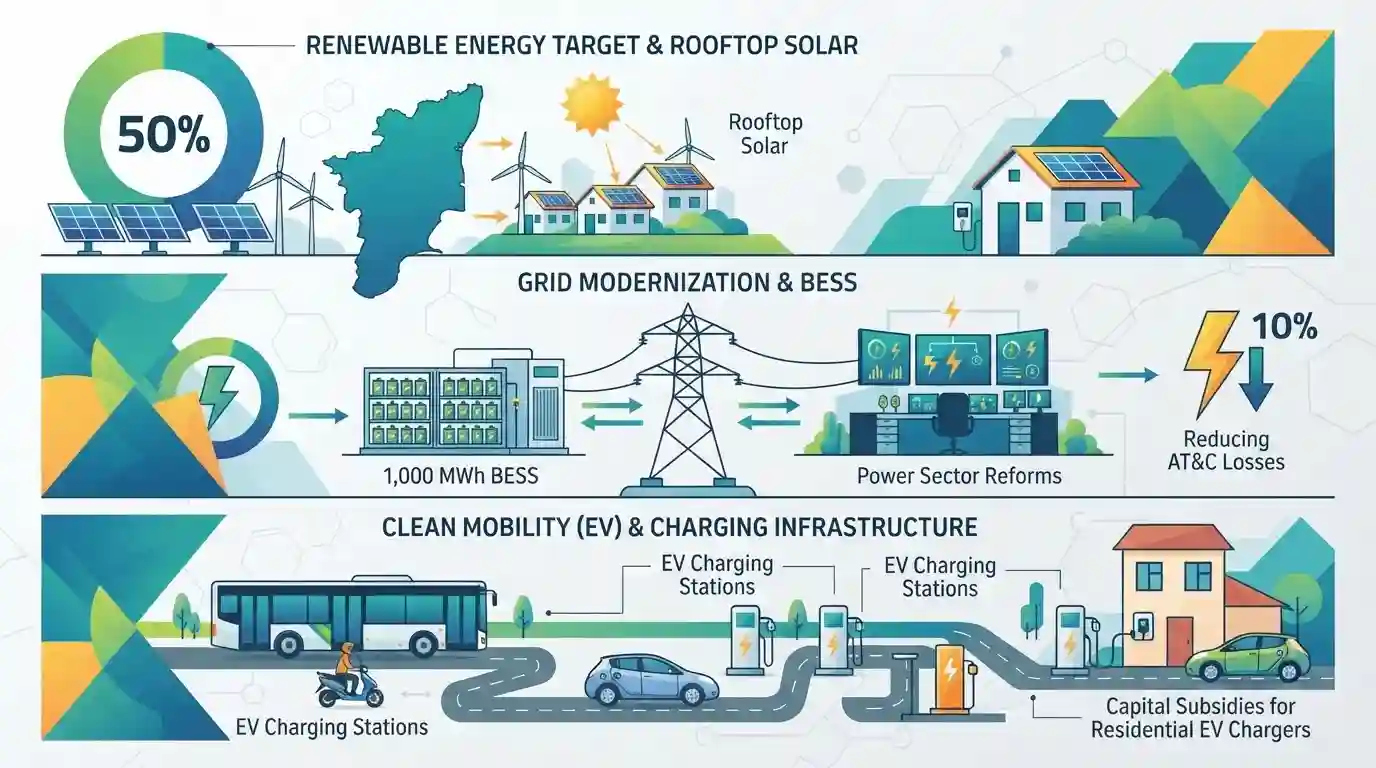
Tamil Nadu has unveiled its Vision 2031, targeting a 50% renewable energy share in its energy mix. Key strategies include aggressive deployment of Electric Vehicle (EV) charging infrastructure, enhancement of rooftop solar projects, and reducing aggregate technical and commercial (AT&C) losses to 10% under the Revamped Distribution Sector Scheme (RDSS). A proposed 1,000 MWh Battery Energy Storage System (BESS) and capital subsidies for residential EV chargers aim to bolster grid stability and clean mobility.
ముఖ్య అంశాలు
- Tamil Nadu's Vision 2031 aims to achieve a 50% renewable energy share in the State's electricity generation mix by 2031.
- Under the Revamped Distribution Sector Scheme (RDSS), the state plans to reduce power distribution (AT&C) losses to 10% and deploy 1.25 lakh smart meters.
- The state targets the installation of 20,000 EV charging stations, prioritizing inter-city corridors, and has launched a portal to match landowners with Charge Point Operators.
- A 50% capital subsidy will be offered to facilitate the installation of EV charging infrastructure in residential apartment complexes.
- To manage renewable energy intermittency and ensure grid reliability, a 1,000 MWh stand-alone Battery Energy Storage System (BESS) will be established using the Viability Gap Funding (VGF) scheme.
ముఖ్యమైన పదాలు
Vision 2031 (Tamil Nadu)

An initiative by the Tamil Nadu government targeting 50% renewable energy share by 2031, emphasizing climate-resilient power infrastructure, electric vehicle expansion, and sustainable urban development.
UPSC context
Relevant for GS-3 (Infrastructure/Energy) and State PCS; highlights state-level proactive climate planning and renewable energy transitions.
PM E-DRIVE Scheme
A ₹10,900 crore central sector scheme (2024–2026) accelerating electric vehicle adoption in India. It subsidizes EV purchases and funds charging infrastructure, succeeding the FAME and EMPS initiatives.
UPSC context
Crucial for GS-3 (Environment, Infrastructure). Tests knowledge of government interventions for clean mobility, domestic manufacturing, and emissions reduction.
Viability Gap Funding (VGF) Scheme
A government grant meant to make economically essential but financially unattractive infrastructure projects commercially viable. Currently used to fund up to 40% of capital costs for Battery Energy Storage Systems (BESS).
UPSC context
Highly relevant for GS-3 (Economy/Infrastructure/Energy). Often tested regarding PPPs and government mechanisms to support renewable energy storage.
Revamped Distribution Sector Scheme (RDSS)
A Ministry of Power flagship initiative (2021) aiming to improve the operational and financial health of DISCOMs. It targets reducing AT&C losses to 12-15% and bridging the ACS-ARR gap.
UPSC context
Important for GS-3 (Economy/Energy). Tests awareness of power sector reforms, DISCOM financial viability, and smart metering initiatives.
ప్రిలిమ్స్ ఉచ్చు
India aims to achieve 50% of its electricity generation from renewable sources by 2030.
India's Panchamrit target is 50% of cumulative electric power *installed capacity* from non-fossil sources, not actual *generation*, which is lower due to plant load factors.
అనుసంధానమైన స్థిర భావనలు
What constitutes AT&C losses in the power sector?
- Technical losses: Energy lost during transmission and distribution due to grid inefficiencies, such as resistance in conductors and transformer losses.
- Commercial losses: Revenue lost due to electricity theft, unmetered usage, faulty metering, and poor billing or collection efficiency by Discoms.
- Economic impact: High AT&C losses cripple Discoms' financial health, creating a debt trap that necessitates intervention schemes like UDAY and RDSS.
How does the Viability Gap Funding (VGF) scheme work?
- Core purpose: It provides a one-time capital grant to economically justified but commercially unviable infrastructure projects with long gestation periods.
- Funding mechanism: Typically provides up to 20-40% of the total capital cost (e.g., for BESS, offshore wind) to attract private developers.
- Tariff reduction: By lowering the capital cost burden on private players, VGF helps reduce the final tariff or toll for consumers.
అంతర-అంశ నమూనాలు
RE Intermittency + Grid Stabilisation
As RE generation increases, grid stability becomes vulnerable to weather patterns. BESS and Pumped Storage Hydro projects are critical GS-3 topics linking climate goals with energy security.
State Discoms + Fiscal Federalism
Discom losses (AT&C) directly impact state fiscal deficits. Central schemes like RDSS enforce reform-linked financial discipline, connecting GS-3 Energy with GS-2 Center-State financial relations.

Expect a multi-statement question linking AT&C losses, the RDSS scheme's smart meter mandate, and Viability Gap Funding for BESS.
అనుసంధాన PYQలు · 3
అనుసంధాన PYQలు · 3
- 2022MainsGS3
Do you think India will meet 50 percent of its energy needs from renewable energy by 2030 ? Justify your answer. How will the shift of subsidies from fossil fuels to renewables help achieve the above objective ? Explain.
- 2023MainsGS3
The adoption of electric vehicles is rapidly growing worldwide. How do electric vehicles contribute to reducing carbon emissions and what are the key benefits they offer compared to traditional combustion engine vehicles?
- 2024PrelimsGS1
Consider the following: 1. Battery storage 2. Biomass generators 3. Fuel cells 4. Rooftop solar photovoltaic units How many of the above are considered "Distributed Energy Resources"?
