Tamil Nadu Resolution Seeks Retrieval of Katchatheevu Island
Source:Indian Express ↗
Why It Matters
The Katchatheevu dispute is a persistent diplomatic and humanitarian issue affecting India-Sri Lanka relations. It also highlights the complexities of Centre-State relations in India, where state-level political and economic interests (such as fishing rights) heavily influence national foreign policy.
Summary
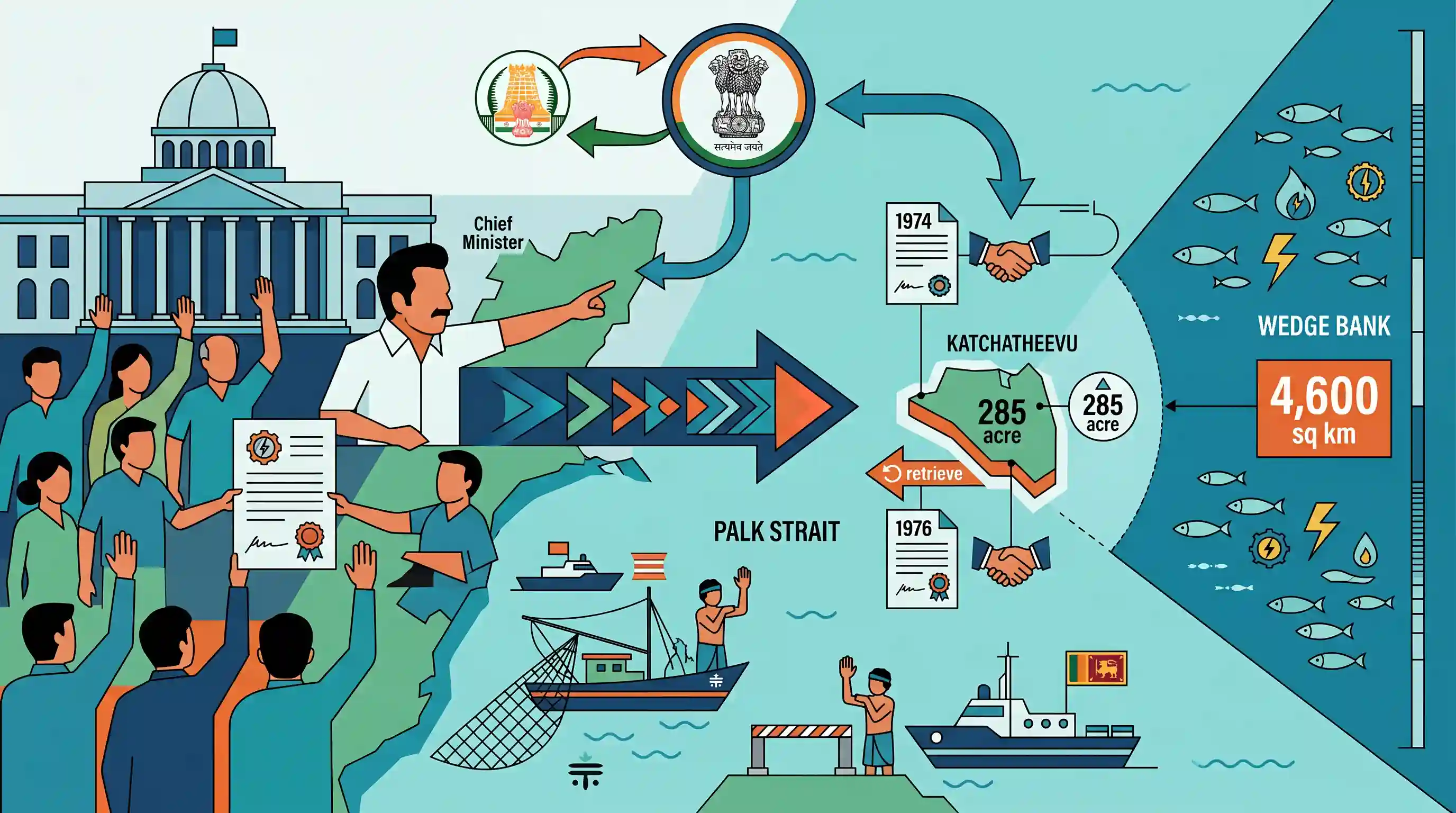
The Tamil Nadu Legislative Assembly unanimously passed a resolution urging the Union Government to retrieve Katchatheevu island, which was ceded to Sri Lanka through bilateral agreements in 1974 and 1976. Moved by Chief Minister M K Stalin, the resolution argues that reclaiming the island is the only permanent solution to protect the traditional fishing rights of Tamil Nadu fishermen and halt their recurring arrests by the Sri Lankan Navy. The debate also touched upon the historic context, noting that while India ceded 285 acres of the island, it gained rights over the 4,600 sq km Wedge Bank.
Key Points
- The Tamil Nadu Assembly passed a unanimous resolution urging the Union government to reclaim Katchatheevu island from Sri Lanka.
- Katchatheevu was ceded to Sri Lanka under bilateral agreements signed in 1974 and 1976.
- Chief Minister M K Stalin stated that retrieving the island is essential to permanently secure the traditional fishing rights of Tamil Nadu fishermen and end their repeated arrests.
- Over 1,383 Indian fishermen have been apprehended by the Sri Lankan Navy between 2021 and 2025.
- During the assembly debate, it was noted that in exchange for ceding the 285-acre island, India secured the 4,600 sq km Wedge Bank area.
Important Terms
Katchatheevu Island

A 285-acre uninhabited island in the Palk Strait, ceded to Sri Lanka by India through 1974 and 1976 bilateral agreements to settle maritime boundaries.
UPSC context
GS Paper 2 (International Relations); tests knowledge of India-Sri Lanka maritime disputes and territorial sovereignty.
1974 & 1976 Maritime Boundary Agreements
Bilateral treaties between India and Sri Lanka that demarcated their maritime boundary, placing Katchatheevu under Sri Lankan jurisdiction while restrictedly defining Indian fishermen's access.
UPSC context
GS Paper 2 (Bilateral Relations); crucial for understanding the legal basis of the Palk Bay boundary.
Wadge Bank
A 4,600 sq km resource-rich continental shelf south of Kanyakumari; India gained exclusive sovereign rights over its resources as part of the 1976 agreement.
UPSC context
GS Paper 1 & 2 (Geography/Resources); important factual detail regarding India’s maritime resource gains.
Berubari Union Case (1960)
A 1960 Supreme Court judgment ruling that ceding Indian territory to a foreign power requires a constitutional amendment under Article 368, rather than simple executive action.
UPSC context
GS Paper 2 (Polity/Constitution); the legal precedent cited to challenge the constitutionality of Katchatheevu’s transfer.
Palk Strait
The shallow waterway separating India’s Tamil Nadu from Sri Lanka’s northern province; the primary geography for recurring fishing rights and maritime boundary conflicts.
UPSC context
GS Paper 1 (Geography); significant for maritime boundary delimitation and Indo-Lankan bilateral geography.
Prelims Trap
The 1974 ceding of Katchatheevu to Sri Lanka was executed through a Constitutional Amendment Act under Article 368.
Unlike the Berubari case, Katchatheevu was ceded via an executive agreement without a Constitutional Amendment, as the Union argued it was a 'disputed' area rather than acknowledged Indian territory.
Static Concepts Connected
Does ceding Indian territory require a Constitutional Amendment?
- Berubari Union Case: In 1960, the SC ruled that ceding national territory cannot be done under Article 3; it requires a Constitutional Amendment Act under Article 368.
- Boundary Disputes Exception: In 1969, the SC clarified that resolving a genuine boundary dispute does not constitute 'ceding territory' and can be done via executive action without an amendment.
- Katchatheevu Context: The Union government used the boundary dispute rationale to cede Katchatheevu via an executive agreement in 1974, classifying it as disputed rather than undisputed Indian territory.
What is 'Paradiplomacy' in the context of Indian federalism?
- Definition: The involvement of sub-national entities (states) in international relations, either by conducting independent foreign relations or influencing the national foreign policy.
- Constitutional Stance: Under Schedule VII of the Constitution, foreign affairs, treaties, and international agreements fall exclusively under the Union List (Entry 10, 11, 14).
- UPSC Relevance: Tamil Nadu's resolutions on Sri Lanka or West Bengal's stance on Bangladesh treaties are prime examples of regional domestic politics influencing India's neighborhood first policy.
Cross-Topic Patterns
Bottom Trawling vs. Marine Ecology
The Katchatheevu fishermen dispute isn't just territorial; it's ecological. Sri Lanka's strict ban on bottom trawling highlights a clash between traditional fishing claims and the need to prevent destructive marine harvesting.
State Paradiplomacy in Foreign Affairs
TN's resolution mirrors West Bengal's resistance to the Teesta water-sharing treaty, illustrating a broader pattern of border states asserting political pressure to constrain the Union Government's bilateral diplomatic maneuverability.
Wadge Bank resource exchange
Often overlooked in the Katchatheevu debate, India gained exclusive sovereign rights to explore petroleum and rich marine wealth in the 4,600 sq km Wadge Bank, linking territorial disputes to resource security.

Prelims may contrast the executive ceding of Katchatheevu with the 100th Amendment Act used for the Bangladesh enclave swap.
Linked PYQs · 3
Linked PYQs · 3
- 2022MainsGS2
India is an age-old friend of Sri Lanka.’ Discuss India's role in the recent crisis in Sri Lanka in the light of the preceding statement.
- 1996PrelimsGS1
The Palk Bay lies between
- 2024MainsGS2
What changes has the Union Government recently introduced in the domain of Centre-State relations ? Suggest measures to be adopted to build the trust between the Centre and the States and for strengthening federalism.
