Tamil Nadu Industrial Policy and Taiwanese Manufacturing Hub
Source:The Hindu ↗
Why It Matters
The article provides an excellent state-level case study for Mains GS3 and GS1 answers on industrial decentralization, SEZ/Industrial Park models, attracting FDI, and sector-specific growth (textiles and marine food processing). It demonstrates how local governments can support 'Make in India' through tailored infrastructure (water, housing) and dedicated policies.
Summary
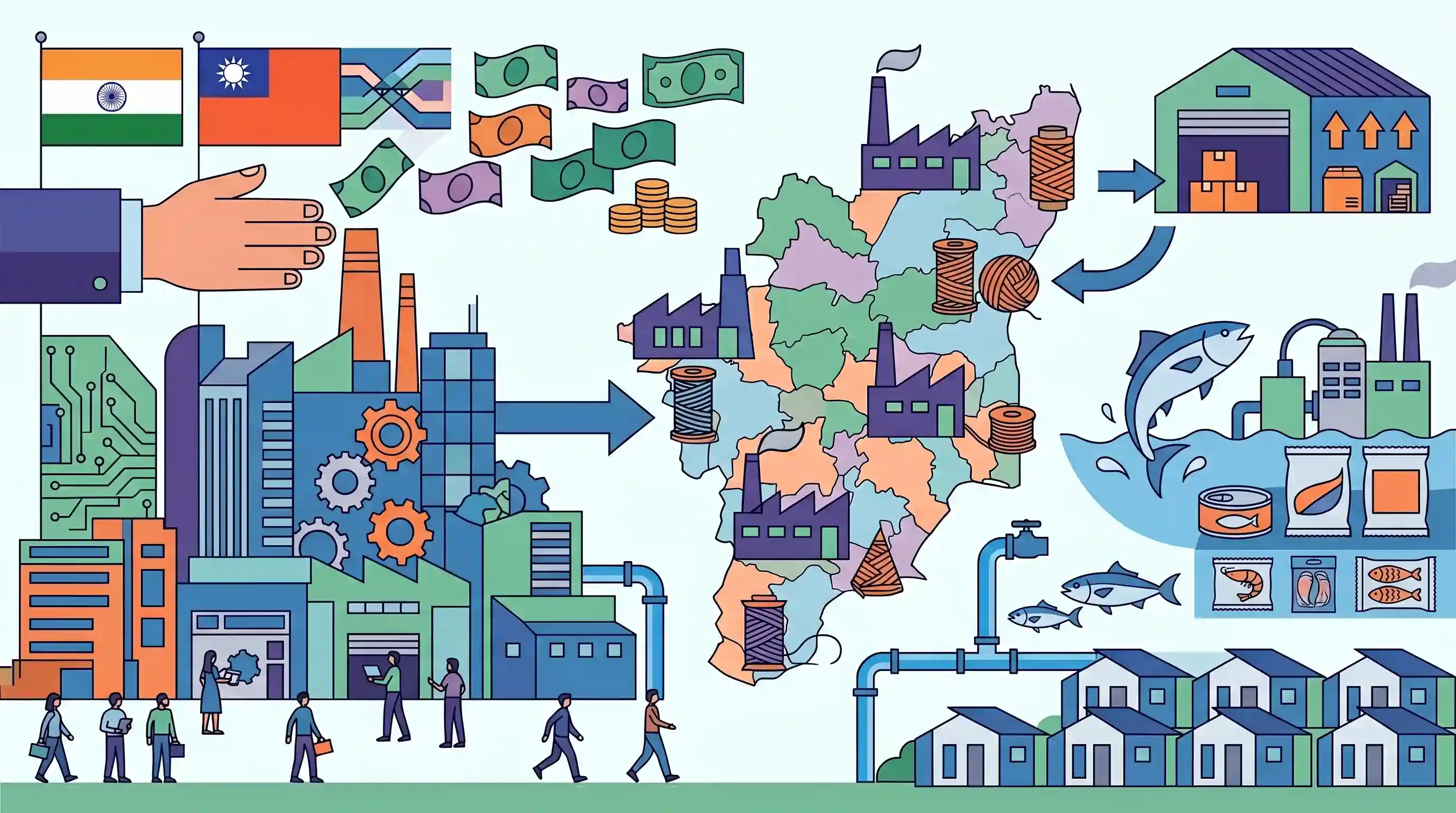
The Tamil Nadu government is rolling out major industrial infrastructure and policy initiatives, notably a dedicated industrial park for Taiwanese electronics/manufacturing firms near Chennai intended to draw ₹10,000 crore in FDI and create 20,000 jobs. As part of a broader decentralized regional development strategy, the State plans to establish SIPCOT Industrial and Tex Parks across multiple backward districts, and roll out a new Tamil Nadu Warehousing Policy alongside a Marine Food Processing Industrial Policy. Ancillary infrastructure such as industrial water supply and worker housing are also slated for expansion, emphasizing state-level proactive measures for manufacturing and employment generation.
Key Points
- The Tamil Nadu government announced a dedicated industrial park for Taiwanese companies near Chennai, aiming to attract ₹10,000 crore FDI and create 20,000 jobs.
- Investment guidance desks will be established in the U.S., Germany, South Korea, and Vietnam to further facilitate foreign investment.
- SIPCOT Tex Parks will be established in multiple districts to decentralize and promote textile and apparel manufacturing hubs.
- A Tamil Nadu Warehousing Policy and a Marine Food Processing Industrial Policy will be released to boost logistics and marine exports respectively.
- A Marine-Food Processing and Export Park will be built at Rajamadam in Thanjavur district to improve local fishermen's livelihoods.
- Supporting infrastructure, including a ₹380 crore reverse osmosis water supply project for factories and ₹120 crore housing for industrial workers, will be implemented.
Important Terms
SIPCOT

State Industries Promotion Corporation of Tamil Nadu. Established in 1971, it develops and manages industrial complexes and parks, specifically promoting industrialization in backward districts.
UPSC context
GS-III: Industrial Policy and Infrastructure. Key for understanding state-led regional development and investment facilitation.
TIDEL
Originally a pioneering IT park in Chennai; it now represents the state's strategy to decentralize the technology sector through 'Neo-TIDEL' parks in Tier-2 and Tier-3 cities.
UPSC context
GS-III: IT Infrastructure and Employment. Relevant for urban development and the 'Distributed Growth' model.
Taiwanese Industrial Park
A specialized manufacturing zone near Chennai designed to attract ₹10,000 crore in FDI from Taiwan, focusing on electronics, technical textiles, and non-leather footwear components.
UPSC context
GS-III: Investment Models/FDI. Highlights bilateral economic ties and sector-specific industrial clustering strategies.
Tamil Nadu Warehousing Policy
A policy framework aimed at strengthening Tamil Nadu's logistics ecosystem, addressing regional storage imbalances, and providing incentives for green, sustainable warehousing infrastructure.
UPSC context
GS-III: Infrastructure (Logistics) and Economy. Critical for supply chain efficiency and the $1 trillion economy goal.
Marine Food Processing Industrial Policy
A planned sectoral policy to enhance the marine value chain, reduce post-harvest losses, and establish dedicated processing and export parks in coastal districts.
UPSC context
GS-III: Food Processing Industry and Blue Economy. Focuses on agricultural value addition and export promotion.
Prelims Trap
State governments cannot independently establish direct foreign investment guidance desks abroad.
Under India's federal structure, states increasingly practice 'paradiplomacy', independently setting up investment promotion desks abroad to attract FDI without relying exclusively on Union agencies.
Static Concepts Connected
What is Paradiplomacy in the context of Indian Federalism?
- Definition: The direct international relations and diplomatic engagement conducted by sub-national (state) governments, bypassing traditional central channels.
- Economic focus: Driven primarily by states' needs to attract Foreign Direct Investment (FDI), secure export markets, and engage with their diaspora.
- Federal shift: Represents an evolution from cooperative federalism to globalized competitive federalism among Indian states.
What are the key location factors for Marine Food Processing hubs?
- Raw material proximity: Highly perishable nature of marine products dictates that processing zones must be immediately adjacent to coastal landing centres.
- Cold chain infrastructure: Absolute dependence on continuous power, reverse osmosis water, and refrigerated warehousing for preservation.
- Export nodes: Proximity to deep-water ports is essential to facilitate international logistics and seamless export routing.
Cross-Topic Patterns
Paradiplomacy & Competitive Federalism
State-led investment desks abroad mark a shift from traditional MEA-led economic diplomacy to decentralized, state-driven global economic engagement.
Blue Economy & Export Mandates
State marine processing policies complement the PM Matsya Sampada Yojana (PMMSY) to reduce post-harvest fisheries losses and boost exports.
China-Plus-One & Taiwanese Supply Chains
Dedicated parks for Taiwanese firms capitalize on global supply-chain realignments, aiming to anchor semiconductor and electronics manufacturing in South India.

Expect a GS-2 Mains question on 'Paradiplomacy', analyzing how competitive federalism drives Indian states to independently attract global FDI.
Linked PYQs · 5
Linked PYQs · 5
- 2015MainsGS3
There is a clear acknowledgement that Special Economic Zones (SEZs) are a tool of industrial development, manufacturing and exports. Recognizing this potential, the whole instrumentality of SEZs requires augmentation. Discuss the issues plaguing the success of SEZs with respect to taxation, governing laws and administration.
- 2023MainsGS3
Faster economic growth requires increased share of the manufacturing sector in GDP, particularly of MSMEs. Comment on the present policies of the Government in this regard.
- 2019MainsGS3
Elaborate the policy taken by the Government of India to meet the challenges of the food processing sector.
- 2022MainsGS3
Elaborate the scope and significance of the food processing industry in India.
- 2013MainsGS1
Analyze the factors for the highly decentralized cotton textile industry in India.
