Governor and State Executive Friction in Tamil Nadu
Source:The Hindu ↗
Why It Matters
The persistent friction between Governors and elected State Governments raises important constitutional questions about federalism and the discretionary powers of the Governor. Furthermore, the digitization of short-term agricultural credit via PACS highlights significant governance reforms in the rural economy.
Summary
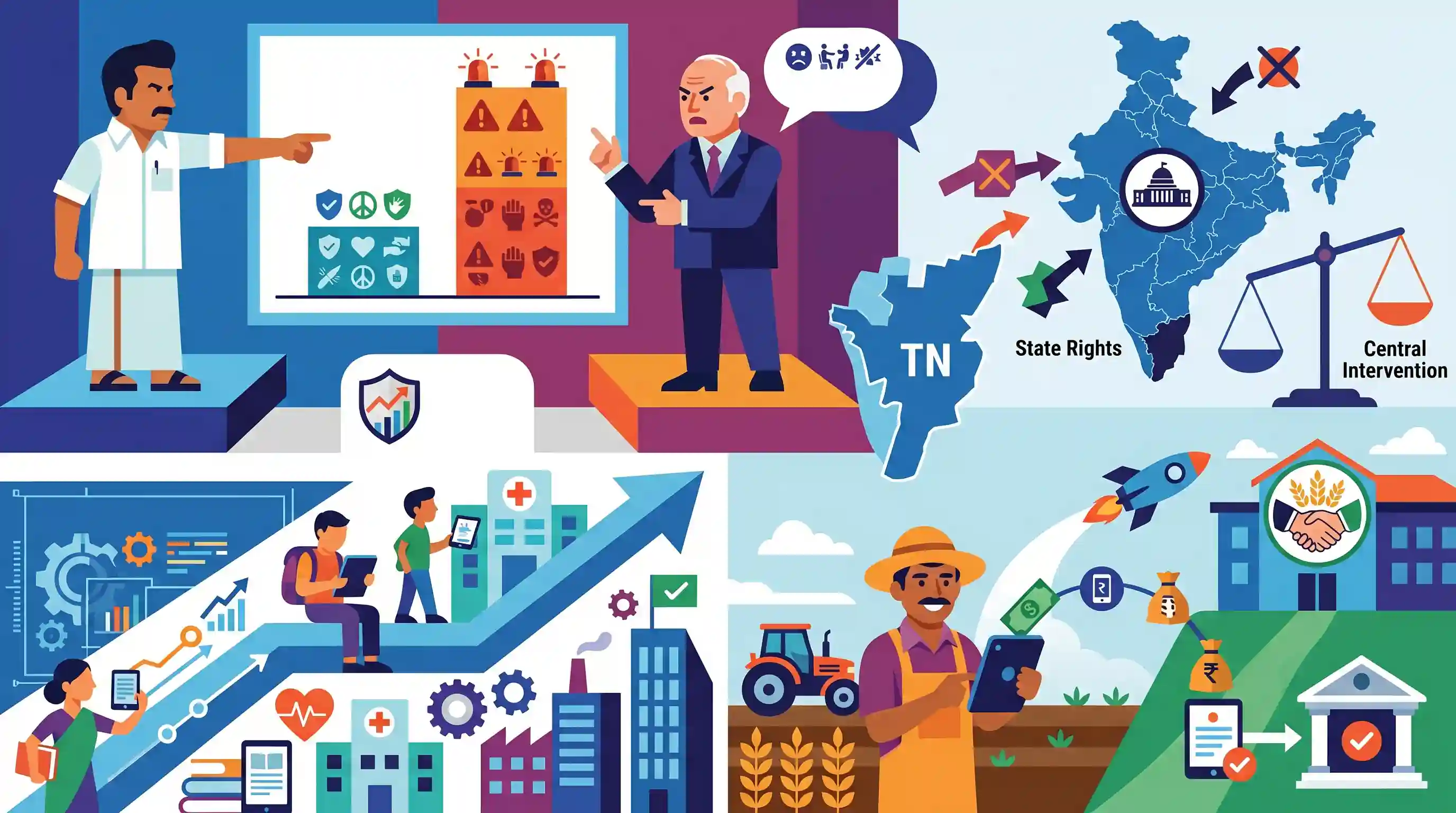
Tamil Nadu Chief Minister M.K. Stalin criticized Governor R.N. Ravi, accusing him of engaging in politics that surpass the opposition\'s and baselessly criticizing the State\'s law and order. Stalin used NCRB data to counter the Governor\'s claims regarding women\'s safety, pointing to higher crime rates in BJP-ruled Uttar Pradesh. In addition to outlining the political friction, the Chief Minister announced the 'Dravidian Model 2.0' for the upcoming 2026 elections and launched a pilot instant crop loan scheme under Primary Agriculture Cooperative Societies (PACS), facilitating same-day online loan disbursements for farmers.
Key Points
- Tamil Nadu CM M.K. Stalin accused Governor R.N. Ravi of doing "cheap politics" and undermining the state government\'s Dravidian Model.
- The Governor alleged poor law and order and rising crimes against women in the State, which Stalin countered using NCRB data showing UP topping such crimes.
- An instant crop loan scheme was launched under Primary Agriculture Cooperative Societies (PACS) in Dharmapuri, allowing same-day processing and online crediting of loans to farmers.
- The conflict underscores ongoing Centre-State frictions regarding the political and constitutional role of Governors in opposition-ruled states.
Important Terms
Primary Agriculture Cooperative Societies (PACS)

Village-level cooperative credit societies that provide short-term and medium-term agricultural finance. They form the grassroots tier of India's short-term cooperative credit structure and are regulated by state governments.
UPSC context
GS Paper III: Agricultural credit and cooperatives. Tests understanding of rural financial inclusion and the three-tier cooperative credit structure.
National Crime Records Bureau (NCRB)
A central agency under the Ministry of Home Affairs (MHA) responsible for collecting and analyzing crime data, facilitating fingerprint identification, and implementing the Crime and Criminal Tracking Network and Systems (CCTNS).
UPSC context
GS Paper II: Governance and Law & Order. Crucial for data-driven analysis of social justice and internal security.
Dravidian Model
A governance philosophy in Tamil Nadu prioritizing social justice, regional autonomy, and inclusive growth. "2.0" represents the updated vision for the 2026 elections, focusing on modernizing welfare schemes.
UPSC context
GS Paper II: Federalism and Governance. Tests knowledge of regional political ideologies and their impact on state-level development indicators.
Magalir Urimai Thittam
A flagship Direct Benefit Transfer (DBT) scheme in Tamil Nadu that provides a monthly cash assistance of ₹1,000 to eligible women heads of households to promote financial independence.
UPSC context
GS Paper II: Social Justice/Welfare. Relevant for questions on women empowerment and basic income models.
Vidiyal Payanam
A Tamil Nadu state initiative providing free travel for women in ordinary government-operated city and town buses to enhance female workforce participation and mobility.
UPSC context
GS Paper II: Governance/Welfare Schemes. Focuses on gender-sensitive urban planning and social security.
Instant Crop Loan Scheme
A pilot digital initiative in Tamil Nadu designed to facilitate same-day, online disbursement of agricultural credit to farmers through Primary Agriculture Cooperative Societies (PACS).
UPSC context
GS Paper III: Technology in Agriculture. Relevant for digital governance and improving rural credit accessibility.
Prelims Trap
"Primary Agricultural Credit Societies (PACS) are regulated directly by the Reserve Bank of India."
PACS are explicitly excluded from the Banking Regulation Act, 1949. They are regulated by the Registrar of Cooperative Societies of the State government, not the RBI.
Static Concepts Connected
What is the three-tier short-term cooperative credit structure in India?
- Apex Level: State Cooperative Banks (StCBs) operate at the state level, linking the cooperative structure to NABARD and the RBI.
- Intermediate Level: District Central Cooperative Banks (DCCBs) function at the district level, channeling funds from the apex bank downwards.
- Grassroots Level: Primary Agricultural Credit Societies (PACS) operate at the village level, dealing directly with rural borrowers for seasonal crop loans.
What is the Governor's constitutional role regarding law and order?
- State List Subject: Under the 7th Schedule, 'Public Order' and 'Police' are State List subjects governed by the elected State executive.
- Normal States: Governors have no discretionary powers over law and order in standard states like Tamil Nadu; they must act on aid and advice.
- Special Responsibility: Specific constitutional provisions grant Governors special responsibility for law and order only in select states (e.g., Arunachal Pradesh under Article 371H).
Cross-Topic Patterns
PACS computerization + Common Service Centres
Tamil Nadu's instant crop loan push parallels the Union Ministry of Cooperation's drive to computerize PACS and enable them to function as Common Service Centres (CSCs) for broader financial inclusion.
NCRB data + Mains substantiation
NCRB's 'Crime in India' statistics are critical fodder for GS1 (Society) and GS2 (Governance) to substantiate answers regarding women's safety, domestic violence, and regional law enforcement disparities.

Expect a 2026 Prelims trap distinguishing PACS's exclusion from RBI regulation against the RBI's control over Urban Cooperative Banks.
Linked PYQs · 4
Linked PYQs · 4
- 2022MainsGS2
Discuss the essential conditions for exercise of the legislative powers by the Governor. Discuss the legality of re-promulgation of ordinances by the Governor without placing them before the Legislature.
- 2023MainsGS2
Explain the significance of the 101st Constitutional Amendment Act. To what extent does it reflect the accommodative spirit of federalism?
- 2024MainsGS2
What changes has the Union Government recently introduced in the domain of Centre-State relations ? Suggest measures to be adopted to build the trust between the Centre and the States and for strengthening federalism.
- 2020PrelimsGS1
Consider the following statements: 1. In terms of short-term credit delivery to the agriculture sector, District Central Cooperative Banks (DCCBs) deliver more credit in comparison to Scheduled Commercial Banks and Regional Rural Banks. 2. One of the most important functions of DCCBs is to provide funds to the Primary Agricultural Credit Societies. Which of the statements given above is/are correct?
