DMK and Congress Seal Seat Sharing Deal in Tamil Nadu
Source:Indian Express ↗
Why It Matters
Understanding seat-sharing dynamics between regional and national parties is crucial for analyzing India's multi-party democracy and the practical realities of coalition politics, which directly relates to the balance of power in a federal structure.
Summary
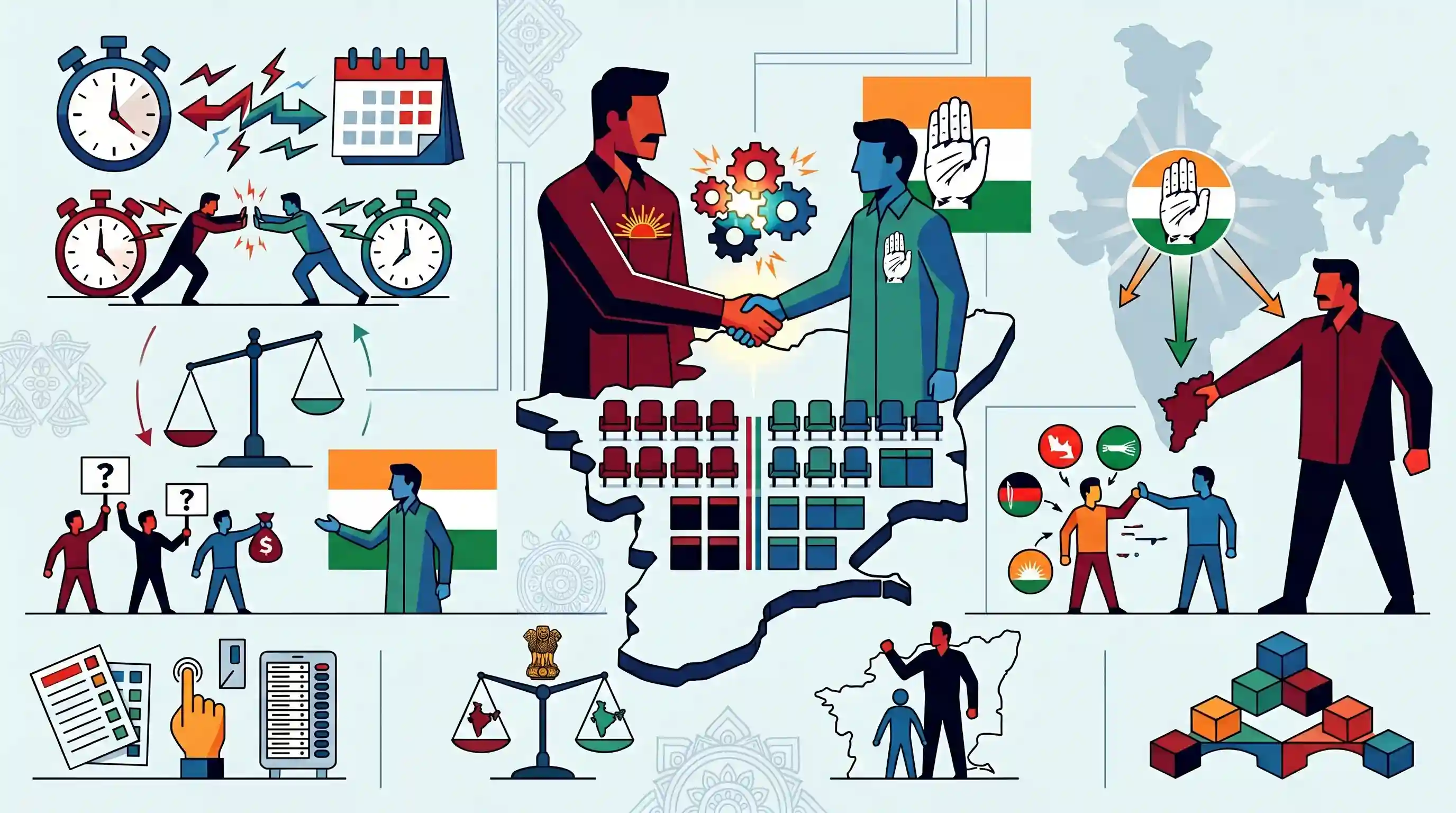
The Dravida Munnetra Kazhagam (DMK) and the Indian National Congress have finalized their seat-sharing pact for upcoming elections in Tamil Nadu after weeks of tense negotiations. The development underscores the intricate nature of coalition politics in India, particularly the power dynamics and bargaining processes between dominant regional parties and national political organizations at the state level.
Key Points
- The DMK and Congress have successfully negotiated a seat-sharing agreement in Tamil Nadu, concluding a period of intense political discussions.
- The negotiations reflect the inherent challenges and bargaining dynamics between a dominant regional party and a national party within a coalition.
- Such electoral alliances are indicative of India's multi-party system where regional forces play a crucial role in shaping state-level political outcomes.
Important Terms
Dravida Munnetra Kazhagam (DMK)

A prominent regional political party in Tamil Nadu, founded in 1949 by C.N. Annadurai, advocating for social justice, state autonomy, and the preservation of Dravidian linguistic and cultural identity.
UPSC context
GS Paper II: Regionalism and State Politics. Tests understanding of regional parties' influence on federalism and their role in national coalition-building.
Indian National Congress (INC)
India's oldest political party, founded in 1885; a national-level "big-tent" party that led the independence movement and currently serves as a principal opposition force against single-party dominance.
UPSC context
GS Paper I (History) and GS Paper II (Polity). Tests the transition from the "Congress System" to a multi-party system.
Coalition Politics
A governance model where multiple political parties cooperate to form a majority; it often involves a "Common Minimum Programme" to align diverse regional and national ideologies.
UPSC context
GS Paper II: Functions of the Union and States. Tests the impact of fragmented mandates on policy-making and legislative stability.
Seat-sharing Agreement
A pre-election arrangement between alliance partners to divide the number of constituencies each will contest, aimed at preventing the fragmentation of votes among ideologically similar parties.
UPSC context
GS Paper II: Electoral Process. Relevant for understanding strategic voting, alliance-building, and the First-Past-The-Post (FPTP) system's impact.
Regional Party
A political entity recognized by the Election Commission of India (ECI) that primarily operates within a specific state, focusing on localized aspirations and regional cultural or linguistic rights.
UPSC context
GS Paper II: Federalism. Essential for analyzing how regional aspirations act as a "pressure group" or "balancing force" at the Centre.
Federalism
The constitutional division of power between the Union and the States; in India, it is characterized by "cooperative" or "competitive" trends often influenced by regional party participation in central coalitions.
UPSC context
GS Paper II: Constitutional Structure. Core topic for questions on Centre-State relations and the devolution of power.
Prelims Trap
The Constitution mandates the Governor to invite the largest pre-poll alliance first in a hung assembly.
The Constitution is entirely silent on the order of invitation. Prioritizing a pre-poll alliance over a single largest party is merely a convention based on Sarkaria/Punchhi Commission recommendations.
Static Concepts Connected
What are the primary criteria to be recognized as a State Political Party?
- 6% Votes & Seats: Must secure 6% of valid votes in Assembly elections plus 2 MLAs, or 6% in Lok Sabha elections plus 1 MP from the state.
- Seat Quota Alternative: Win at least 3% of total seats in the state Legislative Assembly or a minimum of 3 seats, whichever is higher.
- 8% Vote Alternative: Secure 8% of the total valid votes polled in the state during Assembly or Lok Sabha elections, irrespective of winning any seats.
What is the Sarkaria Commission's recommended order of invitation for forming government in hung assemblies?
- Pre-poll alliances: First preference is given to a pre-poll alliance of parties, as it is considered a cohesive political entity with a shared mandate.
- Single largest party: If no pre-poll alliance has a majority, the Governor should invite the single largest party staking a claim with the backing of others.
- Post-poll coalitions: Subsequent preferences are post-poll coalitions (where partners join the government) followed by coalitions receiving outside support.
Cross-Topic Patterns
Coalitions & Cooperative Federalism
Regional parties in national coalitions ensure state-specific socio-economic demands enter Union policy formulation, acting as crucial institutional checks against the centralizing tendencies of national parties.
ECI Adjudication on Party Symbols
Shifting pre-poll alliances often trigger factionalism and party splits. The ECI acts as the sole adjudicatory authority for these symbol disputes under the Election Symbols Order, 1968.

Expect a multi-statement Prelims question mixing ECI criteria for State Party recognition with Sarkaria guidelines on alliances.
Linked PYQs · 1
Linked PYQs · 1
- 2022MainsGS2
“While the national political parties in India favour centralisation, the regional parties are in favour of State autonomy.” Comment.
