Tamil Nadu Government White Paper Highlights State Fiscal Distress
Source:Indian Express ↗
Why It Matters
This article illustrates a critical contemporary challenge in Indian public finance: the precarious fiscal health of highly industrialized states. It touches on fundamental concepts of macroeconomics and governance, such as debt sustainability, the debt-interest spiral, committed vs. capital expenditure, structural deficits, and the power sector's impact on state liabilities. Furthermore, it exemplifies the growing tension between southern states and the Central Government over Finance Commission devolution criteria, which is a major debate in cooperative and fiscal federalism.
Summary
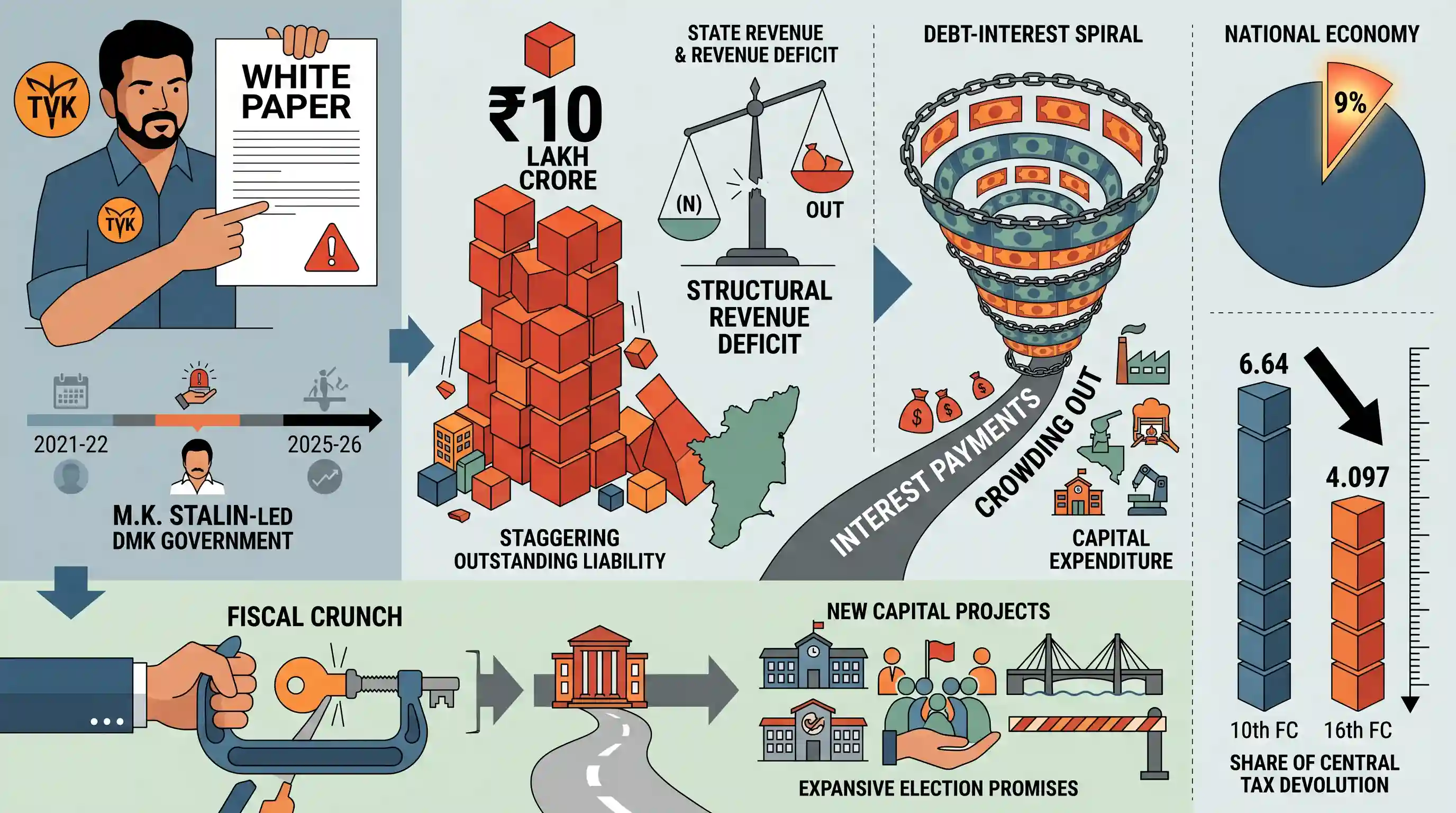
The newly elected C. Joseph Vijay-led TVK government in Tamil Nadu released a comprehensive White Paper on state finances, analyzing the period from 2021-22 to 2025-26 under the previous DMK-led government of M.K. Stalin. The document sounds fiscal alarm bells over Tamil Nadu's staggering outstanding liabilities of ₹10 lakh crore, structural revenue deficits, and an impending 'debt-interest spiral' that is crowding out capital expenditure. It highlights severe strains on fiscal federalism, noting that the state's share of central tax devolution has fallen from 6.64% (10th Finance Commission) to 4.097% (16th Finance Commission), despite contributing 9% to the national economy. This fiscal crunch leaves little room for the new government to fund capital projects or implement its expansive electoral promises.
Key Points
- Tamil Nadu's outstanding liabilities grew at a CAGR of 14.3% post-Covid, escalating from ₹5.13 lakh crore (28.7% of GSDP) in 2020-21 to ₹10 lakh crore (28.3% of GSDP) in 2025-26. At a per-capita level of ₹1.29 lakh, Tamil Nadu's debt is the highest among comparable industrialized states.
- The state is entering a dangerous 'debt-interest spiral', wherein new borrowings are increasingly used to service interest on existing debt. Interest payments consume nearly a quarter (22.8% in 2026-27) of total revenue receipts, and are projected to cross ₹1 lakh crore by 2028-29.
- Interest payments have consistently exceeded capital expenditure (by ₹19,000 crore in 2026-27 Interim Budget), crowding out public infrastructure investments. Committed expenditures (salaries, pensions, and interest) account for 64.4% of total revenue receipts in 2025-26, severely restricting discretionary developmental spending.
- The state suffers from a structural revenue deficit that has persisted since 2013-14. Its revenue-to-GDP ratio declined from 10.01% in 2021-22 to 8.32% in 2025-26, and its own tax revenue as a share of GSDP fell from 5.93% to 5.45%, representing a decline in fiscal self-reliance.
- Loss-making State Public Sector Undertakings (SPSUs), primarily in the power sector (TANGEDCO), account for 14% (₹1.42 lakh crore) of the state's total outstanding liabilities as of March 2026.
- The White Paper highlights vertical and horizontal imbalances in fiscal federalism, pointing out a 38% reduction in Tamil Nadu's share of central taxes—from 6.64% (10th Finance Commission) to 4.097% (16th Finance Commission). The state argues that while it contributes over 9% of national GDP and has 6% of the population, it receives only a 4% share in central tax devolution.
Important Terms
Tamil Nadu Fiscal Responsibility Act (TNFRA)

State legislation enacted in 2003 to anchor fiscal discipline by setting binding targets, including a 3% GSDP fiscal deficit cap and striving to eliminate the revenue deficit.
UPSC context
GS Paper III (Government Budgeting/Fiscal Policy); tests knowledge of state-level statutory frameworks and debt consolidation.
Finance Commission
A constitutional body (Article 280) that recommends the division of tax revenues between the Union and States, and the formula for sharing amongst states.
UPSC context
GS Paper II (Constitutional Bodies/Federalism); tests understanding of fiscal devolution criteria and Union-State financial relations.
TANGEDCO (Tamil Nadu Generation and Distribution Corporation)
The state-owned utility responsible for power generation and distribution in Tamil Nadu, whose massive debt and operational deficits heavily impact the state's budget.
UPSC context
GS Paper III (Infrastructure: Energy/Power Reforms); tests understanding of DISCOM financial stress and public sector debt challenges.
TVK (Tamilaga Vettri Kazhagam)
A regional political party in Tamil Nadu founded in 2024 by actor-turned-politician C. Joseph Vijay, which won the 2026 Assembly elections.
UPSC context
GS Paper II (Political Parties); tests awareness of electoral dynamics, party systems, and political transitions in Indian states.
DMK (Dravida Munnetra Kazhagam)
A major regional political party in Tamil Nadu established on Dravidian ideology, social justice, and federalism, which governed the state from 2021 to 2026.
UPSC context
GS Paper II (Federalism/Regional Parties); tests understanding of regionalism and its socio-political impact in India's federal structure.
Prelims Trap
The Finance Commission has the constitutional authority to mandate the inclusion of all cesses and surcharges in the divisible tax pool.
Under Article 270, cesses and surcharges are constitutionally excluded from the divisible pool. The Finance Commission cannot mandate their inclusion; it requires a constitutional amendment.
Static Concepts Connected
What constitutes the 'divisible pool' of taxes under Article 270 of the Constitution?
- Article 270 scope: Includes all central taxes and duties, except those explicitly mentioned in Articles 268, 269, and specific cesses/surcharges.
- Cess exclusion: Surcharges (Article 271) and cesses earmarked for specific purposes are kept outside the pool, remaining entirely with the Centre.
- 80th Amendment: Amended Article 270 to share the net proceeds of all central taxes and duties with states, establishing the current pool system.
What fiscal debt limits did the N.K. Singh FRBM Committee recommend for states?
- Debt-to-GSDP ceiling: Recommended a strict 20% debt-to-GSDP limit for individual states, within a combined national limit of 60%.
- Fiscal deficit target: Mandated a fiscal deficit limit of 3% of GSDP for states to prevent structural debt accumulation.
- Fiscal Council: Proposed an autonomous Fiscal Council to oversee compliance, provide independent growth forecasts, and monitor off-budget liabilities.
Cross-Topic Patterns
Demographic transition vs Horizontal devolution
Successful demographic control by southern states reduces their relative population weight, penalizing them under horizontal devolution formulas despite their superior socioeconomic performance.
DISCOM bailouts and State FRBM limits
Off-budget liabilities from loss-making state power utilities eventually migrate directly to state balance sheets, breaching state FRBM debt-to-GSDP limits.

16th Finance Commission criteria, Article 270 cesses, and State FRBM targets are highly likely to feature as a core 2026 GS-3 question.
Linked PYQs · 5
Linked PYQs · 5
- 2025MainsGS3
Explain how the Fiscal Health Index (FHI) can be used as a tool for assessing the fiscal performance of states in India. In what way would it encourage the states to adopt prudent and sustainable fiscal policies?
- 2021MainsGS3
Distinguish between Capital Budget and Revenue Budget. Explain the components of both these Budgets.
- 2025MainsGS2
Examine the evolving pattern of Centre-State financial relations in the context of planned development in India. How far have the recent reforms impacted the fiscal federalism in India?
- 2023PrelimsGS1
Consider the following: 1. Demographic performance 2. Forest and ecology 3. Governance reforms 4. Stable government 5. Tax and fiscal efforts For the horizontal tax devolution, the Fifteenth Finance Commission used how many of the above as criteria other than population area and income distance?
- 2018PrelimsGS1
Consider the following statements: 1. The Fiscal Responsibility and Budget Management (FRBM) Review Committee Report has recommended a debt to GDP ratio of 60% for the general (combined) government by 2023, comprising 40% for the Central Government and 20% for the State Governments. 2. The Central Government has domestic liabilities of 21% of GDP as compared to that of 49% of GDP of the State Governments. 3. As per the Constitution of India, it is mandatory for a State to take the Central Government's consent for raising any loan if the former owes any outstanding liabilities to the latter. Which of the statements given above is/are correct?
