Tamil Nadu Assembly Rejects Governor Opinions on University Bill
Source:Indian Express ↗
Why It Matters
This event serves as a strong case study for GS2 questions on Centre-State relations, the constitutional limits of a Governor's legislative powers (such as Article 207 regarding Financial Bills), and the friction surrounding the appointment of Vice-Chancellors in state-run universities.
Summary
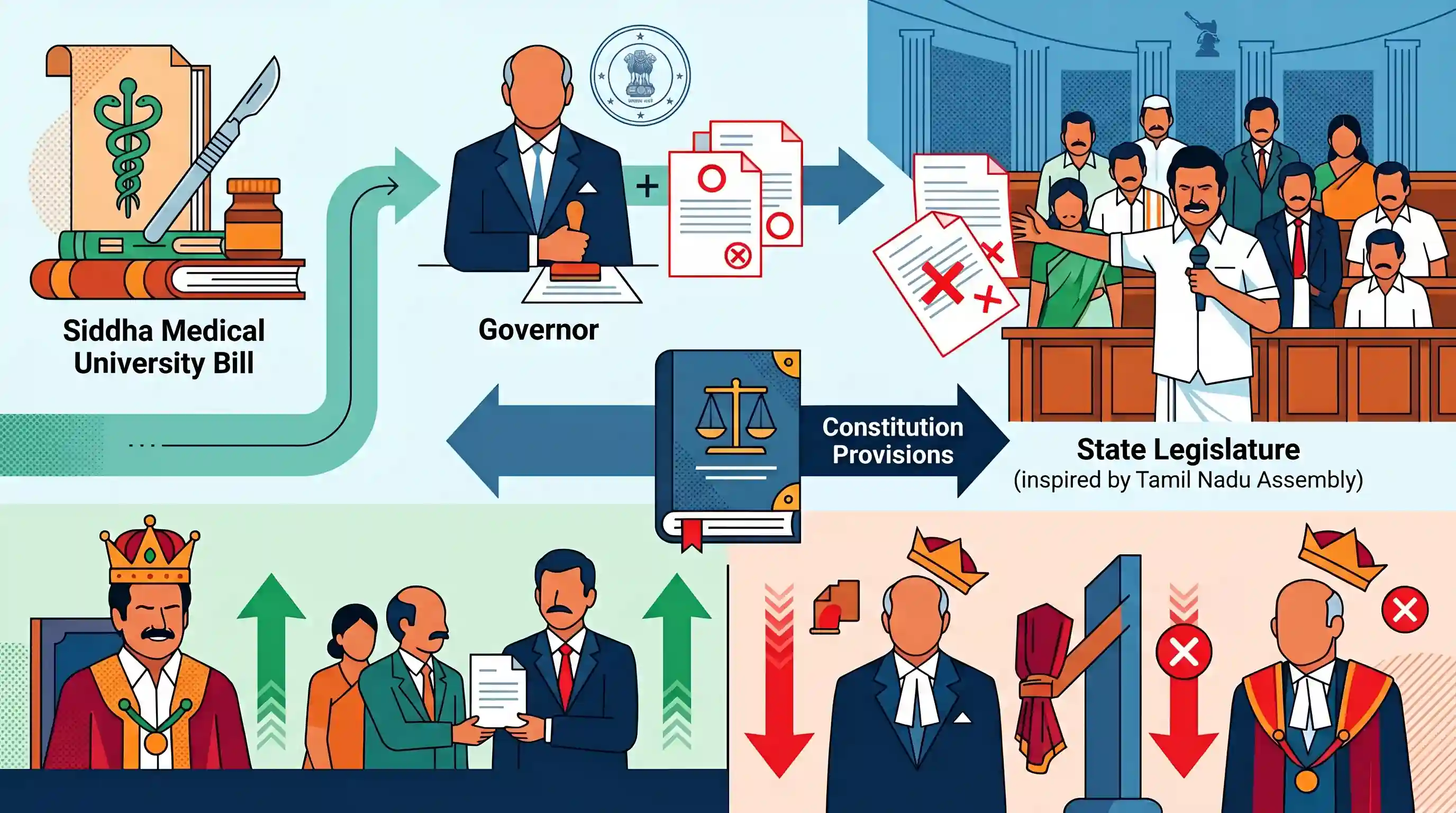
The Tamil Nadu Assembly has unanimously passed a resolution rejecting Governor RN Ravi's opinions on the draft Tamil Nadu Siddha Medical University Bill, 2025. The legislation, categorized as a Financial Bill, required the Governor's recommendation under Article 207(3) of the Constitution prior to its introduction. However, Governor Ravi attached his own opinions to the recommendation and requested they be brought to the members' attention. Chief Minister M K Stalin condemned this as unconstitutional, arguing that only elected MLAs have the authority to debate or amend a Bill. The contentious Bill also seeks to make the Chief Minister the Chancellor of the university, empowering the state government—rather than the Governor—to appoint the Vice-Chancellor, adding another layer to the ongoing Centre-State friction over gubernatorial overreach.
Key Points
- The Tamil Nadu Assembly unanimously passed a resolution rejecting Governor RN Ravi's opinions on the draft Tamil Nadu Siddha Medical University Bill, 2025.
- Because the legislation is a Financial Bill, it required the Governor's recommendation for introduction under Article 207(3); however, the Governor controversially attached his own opinions to be read in the House.
- Chief Minister M K Stalin stated the Governor has no constitutional power to express opinions on a Bill before its passage, asserting that legislation and amendments are the exclusive domain of elected MLAs.
- The proposed Bill replaces the Governor with the Chief Minister as the Chancellor of the university and transfers the power to appoint the Vice-Chancellor to the state government.
- The episode highlights the escalating constitutional friction between non-BJP state governments and Governors over the limits of gubernatorial power and university administration.
Important Terms
Article 207(3)

Constitutional provision mandating that a Bill involving expenditure from the Consolidated Fund of a State cannot be passed by the Legislature unless the Governor has recommended it for consideration.
UPSC context
GS Paper II: Constitutional Provisions. Tests understanding of legislative procedures and the Governor's role in state financial governance.
Financial Bill
Legislation dealing with fiscal matters (taxation, expenditure) alongside other provisions. Unlike Money Bills, these can be debated, amended, or rejected by both Houses of a legislature.
UPSC context
GS Paper II: Parliament and State Legislatures. Differentiates procedural requirements between Money Bills (Art 199) and Financial Bills (Art 207).
Chancellor (State Universities)
The statutory, ex-officio head of state universities. In India, the Governor traditionally holds this role, possessing powers to appoint Vice-Chancellors and override certain academic administrative decisions.
UPSC context
GS Paper II: Appointment to Various Constitutional Posts. Concerns the friction between Governor’s statutory duties and state executive autonomy.
Tamil Nadu Siddha Medical University Bill, 2025
A 2025 state legislation establishing a specialized university while designating the Chief Minister as Chancellor, thereby shifting Vice-Chancellor appointment powers from the Governor to the State Government.
UPSC context
GS Paper II: Centre-State Relations. A case study on legislative attempts to curb gubernatorial influence in state institutions.
Governor’s Recommendation
A mandatory procedural requirement for introducing or passing financial legislation. Controversy arises when Governors use this role to suggest amendments or attach opinions to draft Bills.
UPSC context
GS Paper II: Functioning of State Legislature. Tests the limits of discretionary powers vs. ministerial advice in legislative matters.
Centre-State Friction
The constitutional division of power between the Union and States. Current friction involves "gubernatorial overreach," where Governors are perceived as interfering in state-level legislative and administrative processes.
UPSC context
GS Paper II: Federal Structure. Essential for discussing the evolving role of the Governor as a bridge or a bottleneck.
Prelims Trap
"The Constitution empowers the Governor to act as the ex-officio Chancellor of all state universities."
This is a statutory role created by individual state university acts, not a constitutional mandate. Consequently, state legislatures legally possess the power to amend these laws to remove the Governor.
Static Concepts Connected
How does Article 207 regulate Financial Bills in State Legislatures?
- Prior Recommendation: Financial bills involving expenditure from the State Consolidated Fund require the Governor's prior recommendation for consideration and passage under Article 207(3).
- House Introduction: Unlike Money Bills, ordinary financial bills under 207(3) can be introduced in either House (if bicameral) and are subject to regular amendment procedures.
- No Conditional Caveats: The Constitution simply mandates a recommendation; it lacks explicit provisions allowing the Governor to attach conditional notes or personal opinions before legislative debate.
What is the nature of the Governor's role as Chancellor?
- Statutory Status: The role is derived from specific state university statutes, not the Constitution. This allows state legislatures to legally amend laws and appoint the Chief Minister instead.
- Independent Discretion: When acting as Chancellor, the Governor acts in an individual capacity and is generally not bound by the 'aid and advice' of the State Council of Ministers.
- Punchhi Commission: Recommended stripping Governors of Chancellor duties to shield the constitutional office from everyday political friction and partisan controversies.
Cross-Topic Patterns
Education as a Concurrent List subject
Friction over university appointments stems from Education's placement in the Concurrent List. States argue that central appointees (Governors) should not dictate the administration of state-funded higher education institutions.
Ambiguity in Governor's messaging power
While Article 175(2) allows the Governor to send messages to the legislature regarding pending Bills, attaching personal opinions to prior recommendations under Article 207 stretches constitutional boundaries.

Expect a 2026 prelims statement testing if the Governor needs Council of Ministers' advice while discharging statutory Chancellor duties.
Linked PYQs · 3
Linked PYQs · 3
- 2022MainsGS2
Discuss the essential conditions for exercise of the legislative powers by the Governor. Discuss the legality of re-promulgation of ordinances by the Governor without placing them before the Legislature.
- 2024MainsGS2
What changes has the Union Government recently introduced in the domain of Centre-State relations ? Suggest measures to be adopted to build the trust between the Centre and the States and for strengthening federalism.
- 2023MainsGS2
Discuss the role of Presiding Officers of state legislatures in maintaining order and impartiality in conducting legislative work and in facilitating best democratic practices.
