Tamil Nadu Assembly Election Results: TVK and Bipolar Politics
Source:The Hindu ↗
Why It Matters
It serves as a prime case study for the emergence of new regional parties and the fracturing of entrenched bipolar party systems in state politics. The resulting hung assembly highlights the mechanics and challenges of coalition-building in Indian federalism, relevant to GS Paper 2 (Polity and Governance).
Summary
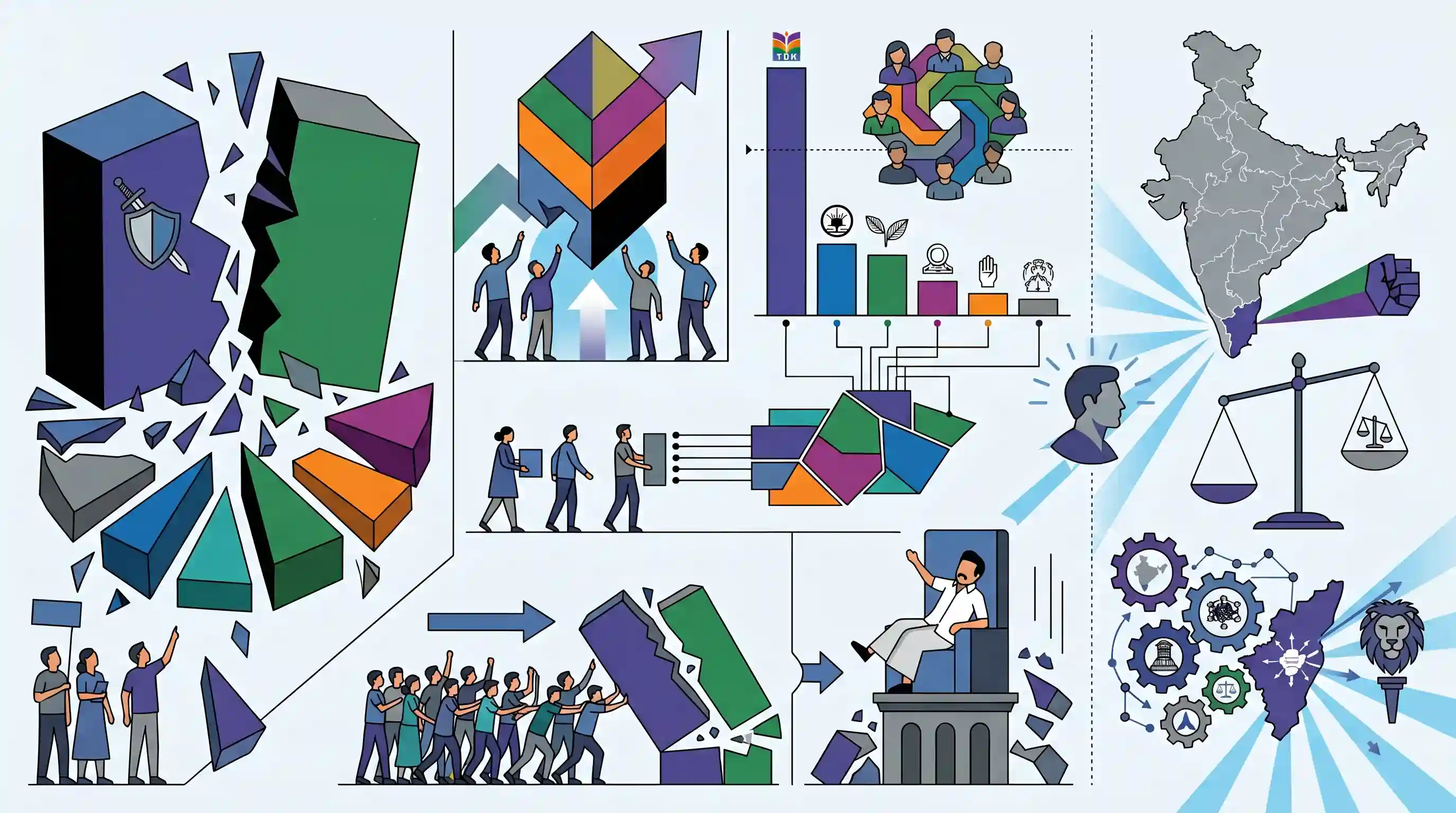
The 2026 Tamil Nadu Assembly elections marked a watershed moment in the state's political history, shattering the historic bipolar domination of the DMK and AIADMK. Actor C. Joseph Vijay’s newly launched Tamilaga Vettri Kazhagam (TVK) made a stunning debut by emerging as the single largest party, securing 107 seats. Falling just short of the 118-seat majority, the election has resulted in a hung assembly, pivoting the state towards coalition politics. The election was characterized by a massive anti-incumbency mandate against the ruling DMK, highlighted by the defeat of Chief Minister M.K. Stalin in his stronghold of Kolathur. This development is significant for understanding shifting electoral behavior, the rise of personality-driven regional outfits, and their impact on state governance and federalism.
Key Points
- Actor C. Joseph Vijay's Tamilaga Vettri Kazhagam (TVK) emerged as the single largest party with 107 seats in the 2026 Tamil Nadu Assembly elections.
- The result disrupts the decades-long bipolar political dominance of the DMK and AIADMK in Tamil Nadu.
- A hung assembly has resulted, as TVK fell short of the 118-seat majority, forcing potential coalition negotiations.
- The incumbent DMK suffered a significant anti-incumbency wave, underscored by Chief Minister M.K. Stalin losing his long-held Kolathur seat.
Important Terms
Tamilaga Vettri Kazhagam (TVK)

A Tamil regional party founded by actor Vijay in 2024. Its ideology emphasizes secular social justice, egalitarianism, and state rights, positioning itself against established Dravidian entities.
UPSC context
GS Paper II: Regional parties, their impact on state/national politics, and personality-driven political outfits.
Dravida Munnetra Kazhagam (DMK)
A major Dravidian party in Tamil Nadu founded in 1949 by C.N. Annadurai. It champions state autonomy, social justice, and the protection of Tamil linguistic identity.
UPSC context
GS Paper II: Federalism, regionalism, and the role of regional parties in Indian democracy.
All India Anna Dravida Munnetra Kazhagam (AIADMK)
A prominent Dravidian party founded in 1972 by M.G. Ramachandran. It prioritizes welfarism, populism, and social justice, following the ideological legacy of C.N. Annadurai (Annaism).
UPSC context
GS Paper II: Evolution of political parties and competitive regionalism in India.
Hung Assembly
A legislative scenario where no single political party or pre-poll alliance secures an absolute majority of seats, often leading to coalition governments or Governor’s discretion.
UPSC context
GS Paper II: Constitutional provisions for government formation and the Governor's discretionary powers.
Coalition Government
A government formed by multiple political parties cooperatively, necessitated by a hung legislature. It relies on a common minimum program and consensus-based decision-making.
UPSC context
GS Paper II: Dynamics of coalition politics, federalism, and its impact on governance stability.
Anti-Incumbency
A voter sentiment of dissatisfaction toward the ruling party, often resulting in its electoral defeat as voters seek change due to perceived underperformance.
UPSC context
GS Paper II: Electoral behaviour, voter sentiment, and the democratic accountability of elected representatives.
Prelims Trap
"The Constitution explicitly prescribes inviting the single largest party when a hung assembly occurs."
The Constitution does not explicitly mention "hung assembly" or this procedure. It relies on the Governor's situational discretion, guided by parliamentary conventions and Supreme Court judgments.
Static Concepts Connected
What guides the Governor's situational discretion during a hung assembly?
- Sarkaria Commission Guidelines: Recommends an order of preference: pre-poll alliance, single largest party claiming support, and finally a post-poll coalition.
- Floor Test Mandate: The landmark S.R. Bommai judgment ruled that majority must be proven strictly on the floor of the House, not via physical verification in Raj Bhavan.
- Timeframe for Majority: The Governor usually grants the appointed Chief Minister a reasonable timeframe (typically 10-15 days) to prove their majority in the legislature.
What are the criteria to be recognized as a State Political Party?
- Vote Share + Seats: Securing at least 6% of valid votes polled in the state assembly election plus winning a minimum of 2 seats.
- Absolute Seat Rule: Winning 3% of the total assembly seats or 3 seats in the legislative assembly, whichever is higher.
- Alternative Criteria: Securing 8% of total valid votes polled in the state during a Lok Sabha or Assembly election, even without winning any seat.
Cross-Topic Patterns
Hung mandates and Anti-Defection law
Hung assemblies increase the risk of horse-trading, heavily testing the Tenth Schedule (Anti-Defection Law) and the partisan limits of the Speaker's adjudicatory powers during government formation.
Electoral federalism and regionalism
The success of regional outfits acts as a structural counterbalance to national centralisation, shaping federal coalition dynamics and inter-state resource-sharing debates (e.g., Finance Commission payouts).

Expect a Prelims question on the Governor’s situational discretion in hung assemblies, specifically targeting Sarkaria Commission conventions.
Linked PYQs · 3
Linked PYQs · 3
- 2022MainsGS2
“While the national political parties in India favour centralisation, the regional parties are in favour of State autonomy.” Comment.
- 2024MainsGS2
Examine the need for electoral reforms as suggested by various committees with particular reference to "one nation one election" principle.
- 2017MainsGS2
Simultaneous election to the Lok Sabha and the State Assemblies will limit the amount of time and money spent in electioneering but it will reduce the government's accountability to the people." Discuss.
